Study shows wild horse herds with functional social structures contribute to low herd growth compared to BLM managed herds

© Novak


International Society for the Protection of Mustangs and Burros (ISPMB)

As we complete our thirteenth year in studying the White Sands and Gila herds, two isolated herds, which live in similar habitat but represent two different horse cultures, have demonstrated much lower reproductive rates than BLM managed herds.  Maintaining the “herd integrity” with a hands off management strategy (“minimal feasible management”) and no removals in 13 years has shown us that functional herds demonstrating strong social bonds and leadership of elder animals is key to the behavioral management of population growth.

ISPMB’s president, Karen Sussman, who has monitored and studied The Society’s four wild herds all these years explains, “We would ascertain from our data that due to BLM’s constant roundups causing the continual disruption of the very intricate social structures of the harem bands has allowed younger stallions to take over losing the mentorship of the older wiser stallions.

In simplistic terms Sussman makes the analogy that over time Harvard professors (elder wiser stallions) have been replaced by errant teenagers (younger bachelor stallions).  We know that generally teenagers do not make good parents because they are children themselves.

Sussman’s observations of her two stable herds show that there is tremendous respect commanded amongst the harems.  Bachelor stallions learn that respect from their natal harems.  Bachelors usually don’t take their own harems until they are ten years of age.  Sussman has observed that stallions mature emotionally at much slower rates than mares and at age ten they appear ready to assume the awesome responsibility of becoming a harem stallion.

Also observed in these herds is the length of time that fillies remain with their natal bands.  The fillies leave when they are bred by an outside stallion at the age of four or five years.  Often as first time mothers, they do quite well with their foals but foal mortality is higher than with seasoned mothers.

Sussman has also observed in her Gila herd where the harems work together for the good of the entire herd.  “Seeing this cooperative effort is quite exciting,” states Sussman.

ISPMB’s third herd, the Catnips, coming from the Sheldon Wildlife Range where efforts are underway to eliminate all horses on the refuge, demonstrate exactly the reverse of the organization’s two stable herds.

The first year of their arrival (2004) their fertility rates were 30% the following first and second years. They have loose band formations and some mares are without any harem stallions.  Stallions are observed breeding fillies as young as one year of age.  Foal mortality is very high in this herd.  Generally there is a lack of leadership and wisdom noted in the stallions as most of them were not older than ten years of age when they arrived.  In 2007, a decision to use PZP on this herd, a contraceptive, was employed by ISPMB.  This herd remains a very interesting herd to study over time according to Sussman.   “The question is, can a dysfunctional herd become functional,” says Sussman who speculates that the Catnips emulate many of the public lands herds.

In 1992 when Sussman and her colleague, Mary Ann Simonds, served on the National Wild Horse and Burro Advisory Board, they believed that BLM’s management should change and recommended that selective removals should begin by turning back all the older and wiser animals to retain the herd wisdom.  Sussman realizes that the missing ingredient was to stop the destruction of the harem bands caused by helicopter roundups where stallions are separated from their mares.  “Instead, bait and water trapping, band by band, needed to be instituted immediately,” says Sussman.  Had this been done for the past twenty years, we would have functionally healthy horses who have stable reproductive rates and we wouldn’t have had 52,000 wild horses in holding pastures today.   BLM’s selective removal policy was to return all horses over the age of five.  When the stallions and mares were released back to their herd management areas by the BLM, younger stallions under the age of ten fought for the mares and took mares from the older wiser stallions.  This occurs when there is chaos happening in a herd such as roundups cause.

Sussman also believes that when roundups happen often the younger stallions aged 6-9 are ones that evade capture.  This again contributes to younger stallions taking the place of older wiser stallions that remain with their mares and do not evade capture.  She is advocating that the BLM carry out two studies: determining the age of fillies who are pregnant and determining age structures of stallions after removals.

Currently Sussman is developing criteria to determine whether bands are behaviorally healthy or not.  This could be instituted easily in observation of public lands horses.

Taken from BLM’s website:  “Because of federal protection and a lack of natural predators, wild horse and burro herds can double in size about every four years.”

White Sands Herd Growth: 1999-2013 – 165 animals.

BLM’s assertion herds double every four years means there should be 980 horses or more than five times the growth of ISPMB’s White Sands herd.

Gila Herd Growth:1999-2013- 100 animals.

BLM’s assertion herds double every four years means there should be 434 horses or nearly four times the growth of ISPMB’s Gila herd.

Sussman says that BLM’s assertion as to why horse herds double every four years is incorrect. The two reasons given are federal protection of wild horse herds and lack of natural predators. ISPMB herds are also protected and also have no natural predators, but they do not reproduce exponentially. She adds that exponential wild horse population growth on BLM lands must have another cause, and the most likely cause is lack of management and understanding of wild horses as wildlife species.  Instead BLM manages horses like livestock. “According to the Wild Horse and Burro Act of 1971, all management of wild horse populations was to be at the ‘minimal feasible level’,” Sussman says. “When the BLM’s heavy-handed disruption and destruction of wild horse social structures is the chief contributing factor in creating population growth five times greater than normal, than the BLM interference can hardly be at a ‘minimal feasible level.’”

Sussman concludes that ISPMB herds are given the greatest opportunity for survival, compared to the BLM’s herds which are not monitored throughout the year.  “One would assume,” Sussman says, “herds that are well taken care of and monitored closely would have a greater survival rate.  Yet, even under the optimum conditions of ISPMB herds, they still did not increase nearly 500% like BLM herds.”

Karen Sussman has been riding horses since the age of four.  She has spent the last thirty-two years working with wild horses and burros and has been involved in every aspect of the BLM’s Wild Horse and Burro program including: assisting in the development of a consistent training program for the prison training program, development of a volunteer compliance program for adopted wild horses and burros, a catalyst for the increasing fines from $2,000 to $100,000 for the death of wild horses or burros, monitoring fee-waivered animals in Montana.  Sussman received the prestigious Health of the Land Award serving on the BLM’s Black Mountain Eco-team developing a gold-standard model for managing wild burros.  She served on the National Wild Horse and Advisory Board in 1990-92

Sign up for Intro to Environmental Law (free)

(Photo © Grandma Gregg)

(Photo © Grandma Gregg)

What:  Introduction to Environmental Law and Policy Course
 
 
When:  Starts Monday, January 13, 2014  (This is not a cutoff date.)
 
Where:  Anywhere, anytime, on-line.
 
Length:  Six weeks
 
Professor:  Don Hornstein, J.D., University of North Carolina at Chapel Hill
 
Cost:  FREE — including all materials that you’ll need
 
Register:  FREE — It’s a very simple procedure too.
 
Earn:  A Statement of Accomplishment, but no college credit.
 
Prerequisites:  None.  Designed for the under-grad.
 
Format:  Videos (15 to 20 minutes each) and short readings per topic.
 
Repeat:  Rewatch the videos and reread the readings as often as you like.
 
Quizzes:  Typically 8 questions, multiple choice.  Take when you’re ready.
 
Retake:  To improve your score on any test, you can retake it … twice!
 
Participation:  There are opportunities to take part in a forum if you’d like.
 
Professor Hornstein teaches what is known as “positive law” (what the law actually is) as opposed to “normative law” (what the law ought to be).  He is an outstanding teacher.  
 
The course imparts insight into how lawyers and judges think and reason with regard to environmental law.  It does not specifically address wild horse and burro issues.  But the information is still relevant for our purposes.  For instance, one of the first topics covered is “nuisance law.”  On the surface, it might not seem applicable to our advocacy.  But wait — don’t the wild horses and burros get blamed for being nuisances when they step outside the invisible boundaries of their herd management area?  So, understanding “nuisance” as a legal concept — determining what is and what is not deemed a nuisance according to the courts — can make us better-able to defend our clients.  Advocates who have reviewed and responded to BLM environmental assessments will already be familiar with many of the terms, concepts, and laws that are discussed.  
 
Dr. Hornstein has many teaching assistants that help him.  They are eager to answer questions.  Also, you will find that students from all over the world, not just America, take the course.  Last term, there were reportedly about 20,000!  Yes, twenty thousand!  
 

 A special thanks to Marybeth Devlin for bringing this class to our attention.


BREAKING NEWS: San Francisco protest against U.S.A. horse slaughter today

Protest Horse Slaughter Med


New Mexico Attorney General Gary King

New Mexico Attorney General Gary King

for immediate release

BREAKING NEWS:  San Francisco protest against U.S.A. horse slaughter today

Outrage over plant scheduled to open in the West

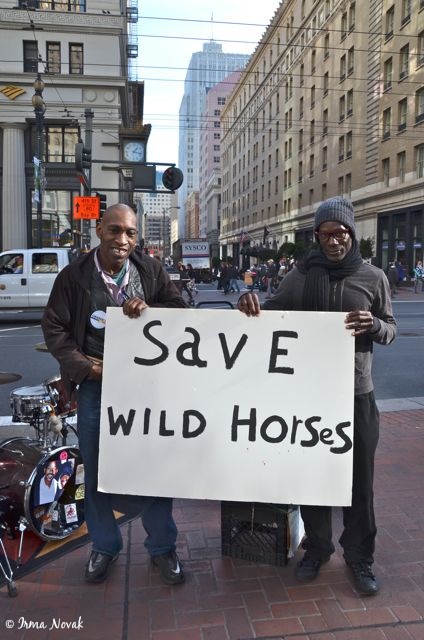
SAN FRANCISCO, Ca. (January 10, 2014)–Concerned Americans protest in downtown San Francisco against slaughtering domestic and wild horses for human consumption in foreign countries. They stand with Attorney General Gary King in New Mexico who is fighting against horse slaughter plants opening in the West. King’s case will be heard in court Monday.

“Majestic horses must not be cruelly slaughtered in America to be served on a dinner plate abroad,” states Anne Novak, executive director of Protect Mustangs. “We hope Gary King will be able to fight horse slaughter in court and win.”

“Native wild horses and domestic horses are at risk of slaughter if the New Mexico plant opens,” explains Kerry Becklund, outreach director for Protect Mustangs. “80% of Americans are against horse slaughter. It’s disgusting.”

San Francisco Protest Info:

When: Friday January 10th from Noon – 1pm

Where: Corner of Market & Montgomery, San Francisco

Info: www.ProtectMustangs.org

Protect Mustangs
is a San Francisco based non-profit devoted to protecting native wild horses. Their mission is to educate the public about the indigenous wild horse, protect and research American wild horses on the range and help those who have lost their freedom.

# # #

Media Contacts:

Anne Novak, 415-531-8454, Anne@ProtectMustangs.org

Kerry Becklund, 510-502-1913, Kerry@ProtectMustangs.org

Photos, interviews and video available upon request

Links of Interest™:


New Mexico AG sues to stop horse slaughter: http://www.usatoday.com/story/money/business/2013/12/19/new-mexico-ag-sues-to-stop-horse-slaughter/4133191/


Judge blocks horse slaughter for at least 48 hours http://www.foodsafetynews.com/2013/12/state-judge-in-new-mexico-blocks-horse-slaughter-at-least-for-48-hours/#.Us7pEvas1Nc


Countersuit: http://www.reuters.com/article/2014/01/06/us-usa-horses-slaughter-idUSBREA0518720140106
Wild horse roundup footage & abuse: http://www.youtube.com/watch?v=yF49csCB9qM

Protect Mustangs www.ProtectMustangs.org

Protect Mustangs on Facebook: https://www.facebook.com/ProtectMustangs


San Francisco protest against horse slaughter ~ Friday, January 10th

Protest Horse Slaughter Med

Come to the San Francisco Protest Against Horse Slaughter! We are coming together to stand against slaughtering domestic and wild horses. We stand with Attorney General Gary King ( @NewMexicoAGO) in New Mexico who is fighting against Horse Slaughter plants opening. King’s case will be heard in court Monday.

When: Friday January 10th from noon – 1pm
Where: Corner of Market & Montgomery, San Francisco, California
Bring: Handmade Signs and friends to hold them!

Questions? Email us at Contact@ProtectMustangs.org

Check back here for updates and on Facebook.

Links of Interest™:

New Mexico AG sues to stop horse slaughter: http://www.usatoday.com/story/money/business/2013/12/19/new-mexico-ag-sues-to-stop-horse-slaughter/4133191/

Judge blocks horse slaughter for at least 48 hours http://www.foodsafetynews.com/2013/12/state-judge-in-new-mexico-blocks-horse-slaughter-at-least-for-48-hours/#.Us7pEvas1Nc

Countersuit: http://www.reuters.com/article/2014/01/06/us-usa-horses-slaughter-idUSBREA0518720140106

Farmington teen organizes awareness event against horse slaughter: http://www.daily-times.com/four_corners-news/ci_24864867/farmington-teenager-organizes-awareness-event-about-horse-slaughtering

Gary King: http://www.garykingforgovernor.com/

Protect Mustangs on Facebook: https://www.facebook.com/ProtectMustangs

Gary King Calls on the Governor to Have State Do the Right Thing on Horse Slaughter

Protect Mustangs.org

Protect Mustangs.org

January 8, 2014

(Albuquerque, NM) – Candidate for Governor Gary King today called on Governor Martinez to take immediate steps to block the proposed horse slaughterhouse in Roswell by directing her Secretary of the New Mexico Environment Department (NMED) to take into serious consideration the opinion of the state environmental hearing officer who yesterday recommended that the operational permits to the Valley Meat company be denied.

“By waiting to block the permits, Governor Martinez has not only endangered these majestic horses, she is wasting thousands of taxpayer dollars. She could end this highly controversial project now by instructing her cabinet Secretary in charge of granting or denying a permit to the Valley Meat company to consider the strong evidence against this project,” said King.

“Horse slaughter is wrong. Human consumption of horse meat that may contain drugs could be dangerous. Discharging thousands of gallons of waste every day from an industrial horse slaughter operation would harm the environment,” said King. “Governor Martinez could have taken action long ago to address this controversy. This isn’t about politics – it’s about the humane treatment of horses and good stewardship. The only question is whether she will finally make the right decision. ”

“I am grateful to the many thousands of people from within New Mexico and around the country who have signed my petition, asking Gov. Martinez to stop the horse slaughterhouse. While the state court will hopefully make the right decision, this has gone on too long,” King added.

###

Horse slaughterhouse wants to file lawsuit against hero

attorney-general-gary-king*304

From Gary King:

Right now I am doing everything I can to protect our majestic horses by blocking the horse slaughterhouse in New Mexico. Our latest victory was last Friday, when we won a 10-day temporary restraining order in court that keeps the horse slaughterhouse from opening in violation of our state laws.

Now, the same people who want to slaughter horses are coming after me.

It was reported today that they’re now going to sue me for slander and harassment.

Why? Because I’m leading a national fight to keep them from opening, a fight that has mobilized people both inside and outside of New Mexico who simply won’t give up on our horses. And I will not be intimidated.

I grew up in a ranching family. I love these animals and I know what’s at stake. I’m not going to stop fighting – and when I become Governor I will continue to stand up for our New Mexico values.

Thank you for joining me in support of this endeavor. If you live in New Mexico, I need your help to gather signatures for my nominating petition to appear on the ballot for governor in November, and ensure that I can keep working on this important issue. Please click here to download the petition, print it out and sign it, and please get any other New Mexico registered Democrats to sign as well. Then mail it to my campaign by January 20th at:

Gary King for Governor

PO Box 40
Moriarty, NM 87035

Thank you for all your kind notes and support of my campaign.

Gary King

Democratic Candidate For Governor
Gary King for Governor

Signatures needed to help America’s wild horses

 Dianne_Feinstein,_official_Senate_photo

We are going to a meeting at Senator Dianne Feinstein‘s office soon and need your help to get more signatures on 3 important petitions:

1.) The DEFUND the ROUNDUPS PETITION http://www.change.org/petitions/defund-and-stop-the-wild-horse-burro-roundups

2.) SAVE OUR NATIVE WILD HORSES PETITION http://petitions.moveon.org/sign/save-our-native-wild

3.) PETITION for EMERGENCY SHELTER & SHADE http://www.change.org/petitions/bring-emergency-shelter-and-shade-to-captive-wild-horses-and-burros

Please help by sharing and emailing the two petitions to your friends and family. Thank you so much for helping America’s wild horses!

( Senator Feinstein photo courtesy Wikimedia Commons)

Help us help the wild horses!

Expenses Jan 2014


We need your help to continue the fight for mustang freedom and to care for the wild horses we have saved from probable slaughter.

Please donate to Contact@ProtectMustangs.org via www.PayPal.com

Mail in your donations to:
Protect Mustangs

P.O. Box 5661

Berkeley, Ca. 94705

We are in the process of filing for our 501c3 and are currently a California nonprofit.

Last month our Executive Director, Anne Novak, donated more than 240 hours of her time to Protect Mustangs. Our other team members donated their time too.

Our bill to feed the rescued wild horses is huge. For example a 100 pound bale of hay is $21.00 in the San Francisco Bay Area. They eat a lot of bales every month. Please help us with our expenses to help the wild horses. Thank you!

www.ProtectMustangs.org   Information: 415-531-8454

Happy New Year! Become a member of Protect Mustangs for 2014

Photo Copyright Anne Novak

Photo Copyright Anne Novak


This is the year of the horse! Make a difference in 2014. America’s iconic wild horses need your help!

Become a 2014 member of Protect Mustangs for $5, $10, $20, $50, $100, $250, $500, $750 or $1000. Join us as we continue our rescue, research, outreach and education. We are advocating for wild horses to live unharmed in freedom and to protect the mustangs in captivity.

Besides becoming a member, we welcome your continued support earmarked for our Save the Mustangs Fund, Field Work Fund, Legal Fund, or the Outreach Fund.

You may donate via PayPal to Contact@ProtectMustangs.org. Visit our homepage for the donate button or mail your check to:

Protect Mustangs

P.O. Box 5661

Berkeley, Ca. 94705

Please include your name, email and address so we may send you a receipt. We are a nonprofit organization registered in California who believes in accountability and transparency. We are currently filing for our 501c3 nonprofit status which makes your 2014 donations tax deductible to the fullest extent of the law.

We look forward to hearing from you.

Best wishes to you for 2014!

Many blessings,

Anne Novak

Executive Director

Protect Mustangs