Proposed Wyoming gas field would be one of the largest on the planet

Posted on January 31st, 2013 by The Wyoming Outdoor Council

This image, taken from GoogleEarth, shows the heart of the Jonah Field, which, compared to this proposed project had roughly one-third the number of wells approved.

This GoogleEarth image shows the heart of the Jonah Field, which, compared to this proposed project had roughly one-third the number of wells approved. While the Jonah has more well pads relative to wells (on roughly 30,000 acres), the Continental Divide-Creston project will cover more than 1 million acres.

Let’s speak up before March 6 to help protect residents, workers, and the environment

By Bruce Pendery

The Bureau of Land Management is analyzing a mammoth, 9,000-well natural gas drilling project proposed in south-central Wyoming near Wamsutter.

Called the Continental Divide-Creston project, it would be one of the largest single natural gas field developments in the United States.

We are asking for your help to reduce the environmental impacts of this project as much as possible. Please send your comments to the BLM by March 6! (See below)

Our biggest concern—and what we are focusing on the most—is making sure this project is done right relative to air quality. This development needs to be conducted in such a way that residents and workers are safe and can breathe clean air, and that the air, land, and wildlife, stays healthy in the future.


This Proposed Project Will Be Bigger than Rhode Island

The BLM would allow BP America Production Company and other operators to drill up to 8,950 new wells. The project area would include 1.1 million acres—or more than 1,600 square miles—much of which would be in what’s known as the “railroad checkerboard.” And much of this proposed project would involve “infill” of existing natural gas fields where 4,400 wells have already been drilled.

The Wyoming Outdoor Council does not oppose development in this area outright because it is not located in one our “heritage landscapes” (iconic areas where we believe any energy development is inappropriate) and it is largely an “infill” project where there is already a lot of existing disturbance.

However, although much of this area is far from pristine, we need to do everything we can to ensure that companies “do it right” at every stage of this project’s development. Therefore, we believe the BLM should require careful, effective, environmentally protective measures as conditions to the development in order to protect residents, workers, air quality, and remaining wildlife habitats.


How to Make a Difference

The BLM has prepared a draft environmental analysis, called an “environmental impact statement” for this project. It considers five alternative development options but it does not specify a “preferred alternative.”

The BLM is now accepting comments on this draft analysis. The comment deadline is March 6. It would be very helpful if you could offer your input on the draft. This could help improve the project, and help ensure that we “do it right” in the face of this massive level of development.

Here are some issues you might consider raising in your comments:

  • While much of this project is in the “railroad checkerboard”—where the BLM’s ability to protect the environment is reduced because of the intervening privately owned sections of land—the project area extends into large, contiguous blocks of public land roughly 20 miles north and south of Interstate 80. You can ask the BLM to provide enhanced protection for these contiguous areas of public lands.
  • The Directional Drilling alternative is the most environmentally protective of the current alternatives, so please ask the BLM to adopt it. This alternative would be even more effective if the BLM were to set a limit on the number of well pads that can be developed.
  • Directional Drilling has become increasingly common and popular with industry with the horizontal “reach” of these wells becoming ever greater.Having multiple wells drilled from a single well pad with directional drilling to access gas resources at great distances can greatly reduce environmental impacts. You can ask the BLM to maximize the use of directional drilling, and to require the greatest “reach” possible.


Where to Send Comments:

You can submit your comments to the BLM by March 6 by e-mail:Continental_Divide_Creston_WYMail@blm.gov, or fax: 307-328-4224, or by regular mail: Bureau of Land Management, Rawlins Field Office, P.O. Box 2407, Rawlins, WY 82301.

You can view the draft environmental impact statement here:http://www.blm.gov/wy/st/en/field_offices/Rawlins.html.

Cross-posted from: http://wyomingoutdoorcouncil.org/blog/2013/01/31/proposed-wyoming-gas-field-would-be-one-of-the-largest-on-the-planet/

Who has heard about the Salazar Plan for wild horses?

Secretary Ken Salazar Public Domainhttp://www.doi.gov/images/SecySalazarOfficialPortrait.jpg

Secretary Ken Salazar Public Domainhttp://www.doi.gov/images/SecySalazarOfficialPortrait.jpg


Salazar Presents Ambitious Plan to Manage West’s Wild Horses

By Lyndsey Layton and Juliet Eilperin

Washington Post Staff Writers
Thursday, October 8, 2009
 

The government plans to aggressively sterilize wild horses and transplant thousands to new public preserves in the Midwest and East as a solution to the nearly 40-year-old problem of how to manage the exploding numbers of wild horses in the West, Interior Secretary Ken Salazar said Wednesday.

“We have a huge problem — out-of-control populations of wild horses and burros on our public lands,” Salazar told reporters. “The problem has been growing and simmering over time, and it’s time for us to do something about it that protects the horses, the public lands and the taxpayers.”

With no natural predators remaining in their habitat, the wild horses and burros that roam federal land in 10 Western states have been thriving, growing from 25,000 in 1971 to 69,000 today. They compete with other wildlife and with cattle for food and water, and they have been blamed for damaging their surroundings.

The Bureau of Land Management says the range can support about 26,600 wild horses and burros. But today the free-roaming herds total about 37,000. There are another 32,000 in holding facilities.

Salazar is proposing that the federal government spend about $96 million to buy land in the Midwest and East to create two preserves that could each support 3,600 horses. It is unclear exactly where the preserves would be located. The annual operating and maintenance costs would be about $1.7 million, according to the bureau.

The secretary said he envisions that the preserves would be open to the public and that tourists would visit to see the horses, but he offered few details about how that would work.

The government intends to partner with nonprofit organizations and other private groups to create five more preserves, so that 25,000 animals would be living on preserves by 2014. All the animals would be sterilized or segregated by sex to prevent procreation.

At the same time, the government would seek to sterilize or control the reproduction of enough animals on the range so that the birthrate is 3,500 foals a year. That would equal the adoption rate of the wild horses and burros, resulting in no net growth of the wild herd. Under the proposal, the costs for the wild horse and burro program would start decreasing by 2019.

Long an American icon and inspiration for song and story, the wild horse has special protection under a 1971 law. The federal statute calls wild horses “living symbols of the historic and pioneer spirit of the West” that should be “protected from capture, branding, harassment, or death.” But the same law also requires the government to achieve “appropriate management levels” of roaming horses so that they do not overwhelm federal lands — and that is the part that has been vexing government officials.

Since the 1980s, the federal government has hired cowboys to round up some excess horses and place them in holding facilities, where they await adoption by the public. But the adoption rate has slowed along with the economy. In fiscal 2008, the government placed 3,706 horses into private adoption, compared with 5,701 in fiscal 2005.

The number of horses and burros in holding facilities is now about 32,000 — nearly the same number roaming wild on the range. Meanwhile, the cost to taxpayers for feed and care of the animals in holding facilities keeps climbing. The budget for the wild horse and burro program rose from $39.2 million in fiscal 2007 to more than $50 million last year.

A year ago, officials at the Bureau of Land Management suggested they might turn to euthanasia — causing an immediate outcry from members of Congress, horse lovers and animal advocates. Madeleine Pickens, the wife of billionaire T. Boone Pickens and a racehorse breeder, jumped into the conflict and announced her intention to buy a ranch and adopt 30,000 horses. She created a nonprofit foundation and a Web site, athttp://www.madeleinesmustangs.org, and signed a letter of intent to buy land in northeast Nevada. But her negotiations with the government have sputtered over her request for annual federal stipends to care for the horses and the use of some federal lands for grazing.

Pickens said Wednesday that she was unsure what Salazar’s announcement means for her project. “It’s pretty vague,” she said, referring to the government’s plan. “The good news is they’re going to do something, which is more than nothing.”

Salazar’s proposal must be approved by Congress, and a key lawmaker voiced his support Wednesday.

“I applaud Secretary Salazar’s commitment to reversing the historic trend of treating wild horses like a nuisance and subjecting them to long-term storage and slaughter,” said House Natural Resources Committee Chairman Nick J. Rahall II (D-W.Va), who had criticized Interior’s handling of the issue in the past. “We have been fighting this battle for a long time now and will continue to do so until the BLM fulfills its duty under the law to protect America’s free-roaming wild horses and burros.”

Some animal advocates, including Wayne Pacelle of the Humane Society, praised the plan, but others decried it. American Horse Defense Fund President Shelley Sawhook said it would be costly and only amounted to “a stop-gap measure.”

“I’m skeptical of the entire thing,” Sawhook said. She blamed the current predicament on government officials having taken 19 million acres of federal habitat away from the horses and burros. “That needs to be returned to the horses,” she said. “If that 19 million acres were still there, there would be no need for holding pens. There would be no need for relocation.

Cross-posted from: http://www.washingtonpost.com/wp-dyn/content/article/2009/10/07/AR2009100703237.html

Geothermal lease sales on public land for $2 per acre

Don’t they frack to get Geothermal Energy?  Is this why our wild horses are being removed?


Native wild horse mare and foal. (Photo © Molly Malone)

Native wild horse mare and foal. (Photo © Molly Malone)

BLM Nevada News

NEVADA STATE OFFICE NO.  2013-11

FOR RELEASE:  Jan. 30, 2013

CONTACT:  JoLynn Worley, 775-861-6515, email: jworley@blm.gov


Geothermal Competitive Sale Results

Reno, Nev.—The Bureau of Land Management (BLM) Nevada generated $28,982 during its competitive geothermal lease sale held in Reno on Jan. 29, selling five parcels, two in Churchill County, two in Humboldt County and one in Pershing County, that comprised 7,056 acres. The high sale bid on each of the five parcels was $2 per acre.  Four of the parcels were sold to Ormat Nevada Inc ., and one was sold to Colorado-based Presco Energy, LLC. 

Geothermal leases are issued for a 10-year primary term. Annual rental for a competitive lease is $2 per acre for the first year, and $3 per acre for lease years 2 through 10. Annual rental for a noncompetitive lease is $1 per acre for lease years 1-10. Additional environmental analysis would need to be conducted to receive permits to drill or build a facility to develop the energy from the geothermal source.

The BLM offered 7 parcels totaling 10,024 acres. A complete summary of the parcels offered and the winning bids is available online at: www.blm.gov/nv.

The BLM Nevada is accepting land nominations until April 12 for parcels to be included in the next geothermal sale, which is tentatively scheduled for November 19, 2013. The BLM reviews nominated parcels for availability, environmental and cultural concerns prior to being placed on the sale list.

—BLM—


Opinion L.A.

OBSERVATIONS AND PROVOCATIONS
FROM THE TIMES’ OPINION STAFF

Is that a fracking earthquake?

March 9, 2012

Environmentalists: Prepare to be shaken up. It turns out that hydraulic fracturing, a.k.a. fracking, a.k.a. the latest fossil fuel industry outrage to be perpetrated on planet Earth, isn’t just a menace because it may be contaminating groundwater. It also can cause earthquakes.

Ohio oil and gas regulators said Friday that a preliminary report on the relationship between a fracking waste disposal well near Youngstown and a series of minor earthquakes in northeastern Ohio last year found evidence “strongly indicating the Youngstown-area earthquakes were induced.” What the frack does this mean? In addition to giving anti-frackers something else to complain about, it means companies drilling for natural gas will probably face a host of new regulatory restrictions aimed at ensuring they don’t do anything earth shattering in the future. In Ohio, regulators announced a series of new rules for disposing of and transporting brine, a waste product from fracking, and they’re likely to spread.

That’s not a bad thing. But before greens who aim to restrict or ban fracking get too worked up about this new entry to the list of its dangers, they should consider that very similar risks also apply to another energy source considered by many — including Al Gore and President Obama — to be among the world’s great hopes of fending off climate change and weaning us off fossil fuels: geothermal.

The principles involved in fracking and geothermal power production are similar: In both cases, one drills deep into the earth and injects water (combined with other chemicals, in the case of fracking) into fissures. Geothermal energy is produced when hot rock turns the water to steam, which returns to the surface and is used to turn generators. In fracking, the chemicals are used to force natural gas to the surface. Very little seismic activity has been attributed to the process of fracking itself, but things get more dangerous around disposal wells such as the one in Ohio, in which the waste water or brine from fracking is dispensed with by being reinjected, and far more liquid is involved.

In his book “Our Choice,” Al Gore says of geothermal energy, “Like solar energy and wind power, geothermal energy could — if properly developed — match all of the energy from coal, gas and oil combined.” Obama’s stimulus package, meanwhile, contained $350 million for development of geothermal projects. It’s easy to see what they’re so heated up about. Unlike wind and solar power, whose generation stops when the sun goes down or the wind stops blowing, the Earth’s magma is always hot, and geothermal power production emits only steam. But it turns out that when you inject water into hot fissures, it cracks them, and deep underground shifts can cause considerable surface rumbling. After a major geothermal project in Basel, Switzerland, had to be shut down because it caused quakes that rattled that city in 2009, one of the nation’s biggest projects to pursue the technology (located near my hometown of Santa Rosa) was tabled. The company behind it, AltaRock Energy, is now carrying out experiments in a sparsely populated area in central Oregon instead.

Regulators are right to insist on maximum standards to protect the public from such risky practices, and it’s a very good idea to hold off on major projects until more is known about the science. But those who seek to ban fracking because of its earthquake risks should consider the more beneficial technologies they may be quashing. Geothermal power has vast potential, but until we get to a cleaner future, we’re going to need more natural gas as a transitional fuel. Pursuing both is richly worthwhile, if it can be done safely.

ALSO:

When big business and human rights collide

Michael Mann’s counterstrike in the climate wars

The energy industry’s disturbing influence on politics

— Dan Turner

 Cross-posted from the L.A Times: http://opinion.latimes.com/opinionla/2012/03/fracking-ohio.html

Blondie let us put the halter on

First time wearing a halter. January 29, 2013 (Photo © Protect Mustangs)

First time wearing a halter. January 29, 2013 (Photo © Protect Mustangs)


January 22, 2013 Blondie is allowing the halter on her nose.

January 22, 2013 Blondie is allowing the halter on her nose.


Blondie December 29, 2012

Blondie December 29, 2012


Blondie & Brownie at BLM Litchfield corral with Inez Sept. 2012

Blondie & Brownie at BLM Litchfield corral with Inez & Protect Mustangs Sept. 2012

Blondie is a California wild horse filly from High Rock. She will be 2 years old in the spring. We adopted her when she was a yearling and already had 2 Strikes against her.

We are very grateful to those who donated for Blondie’s transport from Susanville to the Bay Area on December 12, 2012 and are especially grateful to her sponsor.


Donate to haul Tibet, the wild mustang, to his safe place

Tibet earned 2 Strikes from not getting picked at adoptions.

Tibet earned 2 Strikes from not getting picked at adoptions. (Photo by BLM adoptions)

As of tonight, January 29th we raised $400 from wild horse angels towards the total needed ($920) to bring Tibet out from Wheatland, Wyoming to us in the Bay Area. We need to raise $536 more (includes PayPal fees) by February 2, 2013. Please help and donate what you can to get Tibet to his safe place. Thank you for helping Tibet!

Please donate via PayPal to Contact@ProtectMustangs.org or mail your donations to:

Protect Mustangs, PO Box 5661, Berkeley, Ca. 94705. Make checks payable to Protect Mustangs.

It takes a village ~ Please donate any amount so Tibet can afford to be hauled to his safe place.


Tibetan prayer flag depicting Windhorse

Tibetan prayer flag depicting Windhorse

Wild Horse Cash Cow?

By Cynthia Kennedy & Patrick Kennedy

Virginia City News

Reporter Finds Horse Auction To Be Eye-Opening Experience
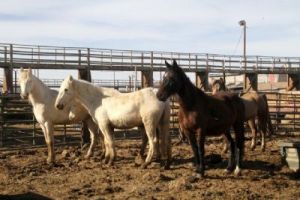
Father, mother and baby Cremellos with bay and buckskin herdmate at the Nevada Livestock Marketing Yard in Fallon on Jan. 9. Photo by Patrick Kennedy

Father, mother and baby Cremellos with bay and buckskin herdmate at the Nevada Livestock Marketing Yard in Fallon on Jan. 9. Photo by Patrick Kennedy

My editor asked me to report on the latest auction of Virginia Range wild horses, at the Nevada Livestock Marketing yard in Fallon.

These are estray horses, not on BLM land and not subject to federal protection, trapped by the Nevada Department of Agriculture (NDA) and considered property of the state.

There had been reports of “shilling” at these recent auctions, and Karen wanted to know if these claims were true.

Everyone should have the opportunity to visit a livestock sale once in their lives. It’s another link in the food chain, as most of the beef, pork and lamb you eat is sold under the gavel.

Nevada Livestock Marketing is located in the middle of Fallon, just south of Highway 50. The first impression you have when you step on the property is the smell.

I’ve been around plenty of cutting horse events and rodeos, and have owned horses most of my life, but this was that smell multiplied by a thousand.

The auction is in a cinder block building and behind it are dozens of pens, linked by alleys, and two wooden catwalks 20 feet above, from where you can survey all the pens. We saw that the wild horses were in corrals on the east side, but the alley to them was blocked by chained gates, so we walked up onto the catwalk, that was still a considerable distance from the horses.

After walking the length of the catwalk, we realized we could step down at the other end and walk up the alley and see the horses. So we did.

There were 41 estrays in the auction, located in several adjacent pens, and they appeared to be comfortable in their surroundings, eating hay from bunkers.

Recently gelded stallions sparred through the fences, but it seemed more play than animosity. Patrick quietly took some photos. We’d been warned in advance by others that photography might not be allowed, but the photos we were taking could never be considered incriminating.

Before they’d been hauled to auction, the males had been gelded, and each horse had been micro-chipped, had a square block of hair shaved from its rump and a large, crude “N” freeze-branded there. None seemed the worse for wear.

As we neared the end of the alley, a cowboy on horseback from afar yelled, “Hey, I’m going to run cows down that alley! You get outta there or I’m gonna call the sheriff!”

We’d gotten our photos, so we responded, “Sure! We’re leaving right now!” and we retraced our steps back up to the catwalk. As we made our way down the rickety boards, stopping to chat with other groups of people who were looking at the stock, three deputies from the Churchill County Sheriff’s Office approached us.

“There’s been a report of people jumping over the fence into the horse pens.” Deputy Lewallen stated. “We’ve been here for 40 minutes Deputy, and haven’t seen anyone in the pens.” I replied. “Well, they’re trying to run cattle, and they say people have been in the alley.” I motioned to the deputy to look down over the railing at two small calves, laying in the straw way below us. “See those two calves? Those are the cattle they’ve been running in that alley, and the horses are over in that far alley.” Lewallen smiled, and we were ready to walk on. “I’ll need to see your IDs.” Now this was getting ridiculous, but Patrick and I gave our IDs, Lewallen ran a search on both of us with his phone, and then we were allowed to go on our way. He and his deputies had been polite and pleasant the entire time, but was this really necessary? After all, this was a public auction of “state property.”

Unfortunately, we’d gotten our timing wrong, and had to wait more than three hours for the horses to go on the block.

During that time, I saw dozens of cows, bulls, steers and calves run through the half-moon shaped pen, that was also a scale, and sold by the pound.

The process was quick, and there were about 30 people in the small indoor amphitheater bidding and watching. I wondered how the wild horses would react to the shaky metal floor, slamming doors, and the odd enclosure into which they’d be driven and separated from their herd. An auction yard has no place for natural horsemanship.

Finally, the bovines were all sold. The bidding ranchers in their crisp, starched Wranglers and Stetson hats left the building. Several cowboys were in the stands, mostly canner bidders. There were also some “grade” domestic horses in the sale.

These horses are victims of the poor economy, high hay prices, and the fact that few little girls long for horses as they did in decades past.

A nice quarter horse or Arabian that would have sold for $1,000 10 years ago, goes for around a hundred. People bidding on these horses have no concern for how well they’re trained, or if they have a friendly personality. Their only interest is in their weight. Now, that horse will sell for around $100, get loaded on a truck with 26 others, and make the long haul to a slaughter house in Canada or Mexico, with no stop to relieve themselves outside of the trailer, or even a drink of water. This is the fate of the free horses that you see on Craigs List every day. Most of them end up at an auction yard.

But this is the sixth auction of estray horses trapped by the NDA since September, attended by the wild horse advocates. It’s easy to pick them out in the crowd: middle-aged women, sitting in groups.

One of them is Shannon Windle of Hidden Valley Wild Horse Protection Fund. Another is Anna Orchard, who lives at the foot of Toll Road. She’s there to buy some of the horses in the Bay Bunch, most of whom have been seen roaming in the foothills, and in the subdivision on Equestrian Road

Orchard comes from a ranching family, “I’ve bought horses in the past from the state prison sale and at the Wild Horse & Burro Expo. For these horses, I’m going to gentle and saddle train them, and then send them up to my family in Canada who will use them as ranch horses. They’re wonderful.”

But how do you bid on a horse when you aren’t even allowed to get near it to evaluate it? Nevada Livestock Marketing does not allow bidders near the horses in advance of the auction, and it’s true that one can’t even take a photo or video. When he pulled out his camera to take photos during the auction, Patrick was sternly reminded of that by owner, Jack Payne. It was all the horse advocates could do, to try to match up the hip numbers with the horses’ brief descriptions on the sale sheet during the auction.

Windle had told me that at past auctions, she’d not even been allowed up on the catwalk nearest the wild horse pens. She’d take the list of sale horses and her binoculars and go up on the far catwalk, and try to match descriptions and hip numbers. Every time, a cowboy down below would yell, “Camera!” and the catwalk would clatter with the running boots of a yard employee bent on stopping her “photography,” only to realize she had binoculars.

The grade horses were first on the block and sold by the pound. An 1100 pound horse sold for around $100. Then the wild horses were prodded through the door. Often, they slipped on the slick metal floor strewn with sawdust, and feces, and had to be chowsed to get up and go on. Neighs rang out as herdmates were separated from one another. At one point, a mare was sold, and several lots later, her nursing foal came through, whinnying frantically for his mother.

“That foal should have NEVER been separated from its mother! You need to stop bidding on that foal and just put it with its mother,” Tam Resovich of the Starlight Sanctuary commanded. Looks were exchanged between Jack Payne and the auctioneer. The usual practice at sale yards is to never separate a nursing animal from its mother. They gave in to Resovich’s request.

But while this would seem to reflect a degree of fairness, what was happening once the wild horses came across the block was decidedly unfair. The estrays that averaged in weight at around 700 pounds. were selling for around $300! Over twice the amount of the much larger grade horses. This was only due to the fact that sale yard owner, Jack Payne, was sitting in a front-row seat bidding on every lot.

Toe-to-toe he went with Shannon Windle, who had bidder numbers from Hidden Valley, as well as several other advocacy groups. Horses from Stagecoach, Fernley, Rhodes Road, and   the Toll Road area went through. But why would Payne bid so much for these horses that were worth far less than the grade horses? He seemed bent to drive the prices paid by Windle, Orchard and the others as high possible.

In two instances (of 41), he did buy horses. Windle dropped out. Later on in the office when bidders were settling their accounts, she asked Payne if she could buy the two horses he’d bought. “Sure, you can pay what I did.” Windle spent $7,720 at the sale that day, and not one wild horse went to slaughter. The horses she did not buy were bought by Orchard and other advocates.

This sale left more questions than answers. I’ve been to many auctions in my lifetime, and never have I bid against the auction house owner in the stands. I know about absentee and phone bidders, but this seemed nothing like those scenarios.

My notes on the auction consisted of hastily scribbled weights and sale prices. If Patrick hadn’t been helping me find the lots on the sheet as they came through, completely out of order, I’d have lost count.

Each horse was in the ring for less than a minute, and the next lot was pushed through before the prior was even bought.

What if a Fandango Pass herd had been sold tonight? It was bad enough seeing these confused animals’ fate hanging by a thread between a sad ending, and the efforts of some good-hearted people. I really don’t think I could have borne it, to see wild horses I personally know go through an auction like this.

Many of the bidders were actually experiencing that conflict and as a result made winning bids.

Is Bidding by the Auction Yard Legal?

To get this answer, I called another livestock auction yard. The owner asked that he remain anonymous, but he angrily complained that Nevada Livestock uses photos of his operation to represent theirs.

He was very proud of his clean yard and pipe pens and catwalks, that starkly contrasted with Nevada Livestock’s. He said that “their yard is a wreck, and we do not bid against bidders at sales here. It’s just not ethical.”

At his sales, “You can look at horses in pens until 20 minutes before the sale. We ask on the PA for people to leave so no one gets hurt. But, we don’t allow photos as the animals could spook and cause problems. If there was an insurance claim, photos could be used against us.”

For another opinion, I called Greg Williams of Lightning Auctions in Sparks. I knew that Greg was formerly a large animal veterinarian, and he would have an informed, unbiased opinion about the question.

“If I bid against my bidders, no one would come to my sales.” he answered. “I had a sale for some 4-H kids who had adopted and trained five wild horses. They were selling them as a project. I could not even get the opening bid of $125 for any of them! I finally bought them all, and gave them back to the kids, as there was no one else who wanted them.”

I told Greg about the wild horses selling in the sale for around $300, and Jack Payne driving up their price. He could not understand why anyone would do that.

To find out why Jack Payne was bidding against his customers, I decided I had to ask him personally. It was a bitter, cold day, and Jack was out working in the yard. I could hear the sounds of the cattle in the background of his phone. I told him I was appreciative that he would talk to me when he was in the middle of work.

“Why did the state choose your facility?”

“I don’t know.”

“How long are the horses in the yard before they’re sold?”

“They come in the night before.”

“How do you feel about the sales?”

“It’s just another commission to me, but they’ve caused a lot of controversy. I feel that if these wild horse people wanted to do good, they’d use the money for orphanages, feed hungry children. These aren’t wild horses, they’re feral. I’m bidding on them just to prove a point, and I’m donating my commissions to charity.”

He went on and talked about how he won’t allow photos or video because, “They’ll use it against you.” But, he did say one could take photos when the horses were coming in, and under the yard’s supervision. I asked him if there was something he’d like to say to the advocates. “Well, the State Brand Inspector, Blaine Northrup, was talking to one of them about the car wrecks they’ve caused, and how a child could have been killed, and they answered that they cared more about the horses than little children! They just don’t care!

“At the first auction they cussed at me, but by the second, they cleaned up their act.”

I then asked him why he was bidding on these horses?

“I have to have competitive bidding. Every sale barn I know, has owners who bid. Price is established by what two people will pay for something. At the first auction, they paid considerably more, and I’ve slacked up on them.”

I also wondered about a buyer’s commission. There is none, and the NDA pays a 5 percent seller’s commission on every lot.

I put in a call to the USDA Packers & Stockyards Administration office in Aurora, Colo., to find out if any regulations were being violated.

There is a “Prompt Payment” regulation that requires that any lot must be paid for by the close of the following business day.

What would Payne do if he was stuck with a wild horse he’d bid $200 for, but was worth only $75 to the canners? That predicament hasn’t happened, as all the lots he’s purchased, even at inflated prices, have been bought by the advocates when settling up after the auctions.

Next on my list was James Barbee, Director of the NDA. He wasn’t in, and his answering machine said he wouldn’t be back for over a week. I left a message.

Next, I called the NDA office in Elko, and they directed me to Ed Foster, their spokesman. He was not in his office, and I left a message. No one returned my calls.

Next, I turned to Shannon Windle, to see if she could answer my management questions. She told me that the estray horses are rounded up and transported to the prison in Carson City. There, they’re held for branding, micro-chipping and gelding. Any male horse a year old or older is gelded, but they’ve been known to geld foals 8-10 months old. There’s no set time for how long they’re there. They run legal advertisements in newspapers in the county seat where the horses were picked up, but all ads also run in the “Nevada Appeal.” People who might own any of the horses have five days after the ad runs to claim their horses. After that, the horses are taken to the next sale.

What About the Horses of the VC Highlands and Virginia City?

I asked Bob Maccario, of the Virginia Range Wildlife Protection Association, to comment about all of this.

He said, “The horses on the Virginia Range are under NDA control, unless they leave the Virginia Range; then they are under BLM control.We cannot do anything like birth control without their authorization. Bottom line is NDA doesn’t want the horses, doesn’t have the resources to deal with them, but tells us, under current NDA policy they cannot enter into any cooperative agreements with any of the groups so we can help. The Director of NDA has very specifically told me, ‘You have no authority to do anything as an individual or as a group (VRWPA).’ and he is correct. As a 501c nonprofit, we will always follow the laws. But we do have the authority of public opinion, and that is why we need everyone at our meetings before it is too late and the horses are removed.”

(Call Bob at 847-7390 for information)

Who is Shannon Windle, and How Can She Buy So Many Horses?

Shannon spent over an hour answering my questions about horse rescue, and I felt very privileged to be talking to someone who has taken on such a huge, costly and emotional task.

So far she has, “Spent over $49,000 on 136 horses sent to auction by the NDA, and they are boarded on private property. We get the money from donations, but barely have enough for feed and transport. Fundraising is a constant. We’ve been extremely fortunate in getting the word out, and the response from the public in northern Nevada, the United States, and around the world has been absolutely incredible. People are outraged, and that’s reflected in their financial support to save these horses. I think it’s driven by all the news about the NDA, and their constant barrage of pricing up horses. I believe the BLM has 55,000 horses in pens across the country. More than on the range, and now the Virginia Range horses are being threatened.”

I asked her how she felt about Jack Payne bidding up the prices (some for more than $600) at his sales yard.

“I wrote a complaint to the Nevada Attorney General, and he forwarded the letter to Blaine Northrup, the Brand Inspector, who brings the horses to the auction. Northrup responded that what Payne did was not unethical or against the law. It’s no different than what he does with the cattle. I told him that Payne doesn’t run up the prices of the cattle. If they were selling for a dollar a pound no one would buy them! I protested that he only ran up the prices on the estrays, but Northrup said the prices were the same as South Dakota and other states where horses were culled. I couldn’t believe that the Attorney General had the department that needed to be investigated, investigate themselves! The agency that was profiting, turned the investigation over to themselves!”

When asked about the major responsibility with these horses, Windle said, “It’s not just me, there are a lot of people involved in this, and a lot of support. Volunteers in the Reno area have grown tremendously, especially the “trailer brigade.” The township of Stagecoach has energized and organized itself and bought the eight horses who were trapped, and put up a fence along the highway. It’s not just me. I’m just a voice. None of this could have taken place without a solid network of wild horse advocates that reaches across this country and around the world. I don’t believe the NDA was prepared for this outpouring of support, nor was Governor Sandoval. I feel I play a very small role in this machine that we are creating. Our next step is to go for a sanctuary.”

But Aren’t These Nuisance Horses?

Windle “Counted 30 horses out of the 140+ horses they’ve trapped as nuisances. Only those 30 needed to be picked up and relocated. The rest were not a public safety issue. The Pleasant Valley horses that caused that big accident, have NOT been picked up. They picked up horses that were eating a woman’s lawn. She was so upset, because she’d only asked for help from the NDA in keeping them off her lawn. They weren’t horses on a highway. They also tried to trap horses way up on Toll Road. How could they be a nuisance or hazard?”

I wondered where most of the horses have been trapped.

“Stagecoach, Hidden Valley, Virginia City, Dayton, Fernley, Rhodes Rd., Damonte Ranch, and Clean Water Way.” Windle related.

What Is Going to Happen Now?

An optimistic Windle replied, “With the 18,000 letters the state has received, they should realize that the majority of the people in this state, and 80% of United States citizens, don’t want to see the horses go to slaughter. The NDA should be working with the advocates. We are willing to assist the NDA in managing them, finding out which ones are causing a public safety issue, identifying areas where these horses should be relocated, and if they become repeat offenders, then & only then, be picked up. They should be given to us so we can find homes for them. We’re 100% behind management, birth control, starting a data base, etc. and we’d use our donor money to as sist. We’d purchase the birth control supplies, computer software, and maintain a volunteer base.

“The worst thing that has happened is that communication has been lost entirely. The NDA will not communicate. If they did, they’d find that some of the beliefs they have about us are wrong. For instance, relocating the horses. I asked Northrup if he would move a group from one area to another, and he said, ‘No way, we don’t do that.’ It’s not their agenda, or one of their options, but if you manage these horses correctly with birth control, and move herds that are causing problems, you can satisfy the needs of developers, residents, and advocates who don’t want them in the streets. It’s amazing what you can accomplish. But now, there’s no communication at all, and the public is upset, and the State of Nevada gets bad publicity.

Will The Upcoming Legislative Session Deal With This?

State Sen. Mark Manendo of Las Vegas believes in setting up wild horse sanctuaries to draw visitors. He recently made public a joint resolution for this that will be introduced in this session. His resolution says, “Building eco-sanctuaries that enable the public to view and photograph wild horses and burros may provide a much-needed boost to the Nevada economy.”

Senate Joint Resolution 1, if passed by both houses of the Legislature, would not have the effect of law, but merely encourages advocates and the state and federal agencies to work together to preserve the horses.

FOR MORE INFO

For further information about this issue, and the entities involved, see the addresses below.

http://agri.nv.gov/uploadedFiles/agrinvgov/Content/Resources/Fact_Sheets/VRE-FactSheet.pdf
http://virginiarange.com/
http://hiddenvalleyhorses.com/main.php
http://www.nevadalivestock.us/
http://thestarlightsanctuary.webs.com/
“Slaughter House Bound” Virginia City News 1-11-13
http://virginiacitynews.com/wild-horses-from-virginia-city-herd-rounded-up-p4940-1.htm

Next Week – Department of Agriculture’s Views

Click (HERE) to Comment and Support the Virginia City News
BLM says it cannot track cattle on its lands


Cows in Nevada (Photo © Anne Novak)

Cows in Nevada (Photo © Anne Novak)

Blames Lack of “Seamless Data” for Excluding Livestock from Range Assessments 

By: Public Employees for Environmental Responsibility (PEER)

Washington, DC January 24, 2013 – The U.S. Bureau of Land Management (BLM) says it was an absence of “reliable data”—and not politics—that caused it to exclude consideration of commercial livestock impacts from multi-million dollar assessments of environmental conditions on Western range lands. BLM thus rejected the first scientific misconduct complaint filed against it by Public Employees for Environmental Responsibility (PEER), which today released a detailed rebuttal of BLM’s self-exoneration.

In a letter dated January 2, 2013, Louis Brueggeman, the BLM Scientific Integrity Officer, rejected the PEER scientific misconduct complaint filed more than a year earlier, on November 30, 2011. He concluded that the complaint had “no merit” since the decision to exclude grazing was reached independently by study team leaders (all BLM managers) solely for “technical reasons” relating to the “lack of sufficient existing data” about livestock impacts.

In reaching this conclusion, BLM ignored meeting minutes produced by PEER in which BLM managers are quoted saying that study of grazing impacts would concern “stakeholders” and the Washington Office due to “fear of litigation.” The claim that the real reason was lack of data does not hold water because:

– Attempts to exclude grazing began at the earliest stages of the study, before data availability was even examined. Further, BLM assertions of data gaps were never examined, let alone verified;
– Other factors being studied, such as invasive species, also have data gaps but these issues did not prevent invasive species from being selected as a study focus; and
– BLM managers hid the existence of a major livestock database which was never given to researchers.

“Caught with its pants down, BLM would have us believe it is wearing ankle warmers,” stated PEER Executive Director Jeff Ruch, noting that the $40 million study was the biggest in BLM history but will end up being largely useless. “As by far the biggest disturbance factor on Western range lands, commercial livestock grazing simply cannot be left out of a scientific landscape assessment.”

PEER today asked Dr. Suzette Kimball, the Scientific Integrity Officer for the entire Interior Department, to reject BLM’s findings and institute an independent review. This is the first scientific misconduct complaint filed against BLM under rules purporting to prevent political manipulation of science.

“Unless some standards of credibility are applied, agencies will be able to simply deny instances of scientific misconduct, no matter how well documented or compelling,” Ruch added. “This scientific integrity process will become a complete joke if BLM can get away with claiming ‘the cows ate my homework.'”

See the original scientific integrity complaint

View the BLM response

Read the PEER letter to Dr. Kimball

Examine line-by-line rebuttal

Look at the damage wreaked by commercial livestock


Citizen investigation exposes evidence of BLM wild horses sold to probable slaughter

Wild horse mares in holding (Photo © Anne Novak, all rights reserved.)

Wild horse mares in holding (Photo © Anne Novak, all rights reserved.)

Wild Horse & Burro Advocates Demand Congressional Investigation

For Immediate release:

WASHINGTON (January 24, 2013)–Wild Horse Freedom Federation (WHFF) released evidence exposing the Bureau of Land Management’s (BLM) wild horse long-term holding contractor selling wild horses to an alleged “kill buyer”. The BLM appears to be trafficking wild horses to slaughter through holding facilites. Debbie Coffey, volunteer director of Wild Horse Affairs at WHFF, uncovered evidence of the contractor selling at least 34 federally protected wild horses. In short and long-term holding, indigenous wild horses retain their wild status and protections but it appears some are being sold to slaughter.

“This evidence shows that the BLM is not protecting our wild horses and is allowing alleged kill buyers to purchase them,” explains R.T. Fitch, volunteer president of Wild Horse Freedom Federation, “The public wants Congress to enforce the Free Roaming Wild Horse and Burro Act that they unanimously signed into law in 1971.  A Congressional Investigation needs to happen now.”

WHFF joins with Protect Mustangs to call for a freeze on roundups, access to document all holding facilities as needed as well as an immediate Congressional investigation into the BLM and their contractors allegedly selling America’s iconic wild horses into the slaughter pipeline.

“It’s time for a deep investigation–done by an entity outside the BLM–to bust these crimes against the American mustang and champion the public who were deceived by officials in charge of protecting our icons of freedom,” states Anne Novak, executive director of Protect Mustangs. “The public is outraged. Protests are being planned as a result of the evidence.”

Coffey, with the assistance of Animal’s Angels, researched and released Wednesday an in-depth article on the activities of a BLM contractor selling 34 BLM wild horses to a kill buyer, while under contract with the BLM and being paid with U.S. taxpayer dollars, to care for iconic wild mustangs on its pastures.  Evidence was obtained through South Dakota Brand Board Inspection records and Freedom of Information Act (FOIA) requests.

Information from government and public records show that Jim Reeves and Lyle Anderson own Spur Livestock. They have a contract with the BLM for a wild horse long-term holding pasture on private land within the Cheyenne River Sioux Reservation in South Dakota, as well as on Indian Trust Lands administered by the Bureau of Indian Affairs.  This U.S. taxpayer funded facility is the Whitehorse Wild Horse Long Term Holding Facility.

WHFF received records from the South Dakota Brand Board that reveal on 11/8/2008, while under contract with the BLM, “owner” Spur Livestock sold 34 horses with “BLM tattoos” to JS Farms–owned by alleged kill buyer Joe Simon.

In a telephone conversation with Jim Reeves, Coffey reports that when asked about 72 horses he bought as alleged pack animals, Reeves said “I’m told not to talk about this kind of stuff.”  He added “I can’t talk about this” and “That’s BLM business.”

When asked about all the wild horses who disappear from their short-term holding facilities after the roundups, BLM officials inform the public and the media that they will be well taken care of on “grassland pastures”.

“The BLM leads the public to believe that captured wild horses are living out their lives grazing peacefully on long-term holding pastures, and claims they do not sell wild horses to slaughter, but at least one contracted middleman did sell BLM wild horses to an alleged kill buyer and the horses very likely met a horrific fate at a slaughterhouse,” explains Coffey. “We want a freeze on roundups, immediate access to document all long-term holding facilities as needed and a Congressional investigation into all aspects of the BLM’s Wild Horse & Burro Program.”

###

Wild Horse Freedom Federation (WHFF) is a registered, Texas non-profit corporation with Federal 501c3 status and registered as a legal non-profit in all 50 states of the Union.  WHFF puts people between America’s wild equids and extinction through targeted litigation against governmental agencies whose documented agendas include the eradication of wild horse and burros from public, federal and state lands. WHFF is funded exclusively through the generosity of the American public.

Protect Mustangs is a California-based preservation group whose mission is to educate the public about the American wild horse, protect and research wild horses on the range and help those who have lost their freedom.

Media contacts:

R.T. Fitch, Volunteer President WHFF, 800-974-3684, rtfitch@wildhorsefreedomfederation.org
Debbie Coffey, Director Wild Horse Affairs WHFF, 800-974-3684, debbie@wildhorsefreedomfederation.org
Anne Novak, Executive Director Protect Mustangs, 415-531-8454, anne@protectmustangs.org

Photos and interviews granted upon request

Links of interest:

Debbie Coffey publishes her research on PPJ Gazette (sources noted): http://ppjg.me/2013/01/22/wild-horses-sold-to-kill-buyer-by-blm-contractor/

http://rtfitch.files.wordpress.com/2013/01/joe-simon-invoice.png

Native wild horses: http://protectmustangs.org/?page_id=562

Petition to Defund the Roundups: http://www.change.org/petitions/defund-and-stop-the-wild-horse-burro-roundups?utm_source=share_petition&utm_medium=url_share&utm_campaign=url_share_after_sign

Wild Horse Freedom Federation: http://wildhorsefreedomfederation.org/

Protect Mustangs: http://protectmustangs.org