Moran Amendment to Ban Horse Slaughter Passes Appropriations Committee

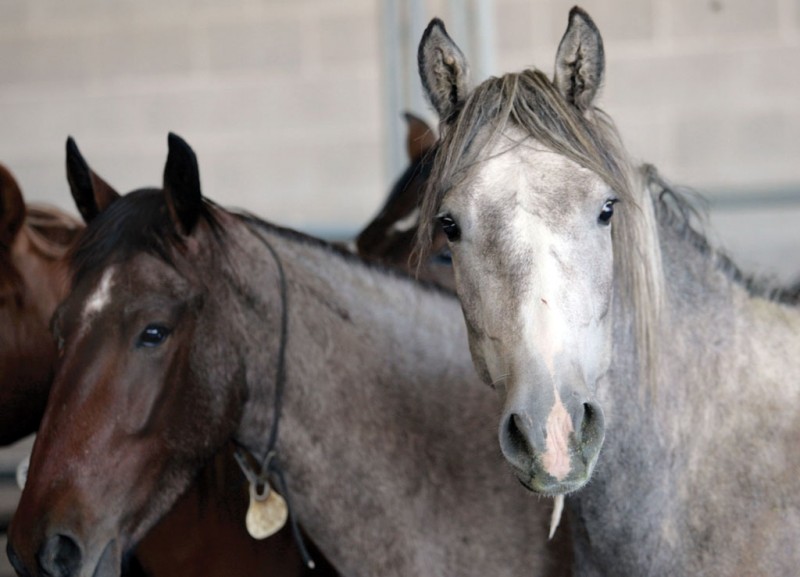
Wild mustang weanling in holding. (Photos © Anne Novak, all rights reserved.)

Jun 19, 2012

Washington, DC – An amendment introduced today by Congressman Jim Moran, Northern Virginia Democrat, to eliminate federal funding for USDA inspections of horse slaughter facilities passed the full Appropriations Committee. The amendment, adopted in the Fiscal Year 2013 Agricultural Appropriations Bill, would effectively prohibit the practice of horse slaughter for human consumption in the U.S. The bill now heads to the floor for a vote by the full House.

“When more than 80 percent of the American population opposes this practice, it is high time we put an end, once and for all, to industrial horse slaughter,” said Rep. Moran. “Horses hold an important place in our nation’s history and culture, treasured by all for their beauty and majesty. They deserve to be cared for, not killed for foreign consumption.”

During debate, Moran noted that the Appropriations Committee cut back funding for USDA’s Food Safety and Inspection Service (FSIS) meat facility inspections by $9 million below Fiscal Year 2012. He argued against expanding FSIS responsibilities to inspect meat shipped to foreign countries that would come at the expense of funding for inspections of chicken, pork and beef consumed by U.S. citizens.

U.S. horse meat may also contain chemicals harmful to humans if ingested. Unlike farm animals raised for their meat, horses are routinely given powerful medications, including the anti-inflammatory pain killing drug phenylbutazone.

“Adding millions of dollars to the federal budget to inspect foreign-owned horse slaughter plants would be a step backwards for America’s iconic horses and a waste of tax dollars,” said Wayne Pacelle, president and CEO of The Humane Society of the United States. “We are grateful to Congressman Jim Moran for leading the charge to restore this critical horse protection provision, and to the House Appropriations Committee for reining in this multi-million-dollar subsidy that could pave the way for the needless killing of American horses for foreign gourmands.”

Moran introduced similar language during debate over the fiscal year 2012 Agricultural Appropriations Bill. Though adopted in the House, the language was removed during conference committee in November. Moran’s amendment today would reinstate the five-year ban on horse slaughter from 2006-2011.

###

99 Virginia Range wild horses rescued from probable slaughter need forever homes

Wednesday, November 14th Shannon texted Anne the good news, “We got them all!”

We are grateful to be of help to our friends at Hidden Valley Wild Horse Protection Fund. They’re saving the historic Virginia Range wild horses and placing them in adoptive homes. Only 99 more wild horses need to find their forever homes. Contact Hidden Valley if you would like to adopt a historic Virginia Range wild horse.

Here is an update from Willis Lamm~

Hidden Valley recovered the Toll Rd. 17.  Reports are that Shannon finally had enough of the shill bidding and let the first horse go to Jack Payne.  After that the prices were slightly high but not so outrageous.  Following the auction Shannon bought the first horse back from Payne.

There are some historic horses in this bunch.  Some are descendents of “Bubba,” the grand sire of the old world buckskins that used to hang out near the overlook on SR-341 before the area burned off in a wildfire.

Bubba

The band before the fire (the buckskins on the right.)

After the fire Bubba and his band, along with Sentinel and his band, were relocated to the eastern side of the range by NDoA.  The two long time rivals still maintained their rivalry but in the years that followed, we never saw either horse leave a mark on the other.

A number of Bubba’s offspring remained in the canyons above Toll Rd. and a few were in the 17 head that NDoA picked up.

Horses that are likely Bubba’s progeny now safe in a very large pasture.

The allied groups got together and once again got the horses to safe harbor, following blood work, worming and vaccinations.  The entire group now has a large protected expanse of land to roam and graze.

Helping Hidden Valley with logistics were LRTC, Karen and James Mayfield from Wild Spirit Horse, Sheila Schwadel from the Fish Springs Posse, and the land was made available by Shari and Eddie Floyd after quite a bit of preparation and materials were provided by Let ‘Em Run and LRTC.

Lacy J. Dalton flagging some wire fencing that was partially hidden by brush.

Once again teamwork achieved successful results.  Thanks to everyone who was “hands on” and who helped behind the scenes.

BLM natural resource specialist asks for internal cleanup

By U.S. Government [Public domain], via Wikimedia Commons

Memorandum:
To: BLM All

From: Stan Olmstead – Natural Resource Specialist

Date: September 28, 2012

Re: Last Formal Comment on the Commitment to the Mission.

Never looking through “rose colored glasses” it is obvious that we have monumental
environmental concerns both in the nation and on the planet and are in need of serious
solutions. The U.S. government has all the abilities to perform state-of-the-arts
environmental management and yet we continue to fail. The land management agencies
have hard-working people and they put in sincere time to perform their work. However if
the Vernal Field Office is representative, there is concern in the implementation of the
BLM mission. The Vernal Office has placed priority on the exploitation of public land
for commodities. This effort is because of a focus on development of energy; due to a
fossil fuel fixation, politics, Energy Policy Act (2005), Vernal Field Office RMP (2008),
and office managers that do not understand their purpose. A quarter of the employees of
the Vernal Office have a personal interest, academic knowledge, and intent to serve the
American public in the performance of the mission. The mission and natural resource
knowledge is their prime reason for working with the Bureau. The intent of the natural
resource professional is to wisely manage habitat and fauna of public land for our
citizens.

U.S. history has shown repeated failure in the care of the natural world. We place
exploitation of natural resources and profits from these resources ahead of wisdom. In the
past we mined, logged, grazed and exploited the natural world. Pressure on our political
officials to reverse this attitude and stop deterioration of natural systems was necessary
and resulted in excellent environmental laws. The U.S. has lost numerous species and yet
we do not act for their ethical protection and subsequently in defense of our own healthy
environment. At the Vernal Office little concern has been shown to care for sensitive
species (mountain plover, sage grouse, hookless cactus). We promote energy
development without stop and continue to measure natural resources by dollar value.

The mission of the BLM is to sustain the health, diversity and productivity of public
lands for the use and enjoyment of present and future generations. As civil servants we
are obligated to all Americans to perform the BLM mission. Yet our elected, appointed
and agency administrators ask us to focus on commodities and economics as opposed to
environmental health. Commodities and economic gains are easier to measure. We work
with our elected officials but we work for our citizens. Outside influences that lead us
away from our required service to the American citizen and the BLM mission, should be
repelled by the servant. Our service to the American people is to fulfill the mission
through science, law, regulations and “team work”. Our fellow civil servants that
administer the Bureau should insist that we work together in a common goal to fulfill the
intent of the mission. Yet the Vernal Office does not work together as a professional
team, instead the office works as fragmented groups, individually following bureaucratic
requirements catering to the exploiter and political antagonist.  There is little thought for
the future by those in charge for real land health.

Health and diversity of public lands are natural entities. They do not include oil wells,
livestock, crested wheatgrass nor guzzlers. These are developments and tools to exploit
and have nothing to do with health and diversity. Productivity is not synonymous with
commodities. Protection of healthy soils, vegetation, clean air & water and a natural
fauna are the true products, which we should diligently promote before commodity
extraction. Science teaches us to not act until we know that harm will not occur to the
natural system. Whereas development asks for proof of damage to the natural system
before you restrict. The natural environment and subsequently the human environment
will be injured seriously if balance is not restored. U.S. federal land management
agencies have it in their power to be the best land stewards anywhere in the world. We
fail not in ability but in our attitude, a lack of understanding, lack of futuristic thinking
and our implementation. Our actions are based on outside forces inconsistent with the
intended mission and wisdom.

The BLM employee that did not study for a career in natural science frequently works for
the Bureau for different reasons than the natural resource professional and it appears from
experience that those who work for these different reasons are unable to visualize the
intended mission. Knowing environmental health, diversity and the true customer must
be known by the team before we can fulfill our service. Without a personal interest for
the health of the land it is difficult to implement a professional understanding. If as some
have said incorrectly that “their job was to promote oil & gas” they fail in the mission
and service to the people.

Aldo Leopold had four requisites for land-health:
1. Cease throwing away its parts
2. Handle it gently
3. Recognize that its importance transcends economics
4. Don’t let too many people tinker with it.

However Vernal:
1. Lost the mountain plover; the only known population in Utah while at the same
time the species is in decline throughout its range. Little effort to prevent this loss
was implemented and is a serious mission departure.
2. Plugging and abandonment of well sites have not been a priority. Numerous oil &
gas wells have not produced for more than 15 years and yet these sites remain un-
reclaimed. Notable of these is Seep Ridge #1; Lease #U-6616 & Seep Ridge #3;
Lease #U-10178-A. Why is it that after more than 20 years of non-production
these two wells remain idle and un-reclaimed? Federal regulation for well
abandonment (Title 43 CFR 3162.3-4) requires abandonment.
3. Land reclamation after use still appears difficult to solve. What’s the problem?
The user wishes to profit from the land and the land is owned by the citizens.
Insist that the user fulfills the reclamation requirement before permitting
additional use. Our only task is to identify need and confirm success.
4. Animal Unit Months; we have grazing allotments, allotments have specified
AUM’s and grazing occurs. Yet we disturb large percentages of our allotments
located in oil & gas fields and AUMs remain the same. If you lose 30% of the
forage in a specific allotment it is logical to reduce the AUMs by 30%.

In the Vernal Field Office we have shown no concern for the cumulative impact of the
developed area and provide in NEPA documents little quantitative analysis. We fragment
habitat extensively in energy areas resulting in ecosystem damage not unlike that which
occurred from over grazing and other historic land exploitation. It took decades for
government to stop over grazing and move toward land health. Today scars remain from
time before the Taylor Grazing Act. We have lost the only population of mountain plover
in the state of Utah, contrary to science, ethics, and policy (BLM Manual 6480 – Special
Status Species Management). We have watched as direct and indirect impacts have
literally killed individuals of a federally listed plant species with only a token effort to
prevent future actions and not an apology for our failure. Analysis of water depletion
associated with endangered fish of the Colorado River system is accomplished through a
series of documented explanations that have no attempt to monitor the quantity of
depletion and is inconsistent with critical habitat for the species. The air within the
Uintah Basin continues to be fouled in our effort to maximize energy and economic gain.
Climate change receives but token language in our NEPA documents. Socio-economics
are measured on dollar values gained without analysis showing measurement of
“degradation/benefit” to the community. Air quality causes respiratory ailments, traffic
within the community is industrial and large sums of money leave the community to
outside corporations. A myriad of other community related issues are in need of detailed
analysis.

We need to alter our bureaucratic method of operation. Focus on our mission and team
implementation as professional civil servants. Work together as a unified team of
professionals to implement the science, law, and regulations for service to the American
people. Discontinue our practice of placing our budget on projects that in truth are
developments in disguise and termed mitigation. We should utilize the budget on
monitoring and over-site. The use of the public land is the burden of the user to minimize
injury and restore to its natural state.

Without serious fulfillment of the mission we continue to harm public land as it has been
harmed so frequently in our historic past. Be honest about what is happening. It is easier
to break something than to fix it, so let us stop breaking the land.

“Our Quest, is to see that we are connected to all things, that there is no separation, only
in the mind”- John Mayers; Geologist.

Salazar says he ‘regrets’ threatening to punch Gazette reporter

Cross-posted from The Gazette

Secretary Ken Salazar Public Domainhttp://www.doi.gov/images/SecySalazarOfficialPortrait.jpg

November 13, 2012 4:22 PM

U.S. Secretary of the Interior Ken Salazar said Tuesday he “regrets” threatening to punch a Gazette reporter for asking him last week about problems in the government’s wild horse program.

Salazar visited Fountain on Nov. 6 as part of a tour through Colorado in support of President Obama’s re-election campaign and Gazette reporter Dave Philipps asked him to answer a few questions on video.

Philipps, a prize-winning investigative reporter, had tried to reach Salazar for months through his press secretary to comment on a story Philipps wrote for ProPublica without response. The story detailed how a Colorado man with business connections to Salazar had been sold hundreds of federally protected wild horses despite being a proponent of horse slaughter. The fate of the horses is unknown.

When Philipps began asking Salazar about the program and possible personal ties he had to the wild horse buyer now under investigation, Salazar cut the interview short.

The secretary, dressed in a suit and wearing his signature white cowboy hat, approached Philipps, pushed The Gazette’s video camera out of the way, and got within inches of the reporter’s face.

“Don’t you ever,” Salazar said in a low voice, pointing a finger. “You know what, you do that again… I’ll punch you out.”

After saying he felt he’d been “set up,” Salazar left.

Listen to the audio of the interview here.

“Holding our public officials accountable is one of the cornerstones of our role as journalists,” said The Gazette’s Director of Content Carmen Boles. “We are dismayed that anyone would respond to legitimate questions in such a fashion.”

The Gazette held the audio, hoping that Salazar would agree to a substantive interview concerning  the wild horse program. His press office responded to requests with a simple statement: “The Secretary regrets the exchange.”

The confrontation was made public by the Colorado Springs-based wild horse advocacy group The Cloud Foundation on Monday and quickly spread through major news organizations and social media Tuesday.

Oaklahoma monthly wild horse and burro adoption event

Release Date: 12/27/11
Contacts: 866-468-7826

Pauls Valley, OK, Boasts Region’s Largest Wild Horse and Burro Facility Adoptions Held Every Second Tuesday, 8 a.m. – noon

PAULS VALLEY, Oklahoma—Attentive travelers along Interstate 35 about an hour south of Oklahoma City will find an uncommon sight in this part of the country: Hundreds of wild horses grazing leisurely along the banks of the Washita River. The Garvin County seat is home to one of the largest wild horse and burro short-term holding facilities east of the Rockies. It’s not a tourist destination, as such, but the site is open to the public one day a month.

The U.S. Bureau of Land Management (BLM) runs the 400-acre facility as a regional hub for its national Wild Horse and Burro Adoption Program. Every second Tuesday, the BLM opens the gates to allow locals an opportunity to adopt one of these “living legends.” Upcoming dates: Tuesday, January 10, 2012, and Tuesday, February 14, 2012, from 8:00 a.m. to noon.

These are adult and yearling horses and burros that once roamed free on public lands in the West.  The BLM periodically removes excess animals from the range in order to maintain healthy herds and to protect other rangeland resources. The adoption program is essential for achieving these important management goals.

A mixed group of 50-plus animals is offered each month, often including burros and young horses. Yearling and weanling horses come from mares that were bred in the wild and gave birth in captivity. The young horses themselves have never lived in the wild but are eligible for adoption as if they had.

Adoption Qualifications
Application approval is required and can be done on site.  To qualify to adopt, one must be at least 18 years old with no record of animal abuse. Adopters must have a minimum of 400 square feet of corral space per animal, with free access to food, water and shelter.  A six-foot corral fence is required for adult horses and five feet for yearlings. All animals must be loaded in covered stock-type trailers with swing gates and sturdy walls and floors. BLM staff will be on hand to assist with the short application process, answer any questions and load horses.

Adoption Fees
The standard adoption fee is $125, as set by law. If more than one person is interested in the same animal, and oral auction will be held to determine the adopter and fee.

$500 Adoption Incentive
BLM pays a one-time $500 care-and-feeding allowance to adopters of selected horses at least four years old. The allowance is paid in full after one year when adopters receive official ownership title for their horse(s). All standard adoption conditions and fees apply.  A limited number of eligible horses will be available. Younger horses, burros and trained animals are not eligible for this incentive.

Wild horses and burros – iconic symbols of America’s western heritage – are renowned for their strength, endurance, agility and intelligence, characteristics bred into them in the wild that make them ideal for work or recreation. Since 1973, the BLM has placed more than 225,000 of these “living legends” in approved homes across the country.

For more information, call toll-free 866-4-MUSTANGS (866.468.7826) or visit www.blm.gov/nm.

Directions to the Pauls Valley Adoption Center: From I-35, take Exit 74 (Kimberlin Rd.) west about one quarter mile to facility entrance.

The BLM manages more than 245 million acres of public land, the most of any Federal agency. This land, known as the National System of Public Lands, is primarily located in 12 Western states, including Alaska. The BLM also administers 700 million acres of sub-surface mineral estate throughout the nation. In Fiscal Year (FY) 2011, recreational and other activities on BLM-managed land contributed more than $130 billion to the U.S. economy and supported more than 600,000 American jobs. The Bureau is also one of a handful of agencies that collects more revenue than it spends. In FY 2012, nearly $5.7 billion will be generated on lands managed by the BLM, which operates on a $1.1 billion budget. The BLM’s multiple-use mission is to sustain the health and productivity of the public lands for the use and enjoyment of present and future generations. The Bureau accomplishes this by managing such activities as outdoor recreation, livestock grazing, mineral development, and energy production, and by conserving natural, historical, cultural, and other resources on public lands.
–BLM– 
Last updated: 01-03-2012

Waiting to hear results from BLM regarding Indiana adoption event

(Photo © Cat Kindsfather, all rights reserved)

——– Original Message ——–
Subject: Neep update today. It’s been 10 days since adoption event
From: 
Date: Tue, November 13, 2012 3:39 am
To: “Deborah Collins” <@blm.gov>
Dear Debbie,

We are looking forward to hearing about the adoption outcome of the Litchfield 11 after Karen Malloy attempted to take control of our efforts to help publicize the California wild horse yearlings going to the Indiana adoption event Nov 2-3rd.

Please get back to us without additional delay on the status of all the California yearlings shipped East. It’s been 10 days now since the adoption event and we have not had our request fulfilled.

We would like to know who was adopted and what state they are going to. We would also like to know who did not get adopted and how many strikes they each have now and where they are located and what is the next adoption event they are going to attend online or in person.

Thank you for your kind assistance.

Best wishes,
Anne Novak

Anne Novak
Executive Director
Protect Mustangs
P.O. Box 5661
Berkeley, California 94705


Interior Secretary threatens to “punch out” Colorado Springs reporter

Chaos Reigns in Re-elected President’s Cabinet

Wild Horse Foe and Public Bully, Ken Salazar

On Election Day, at an enthusiastic gathering of Obama supporters in Fountain, Colorado; Dave Philips, a reporter for the Colorado Springs Gazette Telegraph, had just finished an interview with Secretary of the Interior Ken Salazar about his controversial policies for managing America’s wild horse populations. Just after Secretary Salazar answered final questions about the future safety of wild horses and he turned to leave the interview, he unexpectedly approached Phillips and told him, “If you set me up like this again, I’ll punch you out.”  Standing nearby was Ginger Kathrens, Executive Director of the Cloud Foundation, a Colorado-based wild horse advocacy organization. “I was stunned by the Secretary’s rude and clearly hostile comment toward Dave,” said Kathrens.

Kathrens, who had had been granted permission by an Interior law enforcement official to take pictures at the rally added, “ Salazar walked past me, refused to shake my hand, and told me, ‘You know, you should never do that.” It was unclear to Kathrens what he meant. “These threats would have been inappropriate coming from anyone, but the fact that it came out of the mouth of the Secretary of the Interior is alarming,” stated Kathrens. “I can’t believe that a top official in Obama’s cabinet could be so defensive.”

Phillips’ interview with Salazar was a follow-up to a story he had written in September about the sale of wild horses to Tom Davis, a Colorado killer buyer who purchased over 1,700 wild horses from government holding facilities. The horses ended up in south Texas and it is believed they were trucked over the border to Mexican slaughterhouses. Secretary Salazar acknowledged that an investigation of Davis’ activities is currently underway.

Salazar’s anti-wild horse stance came to light in 2004 during his successful run for the U.S. Senate. After a town hall meeting in Greeley, Colorado, wild horse advocate Barbara Flores asked him what he thought about our wild horses. Candidate Salazar responded, “They don’t belong on public lands.” Salazar vacated his Senate seat in 2008 to take his current position as Secretary of the Interior

The BLM removes far more horses from their legally designated home ranges than can be adopted out to the public. The massive roundups have resulted in the stockpiling of animals in government facilities and privately contracted ranches. Nearly twice as many wild horses are housed in these costly holding operations than currently roam free, leaving most wild herds under populated and vulnerable to inbreeding and die-off due to a lack of genetic diversity.

“You know, this isn’t just about wild horses,” explains Kathrens. “America needs leaders in Washington, and the President needs cabinet members who respect citizens, respect the laws, value discussion and working toward mutual solutions. Ken Salazar displayed none of this on Tuesday.”

Call the White House at 202-456-1111 and ask for special interest Cattle Baron and wild horse foe Ken Salazar to be removed from office, TODAY!!

Happy Ending ~ Sweet Baby Red #2484 finds a home

Pilgrim

Pilgrim formerly Sweet Baby Red #2484 happily adopted by April November 2012 (Photo © April, all rights reserved)

“I just wanted to give you guys an update on Baby Red now known as Pilgrim. I have had him for 1 week now and he has settled in beautifully. I have worked with him for the last 3 days and he is responding so well. He will move his forequarters and hindquarters away and come to me at liberty. I can halter him and he is coming to pressure on the halter already! I would have never known about this 3 strike program that the BLM has in place before seeing your site. I thank you so much for making people aware of these wonderful horses. This is such an awesome experience and I can’t wait to continue building this bond with this horse for years to come! Thank you!”

~April from South Carolina

Pilgrim, formerly known as Sweet Baby Red (#2484) is a Twin Peaks wild horse yearling from California. He was born at the Litchfield holding facility. He was passed over during the internet adoption and became an at-risk mustang with another strike against him. 3-Strikes and federally protected wild horses loose their protected status and can be sold to pro-slaughter buyers by the truckloads.

Protect Mustangs wants to make sure the Litchfield 11 who were passed over during the BLM’s national adoption find forever homes.

“We are keeping track of the eleven yearlings from the Litchfield Corrals, near Susanville,” explains Anne Novak, executive director of Protect Mustangs. “Some of these at-risk youngsters are still in California and some have been sent back East. A few have been adopted and several have accrued another dangerous strike against them.”

If anyone wants to adopt one of the Litchfield 11 please send an email to Contact@ProtectMustangs.org. The preservation group is happy to assist perspective adopters to navigate the BLM’s maze of red tape to adopt a mustang.


Pilgrim (Sweet Baby Red #2484) at the BLM Litchfield Corrals, California Sept 2012 (Photo courtesy BLM)

Obama faces energy team shuffle that may result in Salazar resignation and Grijalva nomination

Cross-posted from VGFarrell on Nov 9, 2012 in Wild Horses for Tuesday’s Horse
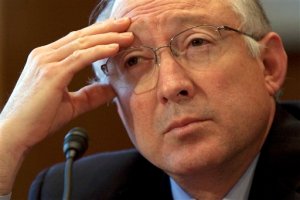
Ken Salazar. (AP Photo/Evan Vucci)

Secretary of the Interior Ken Salazar pauses during a Senate Committee hearing in Washington. (AP Photo/Evan Vucci)

Andrew Restuccia reporting for Politico writes:

“President Barack Obama won four more years in Washington Tuesday, but his energy team likely won’t be sticking around for that long, setting up some bruising confirmation fights in the Senate.

“Democrats close to the Obama administration say Environmental Protection Agency Administrator Lisa Jackson, Energy Secretary Steven Chu and Interior Secretary Ken Salazar could all step down during Obama’s second term, though the timing is far from certain.

“Of course, Democrats caution that nothing is set in stone and the politics of the second term, as well as the possibility of a lengthy confirmation battle over their replacements, could dictate who stays and who goes.” Read more >>

While this may music to the ears of wild horse and burro advocates regarding Salazar, it would be hasty to assume this would resolve all of the threats to the survival of America’s wild equines on public lands as it is not clear who Obama intends to nominate to take Salazar’s place if Salazar indeed leaves. It is not a given.

Another challenge, as cited in the Restuccia article, is the confirmation hearing which promises to be grueling and rash with political maneuvering.

With that said, the candidate that springs to mind among wild horse and burro advocates naturally for Interior Secretary is of course Rep. Raúl Grijalva (D-7-AZ). They will be happy to know that his name is already beginning to take on some buzz inside the Beltway, but there may be other candidates up the President’s sleeve.

Who is Raúl Grijalva?

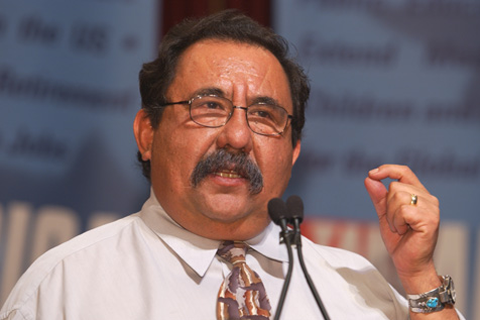
Rep Raul Grijalva at the podium. Google image.

Rep Raul Grijalva at the podium. Google image.

Congressman Raúl Grijalva has a winning resume for Interior Secretary, and the obvious choice in 2008 of many in Washington, and expectantly will be again this time around.

Rep. Grijalva began his public career as a community organizer and has worked his way up through the ranks, and that type of background appeals strongly to President Obama.

Elected to Congress in 2002, Rep. Grijalva earned early credit for his role in creating the Sonoran Desert Conservation Plan, which brought together business interests, landowners and environmentalists reports the New York Times. More recently, he challenged British Petroleum months before the accident in the Gulf of Mexico.

Rep. Grijalva serves on the U.S. House Committee on Natural Resources and appointed Chairman of its National Parks, Forests and Public Lands Subcommittee. However, as a Democrat in a Republican House, he is currently its Ranking Member. The Subcommittee oversees 600 million acres of federal land. Also important, Congressman Grijalva serves on the Subcommittee on Water and Power.

In October 2008, Grijalva “published a 23-page report (‘a partial list’, he deemed it), outlining the Bush administration’s assaults on our national parks, forests and public lands.”

“That document wasn’t a mere Bush-bashing exercise,” reports Billie Stanton writing for the Tuscon Citizen, “it was a blueprint for how to remedy the havoc wrought and how to bring transparency, honesty, ethics and professionalism to the hideously corrupted Department of the Interior.”

Rep. Grijalva is also a member of the Sustainable Energy and Environment Coalition and supporter of the Green Scissors plan (pdf) to cut $200 billion in government subsidies to industries such as coal, oil, gas and timber.

His voting on energy policy (see links in Related Reading below) lines up with much of Obama’s thinking, in particular renewable energy. This is key.

Conservation has always been high on the list of Rep. Grijalva’s priorities in Washington. His record clearly reflects this, and he is popular among a long list of advocates, including those of conservationists and wild horse and burro protectionists.

The League of Conservation Voters (LCV) Action Fund give Rep. Grijalva an inspiring LCV lifetime environmental score of 95% and a perfect 100% on LCV’s National Environmental Scorecard for his voting record in 2011.

This means that Rep. Grijalva clearly understands the link between the nurturing of America’s public lands through the sustaining environmental impact of free-roaming wild horses and burros (that will also by the way benefit the cattle and other wildlife foraging there).

Although energy will be the focus in selecting the next Interior Secretary, the Bureau of Land Management fall under the jurisdiction of the DOI, and the wild horses and burros fall under the oversight of the BLM.

Rep. Grijalva has shown himself to be an influential friend to the lands and wild equines who live on them, particularly in moments of crisis and addressed the Department of Interior on their behalf.

While Rep. Grijalva is a highly commendable candidate to replace Secretary Salazar, he may not be a popular choice of the gas, oil and mining industries, reckoned to be the most powerful lobby in Washington. Billie Stanton, writing for the Tuscon Citizen in 2008 in an article entitled, “Why did Obama forsake Grijalva?” suggests “He was too ‘green’ for gas, oil and mining interests” who “would do everything in their power to block Grijalva” according to a savvy political observer in southern Arizona.
Wild Horses needlessly rounded up by federal government agency, Bureau of Land Management. Google image.

Wild Horses needlessly rounded up by federal government agency, Bureau of Land Management. Google image.

But let’s not get ahead of ourselves.

While we must be vigilant for these sorts of changes, more importantly and urgently, we must stay focused on the treatment of our wild horses and burros under the current regime, and continue to work hard for their protection and survival.

RELATED READING

Wild Horses and Burros

Congressman criticizes Nevada wild horse roundup; Tuesday’s Horse; Jun. 11, 2012

Letter (pdf) to Secretary of the Interior Ken Salazar on the need for more humane horse management policies (signed by more than 60 Members of Congress); Jul. 28, 2011

Congressional wild horse champion rides to the rescue; Tuesday’s Horse; Jul. 8, 2011

Grijalva to host DC premiere of Kleinert’s Wild Horses & Renegades; Tuesday’s Horse; Jun. 22, 2011

Horse slaughter off the Washington radar too long says Rep. Grijalva; Jun. 8, 2011

Congressman Grijalva honors Cloud and all wild horses and burros; Tuesday’s Horse; May 5, 2011

Congressman Grijalva Votes to Save Wild Horses and Mustangs; News Release; Congressman Raul Grijalva website; Jul. 17, 2009

Energy

– See how Grijalva voted on energy issues at VoteSmart.org >>

– See how Grijalva voted on energy and oil issues at OnTheIssues.org >>