|

|
It’s just a matter of policy . . .

Share and TAKE ACTION today for Wyoming’s wild horses!
It’s MUSTANG MONDAY™! Contact Congress here: http://www.contactingthecongress.org/
National CALL-IN day is Monday, September 23rd! CALL and Ask your Congressional Representative and 2 Senators to STOP the WIPE OUT!
Wyoming’s wild horses must not end up in the SLAUGHTER Pipeline!!!
They deserve their land and their freedom! Send your comments in to BLM! Info here: http://protectmustangs.org/?p=5084 Canned comments don’t count! Please write your own and remember there is “No Evidence” of overpopulation according to the National Academy of Sciences. Request a Moratorium on Roundups for Population Studies!
The Wyoming travesty was mentioned in GASLAND 2. See the movie (http://www.gaslandthemovie.com) and share it with your friends.
SAVE Wyoming’s wild horses! They belong to all Americans because they are under federal control.
And WILD HORSE WEDNESDAY™ Let’s live chat the Secretary of the Interior and ASK for a MORATORIUM on Roundups for population studies because we need SCIENCE before any action! http://content.govdelivery.com/accounts/USDOI/bulletins/8be168#.UjydSFTKRBM.twitter
Sign the petition to STOP the Roundups! http://www.change.org/petitions/defund-and-stop-the-wild-horse-burro-roundups

Watch and Share GASLAND 2 http://www.gaslandthemovie.com/


BLM Nevada News
Battle Mountain District Office, No. 2013-21
Release: September 20, 2013
Contact: Jon Sherve, 775-635-4164, email: jsherve@blm.gov
BLM Seeks Public Comments on the Environmental Assessment
for the Copper Basin Exploration Project
Battle Mountain, NV – The Bureau of Land Management (BLM), Mount Lewis Field Office is seeking public comments on the Environmental Assessment (EA) for a proposed Copper Basin Exploration Project that would be located five miles south of Battle Mountain, NV.
Newmont Mining Company has submitted a Plan of Operations to conduct an exploration drilling and trenching project. Newmont is proposing to disturb up to 200 acres of their project area which encompasses 3,169 acres. The disturbance would include roads, overland travel, drill pads, and trenches.
The comment period begins September 23, 2013 and ends October 23, 2013. Written comments received during this 30-day period will be considered during the decision-making process. The EA may be viewed at: http://www.blm.gov/nv/st/en/fo/battle_mountain_field.html or a printed copy can be picked up at the Battle Mountain District Office at 50 Bastian Road, Battle Mountain, NV.
Before including your address, phone number, e-mail address, or other personal identifying information in your comment, be advised, that your entire comment — including your personal identifying information — may be made publicly available at any time. While you can ask us in your comment to withhold from public review your personal identifying information, we cannot guarantee that we will be able to do so.
Questions and written comments should be mailed to David Djikine, Project Lead, 50 Bastian Road, Battle Mountain, NV 89820 or emailed to ddjikine@blm.gov.
-BLM-
Battle Mountain Mineral Assessment Report
and


1.2 RENEWABLE ENERGY-RELATED BLM POLICIES AND REGULATIONS
At the time of writing of this report, the BLM’s solar and wind energy is directed by the regulations and executive orders listed below. The policies and procedures cited in this report are applicable at the time of writing but are expected to evolve over the timeframe of the RMP. The right-of-way (ROW) authorization process, which is required for solar and wind projects, is also expected to change over time.
As of 2013, the BLM’s renewable energy policy is directed by the following regulations and executive orders:
The Energy Policy Act of 2005 (Title II, Sec. 211), which requires the US Department of the Interior to approve at least 10,000 megawatts of renewable energy on public lands by 2015
Executive Order 13212, Actions to Expedite Energy-Related Projects, which requires federal agencies to expedite review of energy project applications
Secretarial Order 3285, which requires the US Department of the Interior to identify and prioritize specific locations best suited for large-scale renewable energy production
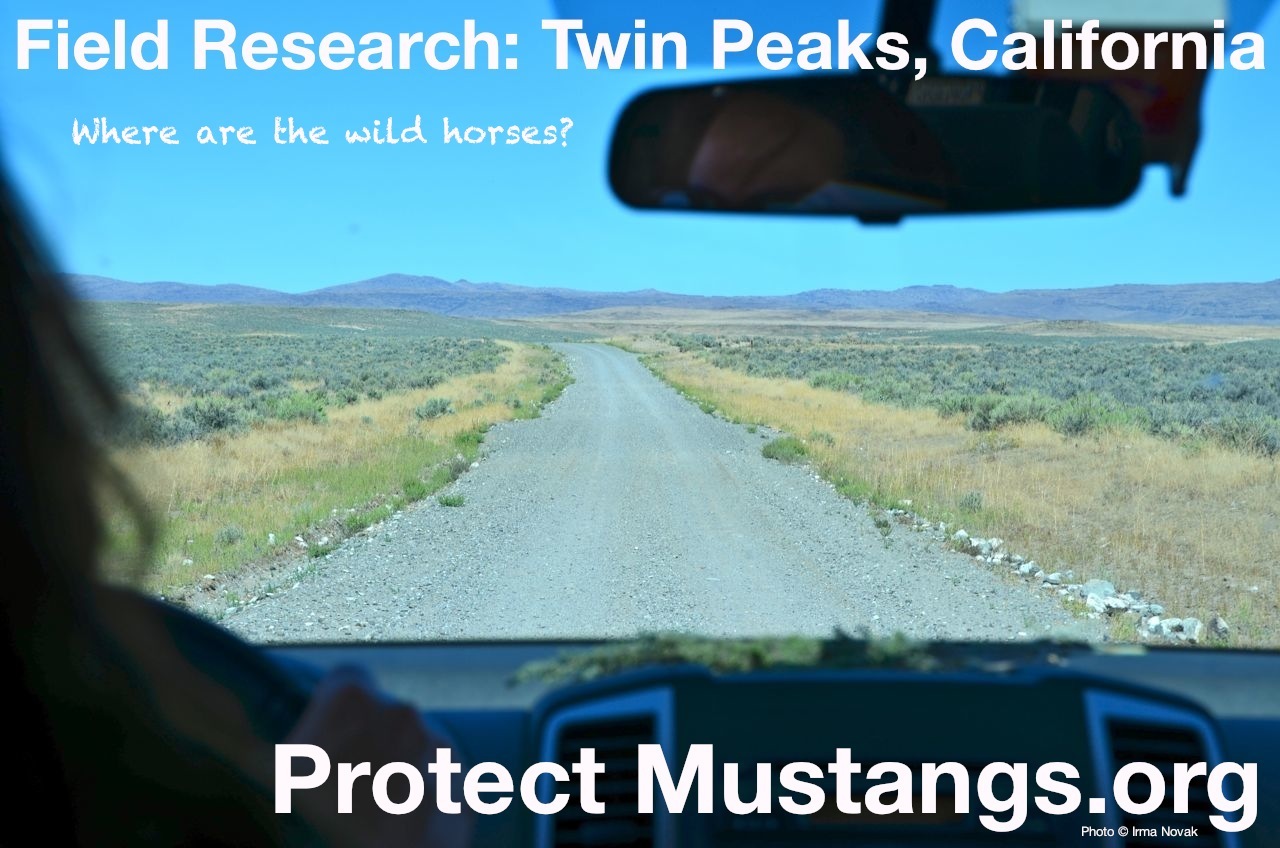
How many are left in freedom? 50,000 are stockpiled in government holding facilities. We call for a moratorium on roundups for population studies. This is urgent!
A big thank you to Cindy A. Lee of Wags and Menace Make a Difference Program Foundation for sponsoring our trip! We are so grateful that Cindy A Lee realizes how important scientific field research is to protect America’s heritage–America’s wild horses.

Dr Friedlander, DVM, visits wild horses in the wild (Photo © Irma Novak, all rights reserved)
“I’d like to know, where are all the wild horses?” ~Dr. Lester Castro Friedlander, DVM.
Below is an excerpt from Dr. Friedlander’s comments today at The Wild Horse & Burro Advisory Board Meeting in Arlington, Virginia.
“I just returned from an extensive trip to observe wild horses in their natural environment as well as in captivity. After traveling hundreds of miles in California and Nevada on the Twin Peaks and Pine Nut ranges, I’d like to know what all the overpopulation hype is about? I only saw one band of 4 horses, including 1 foal in the Pine Nuts range and 10 wild horses in the Twin Peaks 800,000 acre range. Out of the 10 wild horses I saw only 2 that were foals.
. . . I am here today to call for an immediate moratorium on all wild horse and burro roundups so the government will conduct population studies on each herd management area in the West.
We need population evidence, not sketchy population data and not skewed birthrate statistics showing a species fearing extinction and thus reproducing to prevent extinction. The National Academy of Sciences report shows “no evidence” to justify BLM’s overpopulation claims. It’s time for real science and real data . . . ”
September 4, 2013
The BLM is considering a modification to the current fertility plan it uses to control the number of horses on the Pryor Mountain Wild Horse Range. The new plan will significantly increase the number of mares darted with the fertility drug PZP.

Photographer Kassi Renner captures a great image during a rare sighting of the famous stallion Cloud as he takes a flying leap across some rocks on the Pryor Mountain Wild Horse Range.
Courtesy photo
According to language in a scoping report released in the spring of 2013, the goal of the new plan is to treat “nearly all of the mares” on the range with the fertility drug, theoretically rendering them infertile for a period of time. Currently a group of mares in the 5-10-year-old range are not treated with the drug and remain able to reproduce on the range.
Since the 31,000-acre range is fenced, the number of horses must be kept in check to prevent a negative impact on the land and to preserve the limited resources the horses themselves require for their own survival. The BLM plan is to maintain an appropriate management level (AML) of 90-120 wild horses on the range, by means of a carefully planned fertility program.
The original fertility plan, which was implemented in May of 2009, calls for treating a significant number of mares using a system of darting the horses with the drug PZP, which, in theory, renders the mares infertile for one breeding period (approximately one year).
The mares must first be primed with one dose and then darted with second dose before they are rendered infertile. In the opinion of some wild horse advocates, like Matthew Dillon of the Pryor Mountain Wild Mustang Center (PMWMC) in Lovell, not darting the mares in the 5-10-year-old cohort preserves the long-range survival of the herd by preserving certain historic blood lines and maintaining genetic diversity of the herd. Dillon has worked very closely with the BLM in recent years to share his extensive knowledge about the various bloodlines and has made many recommendations to the BLM (which they have adopted) regarding which horses can be safely removed from the range to preserve those bloodlines. He noted that the use of PZP is not a foolproof system and has in a few instances rendered mares completely infertile after just one dose and in other cases not rendered certain mares infertile at all. Mares that have received repeated doses have sometimes lost their ability to reproduce altogether.
“One of the reasons we don’t like the modified program is that we know anything can happen out there on the range,” said Dillon. “Right now we are not having a lot of foal deaths, but that can change. One of the reasons we like the conservative approach of the current program is that we always have that core group of mares that we can count on to reproduce if repopulating becomes necessary due to some natural cause.”
Dillon said he prefers to see the BLM stick to the more conservative approach by leaving certain mares out of the program and doing smaller gathers of 10 or fewer horses to manage the herd.
The PMWMC went on record with the BLM this week in a letter signed by all of its board members expressing their opposition to the plan, stating that “the long-term sustainability of the herd should be the primary management goal…with maintaining primary bloodlines as an objective.”
“I think the plan puts the needs of the horses being removed above the needs of the horses remaining on the range,” said PMWMC board member Nancy Cerroni.
Cerroni acknowledged that the typical 50 horses removed in a gather can be difficult to adopt out, but she said she believes that finding more adoptive homes is the answer, not limiting the breeding population.
“I really don’t think we’ve tapped into all of the avenues for adopting in today’s horse world,” she said. “I think if the problem is getting the horses adopted out that are removed from the range, we should work on that problem as opposed to creating a new problem with a more aggressive fertility program.”
The existing five-year plan, which is scheduled to end in 2015 has significantly reduced the number of horses on the range, but it has not eliminated the need for gathers and the subsequent need to adopt out the horses removed from the range. Some advocates like Ginger Kathrens of the Cloud Foundation, a wild horse advocacy group based in Colorado, say the adoption process has become problematic in that it is becoming more and more difficult to find homes for the horses that are taken off the range. Kathrens, who in the past has been adamantly opposed to the use of PZP on the mares, went so far as to recommend an increase in the number of mares that are darted with PZP in order to reduce the need for removal of horses from the range.
“I am concerned about how difficult it was to get the last group of horses adopted out that were removed from the range during the most recent gather in 2012,” said Kathrens. “In 2009, I saw about 100 people at the auction looking to adopt horses. This year it was more like 40 and many of those were from the same family. There were many instances where horses were not being bid on at all, and some were going for as little as $125. I had to get on the phone and call everyone I knew to get the horses adopted out this time. I just don’t know that I can do that again. That’s why I suggested a more aggressive treatment program using PZP. It’s the only alternative I see right now that is in the best interest of the horses.”
Kathrens said her preference would be to allow nature to take its course, with herd reduction occurring through predation by mountain lions. She noted that more frequent hunting of mountain lions in recent years has significantly impacted that natural cycle, causing more foals to survive than would normally occur.
“My preference would be to see the fence come down, a bigger population of active predators like mountain lions controlling the size of the herd and a return to survival of the fittest,” said Kathrens. “Unfortunately, that’s not realistic right now.”
She noted that, ironically, she is involved in a lawsuit against the BLM regarding the fence but feels she is forced to actually collaborate with them on the issue of the fertility program in the best interest of the horses.
“I think it’s best for horses to live and die on the range,” said Kathrens. “Even in cases where that horse, as a foal, may only live a few days. It is, in my opinion, better for that horse to have lived and died on the range.”
Kathrens sent a letter to the BLM on behalf of the Cloud Foundation in the spring stating, “The Cloud Foundation (TCF) recommends the more effective use of the well-vetted, remotely delivered, reversible one-year vaccine, PZP (Porcine Zona Pellucida) for mares in the Pryor Mountain Wild Horse Range (PMWHR), with the goal of eliminating removals or limiting future removals to 10 young horses or fewer every four or five years.”
The BLM incorporated the Cloud Foundation’s suggestion to increase utilization of the PZP program in their new plan, which calls for modifying the current fertility control prescription to apply fertility control to “nearly every mare on the PMWHR through 2015 in order to help maintain the appropriate management level of 90-120 wild horses and to reduce the need for a large scale gather.
Kathrens said the goal of TCF is to see mortality and reproduction of the herd roughly equal over time. She referred to this as a type of “on the range management,” that TCF advocates for all the herds, not just the Pryor Mountain herd.
“We advocate for the protection of predators–as a form of natural management,” she explained. “From 2001 to 2005, this objective was met on the Pryors, until BLM managers encouraged the hunting of mountain lions and the natural balance was destroyed.”
The modified plan is under a 30-day public review and comment that will end on Sept. 6, 2013. If adopted, the plan will immediately go into effect in September of 2013.
Kristen Lenhardt of the BLM said that the public comment gathering by the BLM during the review period is taken very seriously and is oftentimes incorporated into the final decision made by the BLM.
“Now is a critical time frame for the public to comment,” said Lenhardt. “We encourage the public to submit their comments and suggestions so we can take them into consideration when making this important decision.”
The documents are available for public review on the Billings field office of the BLM website: http://www.blm.gov/mt/st/en/fo/billings_field_office/wildhorses/pryorherd.html. Instructions for submitting comments are also available on that website.
by Patti Carpenter


Cindy A. Lee makes a difference on a national scale
DENVER, Co (September 3, 2013)–Unsung hero, Cindy A. Lee, president of the Wags and Menace Make A Difference Foundation, known on Petline 9, saved a total of 43 wild horses from going to alleged slaughter from the contested Fort McDermitt roundup. The Denver-based nonprofit first saved 34 wild mustangs from alleged slaughter at the livestock auction in Fallon, NV on August 17th. The following week they saved 9 unbranded wild horses who were held up along with 140 others in a legal action that was eventually dismissed. All 43 wild mustangs saved were given veterinary care including vaccinations and care for injuries caused by the roundup and transport to the auction. The McDermitt 43 shipped out and arrived yesterday at two sanctuaries in California. There they will live out their lives in peace and be forever free from harassment.
“This is our American heritage and what’s happening to the wild mustangs is wrong”, says Cindy A. Lee. “My foundation and I will work to save them from harm.”
The Wags and Menace Make a Difference Foundation is a not-for-profit 501(c)(3) organization that seeks to provide medical treatment for sick animals in Colorado and the United States, to fund organizations and activities that benefit animals, and to inspire, teach, and motivate other individuals and organizations to achieve similar objectives. http://www.wagsandmenace.org/
“Without Cindy A. Lee’s heartfelt work these national treasures would end up on a dinner plate abroad,” states Anne Novak, executive director of Protect Mustangs.
Cross-posted from: http://wildinthepryors.com/2013/09/03/help-the-pryor-herd-today/
This is not just CLOUD’S HERD, but the PRYOR HERD. There are so many more horses that deserve just as much if not more attention. This herd is now in danger of being “managed to extinction” by PZP. A phrase that The Cloud Foundation used to live by.

Nye
In 2010 The Cloud Foundation released this:
Observations of PZP contraceptive use in the Pryors
Cross-posted from The Cloud Foundation
TCF does not support or recommend the continued use of the experimental immunocontraceptive drug, PZP, for the Pryor Wild Horse Herd because the drug continues to have an unusual and unpredictable impact on the mares that have received the drug.
PZP treatment was first administered to young females (seven yearlings and one two-year-old) in 2001 when they were given shots in the corrals after a roundup in September 2001. The drug was designed to extend one year of infertility to this group. It was given in two consecutive years. The second year the drug was administered via field darting.
Of these eight young mares, one died and four have foaled. The only two-year-old, Moshi, foaled in 2002, as she was already pregnant. Moshi didn’t foal again for 6 years until her out-of-season filly was born in September 2008.
Of the six remaining yearlings, four have produced a foal. Of the four foals, three were born in September. Administration of PZP was stopped on younger mares in 2005 due to a natural decrease in population largely because of mountain lion predation, and the unexpected absence of foal production by the young mares.
Nearly 50% of the young mares receiving the drug in the years 2001-2004 have never foaled. Of the 34 young mares to receive the drug between 2001-2004, 11 have died, 13 have foaled and 12 have not foaled. Two veterinarians (from Switzerland and Colorado) have independently expressed the same concern to us: mares not producing foals at a typically younger age (i.e. three-seven years) will have a more difficult time conceiving. They point out that this is true not just in horses but in humans as well as other species.
Of the 13 young mares that have foaled, eight foals have been born out of season, including three in September of 2008 alone. One foal born in September, never grew to full-size and was subsequently bait trapped and adopted out in September 2006. Another foal, born to Cecelia, #2224, a mare darted as a yearling and two-year-old in 2003 and 2004, was born in December of 2006. The majority of Pryor Mountain mares foal from May 15- June 15.She didn’t foal in 2007 and then foaled in September of 2008.
Photo evidence attests to the masculine and aggressive behavior of certain PZPed fillies as well as the masculine appearance of Aurora #2036. She has a stallion-like cresty neck and physique. It is obvious that the hormones of these young mares have been altered by PZP.
Of 21 older mares (11 years of age and older) given PZP from 2003-2007, 57% or 12 mares have foaled in spite of the field darting with Porcine Zona Pellucida. Only 43% or nine mares have not foaled (drug worked as designed). One mare, Tonopah #8603, produced a foal at the age of 21 in 2007.
Aside from the cruelty of raising a newborn foal going into a Montana winter, the drug has had other negative side effects in the form of abscesses, bleeding, and swelling on the hips of field darted mares. Of the 54 mares listed on the PMWHR Injection and Reaction Observations –updated June 2007 (BLM-03262), 41 mares are listed with swelling, nodules, bleeding or a combination of all these. 20 mares still have visible signs of nodules even years after they were injected. One mare, Hightail #8901, had an abscess from darting in 2007 which has since healed on its own.
Phoenix #9104 had a major wound at the location of an injection site lump from the last field darting prior to the observed wound. Photo comparisons indicate the wound, which appeared in June 2007 matches the left hip nodule from a previous darting with PZP. (Photos included). The mare and her foal were captured and treated in the corrals at the base of the mountain. Upon release to her band, the abscess looked to be healing although the mare had lost weight while in the Britton Springs corrals. Despite continued weight loss, the mare survived a long winter with deep snow at times, and looks remarkably fit at present.
The BLM has reported that density dependence (the ability for a wildlife population to self-regulate its numbers based on available resources) and compensatory reproduction (over-production by females to increase an under-represented population) have taken place on the Pryor Wild Horse Range. In other words the older mares that continue to reproduce despite the use of PZP are responding to an under-population. Generally the core reproducers as well as the older females share this burden. One older mare, Madonna #8913, who has been darted with PZP yearly since 2003, foaled in June 2007. The foal appeared to have trouble suckling and milk ran out its nose when nursing. The foal likely died during the night, as she was not with her mother the following morning.
To our knowledge this is the only herd in the West to receive PZP via field darts (Assateague Island off the coast of Virginia uses field darts with few reported problems). We believe that the many problems with swelling, bleeding and abscessing may be partially blamed on field darting. The projectile is shot through unclean surfaces on the hips of the mares.
Of the original group of young mares given the shot by hand while in the corrals, only one had any swelling. The other seven had no swelling, nodules or abscesses. This compares with 41 of 54 mares (a staggering 76%) with reported swelling, nodules and bleeding from at least one field darting experience. 43% of the mares darted in 2007 have nodules or bleeding and one mare had an abscess (Hightail #8901).
According to scientific reports, not all darts are recovered. Some needles may break off and remain in the mare where they could cause later abscessing. Significant problems may not be immediately observed, rather bacteria may linger and the problem area might be walled-off for some time then suddenly emerge as in the case of Phoenix #9104. This was mentioned as a possibility by four of the six equine veterinarians with whom we consulted. These veterinarians practice in California, Oregon, and Colorado and were asked for their opinions regarding the efficacy of field darting mares in the PMWHR, the potential hazards of this practice, and the possibility for a late abscess to appear months after the darting. One veterinarian expressed concern that the mare was darted again, thereby placing more strain on the immune system. Phoenix is one of the older mares who has produced a foal despite being darted.
Ironically, the initial stated reason for the administration of PZP by BLM was “purely from the standpoint of compassionate use”. Compassionate use was defined as “the use of the tool (or in this case a fertility control agent) to improve the quality of life of another (in this case younger or older wild mares).” (BLM Field Manager, Sandra S. Brooks-June 3, 2004). BLM sought to prolong the life of the older mares by causing them not to foal and to delay the foaling of the younger mares for one year.
The stated goal of the scientific community regarding an ideal wild horse fertility control agent was that it should be “at least 90% effective” (Wild Horse Contraceptive Research document, 1991 USGS website, posted 2-21-06). While the drug appears to be over 90% effective on Assateague Island, it has not performed in a similar manner in the Pryors. It has not prevented the foaling by a majority of the older mares and it has prevented foaling by the majority of the younger mares, in some cases, for seven years.
Most importantly, instead of trying to manage the Pryor Mountain Wild Horses in a natural way, allowing for a predator-prey balance and only conducting a roundup when truly necessary, wild horse managers opt for the use of PZP in combination with helicopter roundups and bait trapping. These policies threaten the health of the unique Spanish mustangs of the Pryor Mountains.
In addition to the statistical analysis of PZP use, it is hard not to comment on the social stress placed on both mares and their bands stallions when the mares cycle monthly and are repeatedly bred but do not settle. In July of 2008, we witnessed one young mare (#2315) being bred three times in a fifteen-minute period while she struggled to get away. Mares that cycle monthly attract the attention of bachelors and other band stallions on a regular basis and the stallion expends energy both in defense of his mare and in breeding her. This social unrest has not been reported on Assateague Island, but is easily observed in the Pryors, when individual horse bands come in close proximity to each other during the summer months.

Nirvana
Now they issue this:
|
|||||||||||||||||||
|

Maneulita
You can Click TCF to read the original post. I ask TCF to explain.
The Pryor Mountain Wild Mustang Center has released their comment and concerns for this proposal. These folks have had years more experience with these horses then TCF. I ask you to please read their comment and compare. Click on PMWMC to read it. Then ask yourself: ”Who Knows This Herd Best?”
This is the comment I sent in. While I do agree and work with PMWMC, I am still asking for no change to the current program at this time.
August 28, 2013
Jim Sparks, Field Manager BLM Billings Field Office 5001 Southgate Drive Billings, MT 59101
Dear Mr. Sparks,
I am writing in regard to the Bureau of Land Management’s recently released Pryor Mountain Wild Horse Range Fertility Control Modification Preliminary Environmental Assessment August 2013 (DOI-BLM-MT-0010-2013-0034-EA).
I am a Montana resident, permit holder (within the Pryor Range) and very frequent visitor to the Pryor Mountain Wild Horse Range.
I do not support the current Proposed Action in the Fertility Control Modification (2.1 Proposed Action) for the following reasons:
1. Long-term herd sustainability should be a primary management goal for the Pryor Mountain wild horses. The 2009 HMAP has stated that maintaining representation of all bloodlines is a major objective. The 2011 fertility control plan and 2012 gather plan have been consistent with this and the other objectives of the Plan, such as maintaining a core breeding age population.
2. By exposing fillies to PZP for four consecutive years there is an increased risk of sterility in this potential core breeding age group. (example would be Aurora, # 20036, who was primed as a yearling, vaccines in 2009 and has never foaled).
3. Allowing each mare to have only one descendant runs the risk of loss of important bloodlines and may greatly effect the genetics of this herd. This herd has a unique history and bloodlines, and preserving those bloodlines is very important. The Pryor Mountain Wild Horse Range is not the Assateague Island National Seashore, and so the fertility control plan developed there should not be assumed to be appropriate here.
4. I feel that the current fertility plan is beginning to show favorable results. Last year (2012) there were 25 foals born and this year (to date) only 15 (13 surviving). I would
like to see this current program remain in place. I would rather see small removals (of 10 or less) then to have a too aggressive fertility program that may greatly effect this herd.
5. One of the recent publications by an advocacy group, suggested there is no market for the adoption of Pryor Horses, and that was their reason for an increase in the PZP program. I disagree with that and realize that adoption should be a separate issue that should be addressed separately, not making it the reason to increase the current fertility plan. The PMWMC and I have discussed several ways that may help with a successful adoption and we plan to work together in the future to make that happen.
Thank you for considering my comment.
Sincerely,
Sandra P. Elmore
Wild In The Pryors
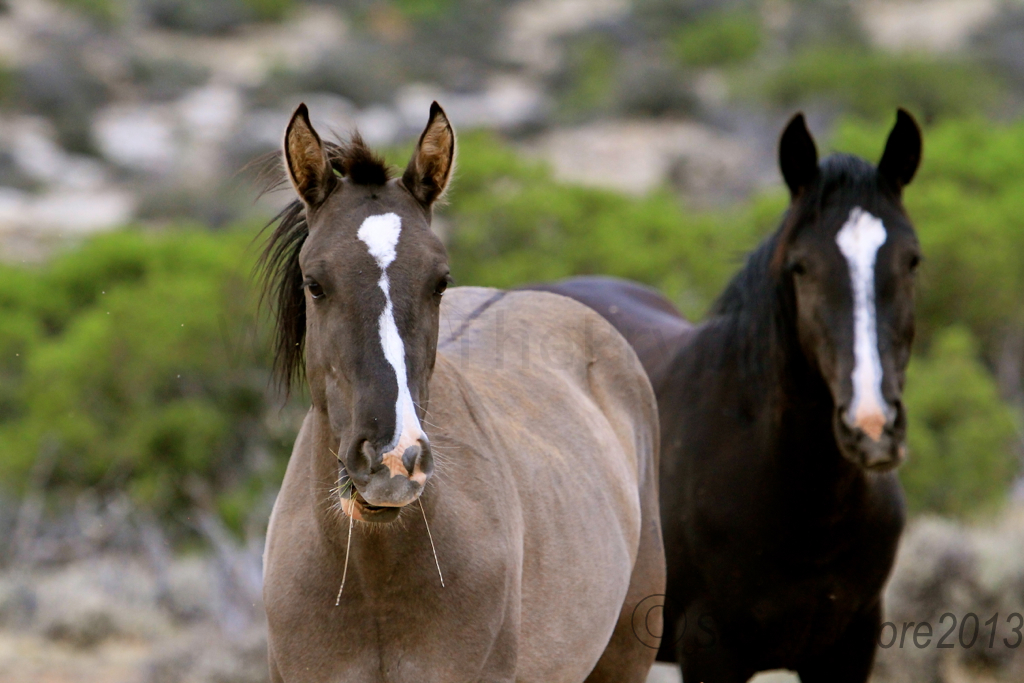
Mercuria
I ask you to please submit a comment against any changes to the program at this time.
You can send your comments to:
Jim Sparks, Field Manager BLM Billings Field Office 5001 Southgate Drive Billings, MT 59101
Or email to make sure it gets there:
blm_mt_wildhorse@blm.gov
Thank you.
Sandy


