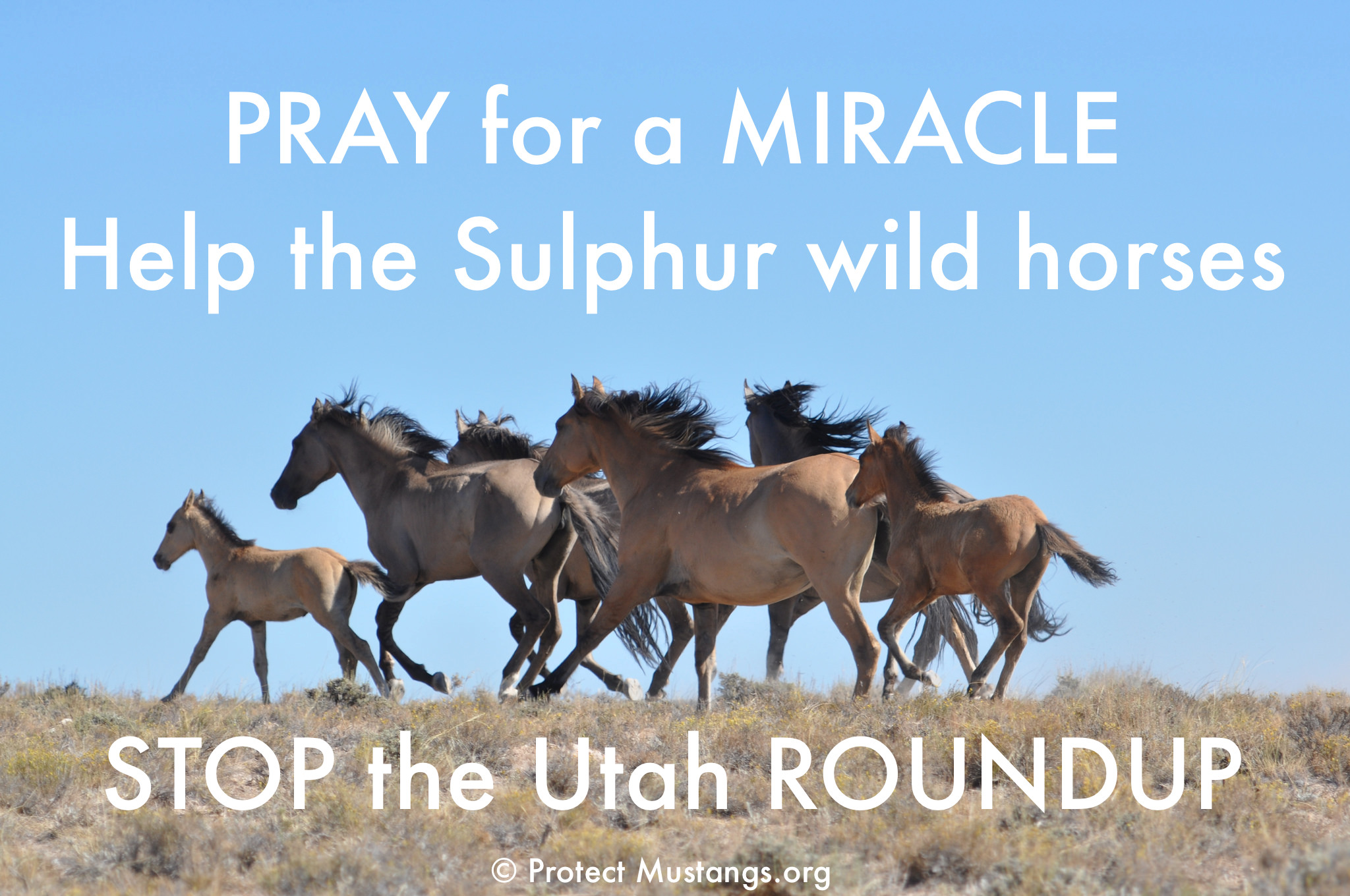
PZP = Roundups = wild horses living behind bars

PM PZP Truth

Spin as they may the TRUTH always shines! This is why the Fish Creek wild horses ended up behind bars at the BLM holding facility. If the BLM and PZP Advocates had not pushed to PZP the mares they would have been left alone–wild & free: http://magicvalley.com/news/local/blm-holds-off-on-plan-to-return-mustangs-to-range/article_36ed5800-bb78-11e4-82d9-879763fdc267.html

(Top photo by Patty Bumgardner no copyright on photo or meme. Sharing for educational purposes only)

The truth

PZP EPA Sterilisant

Comments needed on BLM’s proposed collection of information on wild horses and burros

Stop the Roundups!


Roundups occur to PZP the wild mares with a pesticide for birth control!


PZP EPA Sterilisant


 Send in your public comments and be a voice for America’s wild horses and burros! Ask for management levels to rise for genetically viable herds to survive and for holistic management for all Herd Management Areas. Speak for the voiceless today.

NOTICE FROM THE DEPARTMENT OF THE INTERIOR

Bureau of Land Management

[15XL1109AF LLWO260000 L10600000.PC0000 LXSINASR0000]

Proposed Collection of Information on Wild Horses and Burros; Request for

Comments.

AGENCY: Bureau of Land Management, Interior.

ACTION: 60-day notice and request for comments.

SUMMARY: In compliance with the Paperwork Reduction Act, the Bureau of Land

Management (BLM) will ask the Office of Management and Budget (OMB) to approve

the information collection (IC) described below, and invites public comments on the

proposed IC.

DATES: Please submit comments on the proposed information collection by May 11, 2015.

ADDRESSES: Comments may be submitted by mail, fax, or electronic mail.

Mail: U.S. Department of the Interior, Bureau of Land Management, 1849 C Street, NW,

Room 2134LM, Attention: Jean Sonneman, Washington, D.C. 20240.

Fax: to Jean Sonneman at 202-245-0050.

Electronic mail: Jean_Sonneman@blm.gov.

Please indicate “Attn: 1004-NEW” regardless of the form of your comments.

FOR FURTHER INFORMATION CONTACT: Sarah Bohl at (202) 912-7263.

Persons who use a telecommunication device for the deaf may call the Federal

Information Relay Service on 1-800-877-8339, to contact Ms. Bohl. You may contact Ms. Bohl to obtain a copy, at no cost, of the draft discussion guides for the focus groups and in-depth interviews described in this 60-day notice. You may also contact Ms. Bohl to obtain a copy, at no cost, of the regulations that authorize this collection of information.

SUPPLEMENTARY INFORMATION:
I. Proposed Information Collection
Title: Knowledge and Values Study Regarding the Management of Wild Horses and Burros.
OMB Control Number: 1004-NEW.
Frequency: On occasion.
Respondents’ obligation: Voluntary.
Abstract: The BLM protects and manages wild horses and burros that roam Western public rangelands, under the authority of the Wild Free-Roaming Horses and Burros Act (Act), 16 U.S.C. 1331-1340. The Act requires that wild horses and burros be managed in a manner that is designed to achieve and maintain a thriving natural ecological balance on the public lands. 16 U.S.C. 1333(a). Stakeholders and the general public hold a variety of views on how wild horses and burros should be managed. The BLM has determined that conducting focus groups, in-depth interviews, and a national survey will lead to a better understanding of public perceptions, values, and preferences regarding the management of wild horses and burros on public rangelands.
After reviewing public comments and making appropriate revisions, the BLM will include the discussion guides in a request for OMB approval. Upon receiving OMB approval, the BLM will conduct the focus groups and in-depth interviews. The results of focus groups and in-depth interviews will be used to help design a national survey, which will be the second and final phase of the research.

The BLM will prepare a draft of the national survey and publish a second 60-day notice and invite public comments on the draft national survey. After reviewing public comments and making appropriate revisions, the BLM will include the national survey in a request for OMB approval. Upon receiving OMB approval, the BLM will conduct the national survey.

Need and Proposed Use: The proposed research was recommended by the National Research Council of the National Academy of Sciences in a 2013 report, Using Science to Improve the BLM Wild Horse and Burro Program: A Way Forward. Conducting the focus groups and in-depth interviews will enable the researchers to characterize the range of preferences that exist for wild horse and burro management. The national survey will then assess the distribution of these preferences across the larger population. The research results will assist the BLM to more effectively manage wild horses and burros by providing information to:

  • Help evaluate the benefits and costs of competing rangeland uses and variousmanagement options;
  • Help identify areas of common ground and opportunities for collaboration with stakeholder groups; and
  • Communicate more effectively with the public and with stakeholder groups.Description of Respondents: The BLM intends to survey a variety of respondents for this project by conducting focus groups, in-depth interviews, and a nationally representative survey. For the focus groups and in-depth interviews, the primary respondents will be individuals belonging to a variety of organizations that have previously lobbied, commented on program policy or activities, or have otherwise sought influence with the BLM in regard to its wild horse and burro program. Representatives of wild horse and burro advocacy groups, domestic horse owners, wild horse adopters, the Western livestock grazing community, environmental conservationists, hunters, and public land managers will be included. Nine focus groups across three locations around the country and up to 12 in-depth interviews will be conducted with individuals from these groups. Focus group participants will be recruited by BLM’s research contractor through a variety of approaches tailored to the communities participating in the discussions. In addition, four focus groups (spread across two locations) will be conducted with the general public to explore public understanding of various terms and issues involved in wild horse and burro management so that the questionnaire for the national survey can effectively communicate the relevant topics.

II. Estimated Reporting and Recordkeeping Burden

The estimated reporting burden for this collection is 142 responses and 272 hours. There will be no non-hour burdens. The following table details the individual components and estimated hour burdens of this collection.

Activity

Estimated

number of respondents

Estimated number of responses per respondent

Completion time per response

Total burden hours

Focus Groups

130 (13 groups)

1

120 mins

15,600 mins/260 hrs

In-depth Interviews

12

1

60 mins

720 mins/12 hrs

Activity

Estimated

number of respondents

Estimated number of responses per respondent

Completion time per response

Total burden hours

Totals

142

272 hrs

III. Request for Comments

OMB regulations at 5 CFR 1320, which implement provisions of the Paperwork Reduction Act (44 U.S.C. 3501-3521), require that interested members of the public and affected agencies be provided an opportunity to comment on information collection and recordkeeping activities (see 5 CFR 1320.8(d) and 1320.12(a)). The BLM will request that the OMB approve this information collection activity for a 3-year term.

Comments are invited on: (1) the need for the collection of information for the performance of the functions of the agency; (2) the accuracy of the agency’s burden estimates; (3) ways to enhance the quality, utility and clarity of the information collection; and (4) ways to minimize the information collection burden on respondents, such as use of automated means of collection of the information. A summary of the public comments will accompany the BLM’s submission of the information collection requests to OMB.

Before including your address, phone number, email address, or other personal identifying information in your comment, you should be aware that your entire comment — including your personal identifying information — may be made publicly available at any time. While you can ask us in your comment to withhold your personal identifying information from public review, we cannot guarantee that we will be able to do so.

Jean Sonneman,

Bureau of Land Management, Information Collection Clearance Officer.

15 08:45 am; Publication Date: 3/12/2015]

4310-84-P


http://www.gpo.gov/fdsys/pkg/FR-2015-03-12/pdf/2015-05623.pdf

Debate rages over the use of birth control on wild horses & burros

PM WY BLM Corral small

The debate about the use of birth control on wild horses and burros is coming to the forefront.
The question looms why should current population numbers be suppressed with birth control when there are only half the number present now than in 1971 when they were first protected.

The 1971 law is explicit in saying the animals were fast disappearing from the American scene and that there should be minimal management of the animals. When population counts were done in 1974, there were nearly 50,000 animals based on a counting system that drastically undercounted the animals by today’s standards. Today we are lucky to have 30,000 animals.

The National Academy of Sciences (NAS), whose report was released in 2013, noted that BLM‘s management practices are facilitating high rates of population growth by holding horse populations below levels affected by food limits. “If population density were to increase to the point that there was not enough forage available, it could result in fewer pregnancies and lower young-to-female ratios and survival rates,” according to NAS.

ISPMB’s horses have held their own even with good feed conditions. An example is the Gila herd that began with 31 animals and 14 years later, they have crested to 100 animals. If these were BLM horses, this year we should have 248 horses. ISPMB’s studies have shown that the stability of the harems has led to reduced growth rates. This means that the harems should not be disrupted by removals, separating stallions from mares. We know that once that happens, the stallions lose their mares to younger stallions being released back onto the herd areas.

Bottom line is that roundups whether for removal or birth control injections causes the same problem – increase in fertility rates due to the disruption of the harems. The future for best management practices by the BLM should be in bait trapping when removals are necessary, keeping the harems intact. Even though it is more time intensive, the overall costs in removals and warehousing animals would be and would have been drastically reduced.

The argument against the use of birth control continues for the following reasons: animals would have to be treated yearly which means that the harems would be disrupted constantly. And adding to their disruption, instead of only 50-60% of the animals gathered during a usual roundup, the majority (90%) of the herds must be gathered to implement birth control. This means that there would be almost no harem that wouldn’t be disrupted! The result again, increase in fertility rates from disruption. So combating growth rates by using contraception actually increases rates!

We know that permanent infertility can happen after five years of application of the drug to the same animal. And we don’t know the far reaching effects of the long-term use of the drug on modeling behaviors for the animals or any side affects if foals were to be born to mares that have received long-term treatments.

The final and most important argument against the use of birth control is that we as human beings must select who breeds and who does not breed. In the domestic horse industry, we have failed miserably as breeders of horses. One can easily point to the Quarter Horse Industry where the average age of soundness is seven years, the age of a horse just entering its prime of life. That means at age 8 and older, horses are breaking down due to having too much weight on legs that can’t support the weight. Nature has provided the best breeding program available for wild horses and that being “survival of the fittest.” One just has to look at the legs of a wild horse compared to any other breed of horse. And we know they are generally healthier and happier.

If BLM were to manage wild horses by not disturbing them, they would do more to hold down birth rates in the long run. Removal of “excess” wild horses/burros should only be done by bait trapping to ensure that wild horses and burros truly remain wild. Sadly, instead of feasible minimal management, we now are at maximal intrusive management.

(Note: ISPMB does not discourage the use of birth control in sanctuary settings where horses live together in families and will never breed again.)

Cross-posted from: http://ispmb.org/BirthControlDebate.html

URGENT: Get your comments in by midnight against using PZP on the Onaqui mares in Utah


Send in your own comments before midnight against giving the restricted use pesticide, PZP, made from slaughterhouse pig ovaries today! Email them to blm_ut_cedarmt_onaqui@blm.gov

Marybeth Devlin’s extensive comments will give you some ideas but it’s important to send in your comments using your own words. Keeping it short and sweet is fine. The point to get across is that you don’t what them to be drugged up with an EPA pesticide that sterilizes after multiple use, no roundup and no removal. Request BLM incorporates holistic management for successful management of wild horses on public land.

Comment by Marybeth Devlin

Via email: blm_ut_cedarmt_onaqui@blm.gov
March 6, 2015
Bureau of Land Management
Salt Lake Field Office (SLFO)
2370 South 2300 West
Salt Lake City, UT 84119

Attn: Pam Schuller, Environmental Coordinator
Project Name: Onaqui Mountain Wild Horse Fertility Control Plan EA

Document: Environmental Assessment

NEPA ID: DOI-BLM-UT-W010-2014-0021-EA
Dear Ms. Schuller:

I have reviewed the subject EA and associated documents regarding the plan to continue, and more aggressively apply, the contraceptive Porcine Zona Pellucida (PZP), also known as ZonaStat-H, on the fillies and mares of the Onaqui Mountain Wild Horse herd. I am submitting substantive comments and new information that SLFO would do well to consider. Other information is discussed that you already know, or should know, but on which you have failed to act. For ease of reference, below are the links to the …

News Release

http://www.blm.gov/ut/st/en/info/newsroom/2015/february/blm_seeks_public_comment0.html

Environmental Assessment — 2015

https://www.blm.gov/ut/enbb/files/Onaqui_Fertility_Control_EA_2_18_15.pdf

Cedar Mountain and Onaqui Mountain Wild Horse Herd Management Areas Capture, Treat and Release Plan Fertility Control with Limited Removal — 2012

http://www.blm.gov/style/medialib/blm/ut/natural_resources/wild_horses_and_burros/cedar_onaqui.Par.87472.File.dat/FinalEA.pdf
NEPA-RELATED ISSUES
Public Scoping — Notice Buried — No News-Release — Only 2 Comments

The EA claims that, prior its publication, the required public-scoping was conducted. However, instead of issuing the standard news-release, BLM restricted notification of the scoping-period to a posting on the “Utah BLM Environmental Notification Bulletin Board” (ENBB). However, how would the public know to look on this ENBB, when it is not even one of the options on Utah-BLM’s online “Information Center”?

Not surprisingly, the EA reports that only two comments were received, both in support of BLM’s intensified fertility-control plan and for “managing wild horses on the range within AML.” And who were the two parties that submitted comments in support of birth-control for the Onaqui wild horses and for keeping them within AML?

The first was Iron County, whose commissioners had threatened last July — following the Cliven Bundy standoff — to round up wild horses themselves. Advised that doing so was illegal, Commissioner Dave Miller then co-sponsored a resolution for the states to take over management of the wild horses and burros.

http://www.deseretnews.com/article/865606266/Rural-Utah-will-take-wild-horse-fight-to-New-Orleans-Washington.html?pg=all

The second comment was from the State of Utah Public Lands Policy Coordination Office, an activist-agency whose goal is to “retake ownership” of Federal land. Here’s the link to an article about the PLPCO, aptly titled “The Wild Bunch”.

http://www.cityweekly.net/utah/the-wild-bunch/Content?oid=2159976

How curious that these entities were the only ones who were successful in learning about the scoping period. Did BLM staff alert them to check the ENBB — and where to find it?

What the inadequate number of scoping-comments evidences, is that BLM-SLFO did not provide proper notice but instead, buried that notice where it where it would be hard to find. There are many wild-horse advocacy-organizations that certainly would have submitted comments concerning SLFO’s proposed management-plan for the beloved Onaqui mustangs — if they had known the scoping period was open.

Corrective Action: SLFO needs to restart this process. Re-open the scoping period and properly notify the public. SLFO needs to compile an ample number of diverse comments. The Wild Horse and Burro Program is national in its constituency. Input regarding its management cannot be limited to a few local anti-wild-horse entities.

Public-Comment Period for the EA — Reduced 50 Percent

As if the secretive posting of the scoping notice were not bad enough, SLFO is providing only 14 days for comments on this EA. The standard period is 30 days. By shortening the comment-period by half, SLFO appears to be limiting public-input for a second time — now at the EA-stage of the process.

Corrective Action: This EA must be rescinded until SLFO has completed the re-opened scoping process. Then, when SLFO issues a revised EA per the scoping, a full 30-day comment-period must be offered for public-input. However, to save everyone’s time, the best action is to select the “No Action” alternative, which appears to be the correct path, as is evident by an analysis of the facts.
BLM’S PLANS INTENSIFIED USE OF PZP ON THE ONAQUI MOUNTAIN HERD
BLM’s Proposed Action

The EA seeks to implement a fertility-control plan through the year 2020 to limit the Onaqui herd to 160 wild horses. The current AML ranges from 121 to 210 horses; thus, 160 is below the midpoint between the low and high bounds. The EA says that the short-term goal is to reduce population-growth to “less than seven percent” while the long-term goal is to reduce the need for roundups and removals. To achieve this reduction, SLFO would use the one-year formulation of PZP, and field-dart “select mares.” The darting would be conducted on foot, the EA says, but then clarifies that 4×4 vehicles and off-highway vehicles (OHVs) would be used to “access” the Onaqui HMA. Bait-trapping would be used as deemed necessary.

This is not the first time that Onaqui fillies and mares have been subjected to PZP. Previously, however, the formulation used was PZP-22.

How the Plan Would Work

Starting in late March or early April 2015, SLFO staff would begin vaccinating yearling fillies (which BLM refers to as “mares”) with a “primer” PZP-dose. About 30 to 60 days after that initial injection, staff would administer a second “booster” shot to the fillies. The need to give the second injections within a certain time-frame suggests the fillies might need to be gathered and held captive during that interval.

From then on and for the next five consecutive years, “one-year PZP” inoculations would be given. Once a filly-becoming-a-mare reached the age of 6, PZP would be suspended until she produced “a live foal,” after which she would be contracepted “for the remainder of her natural life.” Mares that had previously been vaccinated with PZP — which was the PZP-22 formulation — would receive annual boosters in the time-frame of November through February, but would be subject to dosing at any time of year.

The EA is ambiguous regarding how treated mares would be “identified” for staff-use in the field. Reference is made to a “photo database” and to identification “by color, face, leg, and coat pattern markings.” But mention is also made of mares to be “individually marked,” and that a “number of the horses have a hip brand as well as neck brands from previous PZP treatments.” Thus, it is possible that SLFO will disfigure the Onaqui fillies and mares with huge freeze-marks on the hip for staff’s administrative convenience. If so, persons visiting the HMA will have their experience spoiled by the hideous four-inch-high brands on the fillies and mares’ coat.

The “No Action” Alternative

As required by NEPA, BLM presents a “No Action” option. Per this alternative, SLFO would defer the plan to gather and contracept the Onaqui herd to a later time. Until then, SLFO would continue to monitor the HMA’s vegetation and the herd’s population.

The “No Action” alternative is actually the best option. Suspend contraception and let natural processes function as they will. Allow a natural ecological balance to revive and thrive in the Onaqui Mountain HMA.
SAY “NO” TO PESTICIDES
PZP — A Pesticide that Is Also a Bio-Hazard

It is inappropriate to treat our wild horses as pests. But that is exactly what BLM does when it injects wild mares with PZP. Rather than being a medicine, PZP — also known as ZonaStat-H — is classified as a pesticide, a contraceptive used on horses labeled “pests.”

Further, PZP is a biohazard, as reflected in the warnings, excerpted below, which are included in the Environmental Protection Agency’s fact-sheet.

Personal Protective Equipment requirements include long sleeved shirt and long pants, gloves and shoes plus socks to mitigate occupational exposure.

A warning that pregnant women must not be involved in handling or injecting ZonaStat-H and that all women should be aware that accidental self-injection may cause infertility.

http://www.epa.gov/pesticides/chem_search/reg_actions/pending/fs_PC-176603_01-Jan-12.pdf

Meta-Analysis Reveals the Risk of Sterilization from ZP Contraceptives

A recent study-of-the-studies — that is, a meta-analysis — was performed of the research-findings with regard to different contraceptive methods. Among the drugs analyzed were various zona pellucida (ZP) formulations. As it turns out porcine zona pellucida (PZP), from slaughtered pig-ovaries, is not the only ZP contraceptive in use. For instance, a particular ZP vaccine was derived from the ovaries of possums.

The meta-analysis disclosed that ZP contraceptives often result in sterilization, which appears to be caused by ovarian dystrophy, destruction of oocytes in all growing follicles, and depletion of resting follicles. Here are some salient excerpts [with emphasis added] that give rise to concern regarding ZP-contraceptives:

The irreversibility associated with immunization using ZP posed a major hurdle in the development of ZP based contraceptive. While irreversibility is not a major concern in case of wildlife management where long term infertility is often desirable. Therefore further development in this area resulted in production of various marketed products playing an imperative role in wildlife management.

Further studies revealed that the infertility induced in immunized female rabbits was irreversible which could not be restored even after the administration of exogenous gonadotropins. Histological examination of ovaries showed the destruction of oocytes in all the growing follicles along with the depletion of resting follicles. This observation indicated that the infertility was a consequence of ovarian dystrophy rather than inhibition of sperm-oocyte interaction.

The immunization of female bonnetmonkeys was carried out using purified porcine ZP3. High antiporcine ZP3 antibody titers were formed and all the animals were rendered infertile. Only 50% of the animals could regain fertility after the decline in antibody titers.

Significant curtailment of fertility was also observed by using recombinant possum ZP3 in grey kangaroos. Though the results were quite exciting, histological examination of ovaries of immunized animals revealed the presence of atretic follicles with degenerating oocytes.
Saunders Comprehensive Veterinary Dictionary, 3 ed. explains what an “atretic follicle” is:

Definition: atretic follicle — an ovarian follicle in an undeveloped state due to immaturity, poor nutrition or systemic disease; manifested by prolonged anestrus.

http://medical-dictionary.thefreedictionary.com/atretic

It is reasonable to conclude that PZP, whether Native PZP or PZP-22, likely has a similar effect on the ovaries, oocytes, and follicles of wild mares. Thus, permanent loss of fertility — even after one inoculation — can result.

Important: The meta-analysis’ finding that “… infertility was a consequence of ovarian dystrophy rather than inhibition of sperm-oocyte interaction” appears to disprove the theory posited by ZooMontana, which supposed that PZP “antibodies then bind to eggs in the mare’s ovaries and effectively block sperm binding and fertilization …” (cited in the EA). The new findings show that PZP works not by blocking the sperm but by degenerating the ovaries. Given these findings, PZP should be abandoned for use in wild horses.

The meta-analysis report can be accessed at the link below.

http://downloads.hindawi.com/journals/bmri/2014/868196.pdf

Earlier Meta-Analysis Disclosed PZP Side-Effects

The meta-analysis linked below was published in the journal Reproduction. Studies of the side-effects of different wildlife contraceptives, including PZP, were reviewed. [Once on the site, page down to the sidebar on the right of your screen next to “Abstract” and click on “Results” and then on “Discussion.”]

http://www.reproduction-online.org/cgi/content/full/139/1/45

Listed below are the findings with regard to PZP:

1. Males lose body condition while the oft-claimed improvement in female body condition did not hold up.

2. Females experienced increased irritability, aggression, and masculine behavior.

3. Mares remained sexually active beyond the normal breeding season and had more “estrus events.”

4. The possibility of “selecting for immuno-compromised individuals” is raised.

5. Finally, the analysis questions the supposed benefit of mares living much longer than their normal life expectancy.

With regard to Finding Number 4 above, by continuing and even intensifying the use of PZP, SLFO could be selecting for immuno-compromised horses. If a disaster were to strike the Onaqui Mountain herd, fertility would need to be quickly restorable. PZP would work against saving the herd if it experienced a stochastic event.

With regard to Finding Number 5 above, interestingly, the EA cited PZP’s correlation with extended longevity of mares as if it were a benefit. Yet, for purposes of genetic sustainability, increasing the number of long-lived — yet sterile — mares would be disadvantageous to a herd, especially one like Onaqui, which is so low in population already.

Potential Adverse Effects of PZP on a Developing Embryo or Fetus

Recall the EPA’s warning that pregnant women must not be involved in handling or injecting ZonaStat-H. If a mare is administered PZP when she is pregnant, might not her unborn foal be adversely affected by the drug even if the pregnancy itself continued? If the embryo or fetus were female, might the vaccine negatively impact the baby’s reproductive system pre-birth? Might her developing ovaries experience dystrophy? Might she become masculinized as a result? Might she never produce foals, thereby eliminating any genetic contribution on her part? If the embryo or fetus were male, might his reproductive system be affected, considering that the testes correspond to the ovaries?

Until these questions can be answered definitively, PZP should not be used on wild horses, whose numbers are already so low that they could qualify as an endangered species.

Potential Adverse Effect of PZP on Yearling Fillies

At one year of age, fillies are just reaching puberty. Is it ethical to subject them at that tender age to a vaccine that will wreak havoc with their ovaries, perhaps sterilizing them permanently? Is it right to masculinize a herd’s fillies?

PZP — Unintended Consequences and Social Disruption

BLM’s proposed action would treat both fillies and mares with the Porcine Zona Pellucida (PZP), a 95-percent-effective contraceptive pesticide. This misguided plan endangers the Onaqui Mountain herd’s long-term survival. The PZP contraceptive is not without risk and can have unintended consequences, such as:

If fillies and mares are in excellent health and condition at the time they are treated, PZP can cause too strong an immune-response, resulting in long delays in restoring fertility or outright sterilization after even the initial treatment. Multiple injections are likely to result in irreversible loss of fertility. That could be one reason why PZP is not used in humans. Note that SLFO intends to administer multiple, consecutive injections.

Ironically, PZP works less well in mares that are in ill health or poor condition — they are likely to conceive despite PZP treatment. Thus, the fittest mares don’t reproduce while the least fit ones — the immuno-compromised — often do. Ironically, PZP selects for horses with a weak immune system.

PZP does not prevent ovulation and does not change mare behavior toward stallions. As a result, mares suffer repeated, stressful, futile breedings while the band-stallions have to battle continuously to keep their always-in-estrus mares.

Out-of-season pregnancies and births occur due to the wearing off of the drug at inopportune times. Foals born at the wrong time of year may not survive, and the mares’ health may be endangered as well.

There are reports of mares treated with PZP becoming masculinized. Previously, the reason for this effect was unknown. But in light of the new finding that PZP causes ovarian dystrophy, that would explain the masculine behavior. Much-less-than normal amounts of estrogen would be produced by the mares’ withered ovaries. Ironically, even though PZP is touted as a non-hormonal contraceptive, it appears to result in hormonal imbalance.

Mares on PZP are less faithful to their family-band, changing allegiance over and over. Such chaos disrupts normal behavior and band-membership continuity. Band-fidelity is crucial to the survival of its members, particularly the foals.

The EA indicates that BLM is aware of these adverse effects. However, by merely describing the findings of various studies, and by failing to abide by the findings that disagree with the proposed plan, BLM shows itself to be ignoring the science.

Body-Condition Improvement Could Lead to Gender-Ratio Imbalance

The EA cites a study that noted the improved body-condition of mares whose reproduction had been curtailed via PZP. This effect is cited as if it were a good thing. However, a study of mares’ body-condition and their subsequent foaling-record, showed that mares in good or improving condition tend to foal colts, while mares in poor or declining condition tend to foal fillies. The difference is significant. The researchers found that 97 percent of mares who were losing condition at time of conception foaled a filly, while 80 percent of mares who were gaining condition when they conceived foaled a colt. Therefore, PZP may correlate with an improvement in body-condition but lead to a lopsided gender-ratio favoring males

http://www.australianwesternhorseshowcase.com.au/Features/nz-study.html

Coincidentally, a visitor to the Onaqui HMA in 2013 remarked on the obvious gender-imbalance of the horses. “It seemed to me that the sex ratio of the herd was quite skewed with many more males than females ….”

http://mollyshoofjourney.blogspot.com/2013/07/my-visit-to-onaqui-mountain-mustangs.html

However, other studies have not found that PZP helped mares be in better body-condition. Those studies found a decline in body-condition for stallions with no improvement in body-condition for mares.

Slow Return to Fertility Acknowledged in EA

The EA cites two studies, both by the developer of PZP, that reported the average time it takes PZP-treated mares to recover their fertility. The mean is 3.7 years, but could be as long as 8 years. Because SLFO plans to contracept fillies and mares for five consecutive years, if those mares do regain fertility, they would, on average, be about 10 years old, but they could be as old as 14. This long delay could result in their perishing of natural causes before ever giving birth.

The EA goes on to note, apparently with curiosity but not concern about the risk of sterilization:

The same study demonstrated that mares treated from one to five consecutive years returned to fertility, but mares treated for seven consecutive years did not. There could be some differences seen with the Onaqui horses as they have received the experimental drug PZP -22 and the mares in the study on Assateague Island have been given just the liquid form or ZonaStat–H.
NATURAL SELECTION
Pumas instead of PZP

What population control is superior to PZP? Pumas. There can be no “thriving natural ecological balance” without apex predators. Mountain lions, wolves, and other such carnivores effectively control wild horse populations by targeting the weak, the sick, the young, and the old. Predators ensure survival of the fittest, as Nature intends. Therefore, the best approach is for BLM to concentrate on promoting and then protecting native predators to permit natural control of the wild horse population on the range.

A puma-conservation program would tend to strengthen the herd, and it would save costs. Concerned livestock operators and nearby residents could use guardian-dogs to protect their animals. There are several specialty-breeds that have been developed just for this purpose, and they are reportedly effective. BLM might even consider buying a number of trained guardian-dogs which, per a neighboring rancher’s request, could be placed with herds or flocks experiencing attacks.

Mountain Lions Are Effective Population-Control Agents for Wild Horses

Many studies have established that mountain lions prey on wild horses more frequently than previously believed. Canadian biologists found that cougars tended to kill younger animals, especially when preying on feral horses. Nearly all of the cougars’ predation-events (86%) involved animals less than 2 years old. That would take care of those six unwanted foals.

http://sci-northern.ab.ca/wp-content/uploads/2010/12/CougarKillRateandPreyComposition.pdf

In an interview with the Billings Gazette, the above study’s lead researcher, Kyle Knopf, described observing a cougar that brought down a feral horse in less than 30 yards from where it attacked.

http://billingsgazette.com/lifestyles/recreation/article_d9cf046b-2c47-539f-a267-972e72e570b6.html

Other research confirms that mountain lions are quite capable, all by themselves, of keeping wild horse populations in check. Longitudinal studies have shown that mountain lions alone successfully controlled the wild-horse population of California’s Montgomery Pass Wild Horse Territory (Turner and Morrison, 2001) and the Nevada Wild Horse Range (Greger and Romney, 1999).

Interestingly, mountain lions also used to keep the Pryor Mountain herd in check until BLM had the lions exterminated in order to experiment in managing the herd using a contraceptive pesticide.

Here is more information in regard to the research on mountain lion predation on wild horses:

The Montgomery Pass Wild Horse Territory, on the California/Nevada border, has had its ppopulation managed by cougars alone. An eleven-year study concluded that the growth of this herd was limited by cougar predation. In fact, the population actually decreased over the course of the research.

http://www.jstor.org/discover/10.2307/3672527?uid=2129&uid=2&uid=70&uid=4&sid=21101018535373

The Nevada Wild Horse Range (current designation) averaged negative population growth due to cougar predation from 1989 to 1998 (Greger and Romney, 1999).

https://ojs.lib.byu.edu/ojs/index.php/wnan/article/viewFile/941/1745

Per The Cloud Foundation, the Pryor Mountain herd averaged no population growth over a four-year period due to predation by mountain lions. Only when those lions were killed — so that BLM could continue practicing management of the herd with PZP — did the wild-horse population begin to grow.

Healthy Predators, Healthy Ecosystems

Minimum feasible management means letting natural selection do its job. Mountain lions, wolves, bears, and coyotes should be allowed to carry out their role of population-control agents. Predators will cull the weak, and a thriving natural ecological balance will ensue. Conservation Researcher Dr. Corey Bradshaw emphasizes “… just how important predators are for healthy ecosystems. Long story short – if your predators are not doing well, chances are the rest of the ecosystem is performing poorly.”

Due to pressure from livestock and hunting interests that mistakenly view predators as pests, it has been the Federal government’s practice to exterminate native predators outright or to allow them to be hunted on a massive scale. That policy is wrong. Predators function to keep the ecosystem in balance. Without them, prey species decline, as do the forage-production species on which the prey-animals feed. Dr. Bradshaw warns: “Without predators, our feeble attempts to conserve ecosystems are doomed to fail.” Here’s the link to his timely article:

http://conservationbytes.com/2012/11/21/essential-predators/#more-8024

Predator Protection

The HMA should be a safe-haven for predators, which will serve as wild-horse population-control agents.

There can be no true “thriving natural ecological balance” without predators. Therefore, BLM should ensure the protection of native predators, instituting a prohibition on hunting them. Conservation measures will work to enable the right number of predators to establish themselves. Large carnivores will keep the wild-horse population in check. Such an approach would favor survival of the fittest, the best genetic adaptations, and keep the herd-populations in equilibrium with minimal human-interference, just as the Wild and Free-Roaming Horses and Burros Act envisioned. Predators are the “no-cost” option.

Recommendations: SLFO should concentrate on promoting and then protecting native predators to enable natural control of the wild-horse population on the range. A puma, bear, wolf, and coyote-protection program should be implemented. BLM should collaborate with the Utah Division of Wildlife Resources to prohibit hunting of predators in the HMA. Concerned livestock operators and residents of the surrounding area should be advised to use guardian-dogs to protect their animals. There are several specialty-breeds that have been developed just for this purpose, and they are reportedly effective. Protecting one’s herd is just part of the cost of doing business.
GENETIC HEALTH AND LONG-TERM VIABILITY
Onaqui Herd — Gene-Pool Changed by Introduction of Mustangs from Other Herds

The EA describes and later reiterates how SLFO has intervened over the years to inject new bloodlines into the Onaqui herd’s gene-pool:

To ensure the genetic diversity of the herd, the Salt Lake Field Office in 2005 released approximately 10 stallions and 10-15 mares from other HMA’s outside the state and from within the state. Since the large release in 2005, we have every 3-4 years released another 3-5 horses into the HMA.

Past actions that have affected the genetic diversity of the herd are: from 2005 to 2011 the SLFO has released horses from other HMA’s to ensure the genetic diversity of the herd is not lost and/or increased. In 2005 there were approximately 10 stallions and 15 mares released. Since then we have also released 3–5 mares every 3–4 years. The released horses came from other states as well as other HMA’s within Utah.

These practices evidence that SLFO’s population-management-approach is a failed strategy. If transplantation / translocation of wild horses from other HMAs — and even from other states — is necessary to support genetic viability, then the Onaqui herd is not genetically self-sustaining but is instead BLM-sustaining. Thus, SLFO is in violation of the Act and its implementing regulations by failing to provide for a self-sustaining herd.

The solution is to allow a higher population, per scientific guidelines.

BLM — Too Involved in Selecting Horses to Go, Horses to Stay

Natural selection is the way a wild-horse herd should be molded. Human-directed selection of which horses will be allowed to breed, when, and how often, interferes with natural processes. Therefore, it is cause for concern that the EA states

In the future SLFO would be proposing to do selective removals with bait trapping. While doing the bait trapping we may gather horses that we don’t want to remove. Salt Lake Field Office staff will be on site to determine if the horses caught in the trap should be removed or not.

Thus, BLM is essentially running a breeding program instead of letting Nature determine those horses best-suited for survival. This is not — and should not be — BLM’s role. Further, the projection of future removals, in spite of the ongoing, massive contraception that SLFO proposes to use on this herd, evidences that PZP does not prevent wild horses from losing their freedom.

Genetic Analysis of the Onaqui Mountain Herd

Per Section 6.1 “References Cited,” the most recent genetic analysis on the Onaqui Mountain herd was conducted seven years ago — in 2008. There have been two gathers with removals and fertility-control actions taken since then. Now, SLFO is planning intensified contraception in the absence of genetic data.

Dr. Cothran’s 2008 report was not included as an attachment, and the EA is silent as to his findings. The fact that SLFO has repeatedly imported wild horses from other HMAs and other states to increase the Onaqui herd’s genetic diversity suggests that Dr. Cothran’s analysis showed a decline in genetic variability. In such cases, Dr. Cothran typically recommends an increase in the population. However, if resources do not permit an increased population, then injecting new bloodlines is a last-ditch resort. Although the resources of the Onaqui Mountain HMA should easily accommodate a viable population, SLFO has opted to truck in horses from other HMAs. Surely this is an example of maximum meddling instead of minimal management.

Recommendations: SLFO needs to conduct a 100-percent evaluation of the Onaqui Mountain herd’s genetic health per DNA samples tested by the Equine Genetics Lab. Per those results, and per guidance from Dr. Cothran, and per consultation with wild-horse-and-burro advocates, BLM must then develop best management practices to restore and maintain gene-pool diversity via a robust population-level. An AML is valid only if it provides for an optimal population — one that can easily self-sustain its genetic viability and bounce back from random catastrophic events. Saying that the Onaqui herd must be kept “within AML” is not a meaningful statement because the current AML does not provide for a self-sustaining, genetically-viable herd. Therefore, BLM has no valid justification for contracepting any fillies or mares in the Onaqui HMA. It is not scientifically valid to contracept in ignorance — without regard to the herd’s genetics. Submitting DNA samples after-the-fact is out of order. The correct order is:

Sample first.
Sample large — 100 percent
Sample regularly — every year
Test samples.
Manage per test-results.

There should be no management-decisions made without knowledge of the genetic profile for each herd-member.

No Impacts to Genetic Diversity?

The EA makes the following claim about the effects of its PZP-plan: “No possible impacts to the genetic diversity of the herd as all horse would have a chance to reproduce.” A chance? SLFO evidently has not thought through its proposal because the PZP-plan would likely diminish genetic diversity to the point of causing the Onaqui herd to go extinct.

Half of wild foals perish before their first birthday (Gregg et al., 2014). So, the chances are 50:50 that a mare restricted to one live foal would lose her genetic contribution. If her foal were a colt, and if he did survive to adulthood, he might never sire an offspring, resulting in both his own and his dam’s genetic contribution being zero. If the foal were a filly, and if she managed to survive to adulthood, she might well already be sterile from multiple, consecutive PZP injections, resulting in both her own and her dam’s genetic contribution again being zero. At the herd-level, genetic diversity would decline steadily, as has been the case for years now. BLM’s plan constitutes management-to-extinction.

BLM — Wrong Assumptions regarding Wild-Horse Reproduction

The EA assures itself that …

Due to the relatively long time between generations (~10 years) and the long reproductive life-span of individual horses, the loss of genetic material from the herd is relatively slow and able to be monitored and mitigated by management.

Equine reproduction is indeed a slow process. If she’s lucky, a mare may produce one foal a year. Living in the wild, a mustang-mare will likely lose that foal before it reaches its first birthday. She herself may perish. All that is bad news for genetic viability at the herd-level. Hence, an optimal population is necessary. A self-sustaining herd should not need monitoring and mitigation by management.

AMLs Should Provide for Better Than MVP, but Must Provide for At Least MVP

BLM is required by law to manage the wild horses in self-sustaining herds. To be self-sustaining, a herd must be genetically viable. To achieve viability, sufficient population is necessary.

A scientifically-valid AML needs to comply with the recommendations of the International Union for Conservation of Nature (IUCN) regarding minimum-viable population (MVP) for equids. An “appropriate management level” (AML) should have a baseline — a starting point — of at least 2,500 horses. This level is the recommendation of the IUCN, the world’s oldest and largest global environmental organization. The IUCN is a neutral forum for practical solutions to conservation challenges and a leading authority on the preservation of genetic diversity in wild equids, including feral horses and burros. The IUCN notes that the selective pressures wild equids have endured in the wild are likely shaping them genetically to be hardy stock that could prove useful as a genetic resource.

http://data.iucn.org/dbtw-wpd/edocs/1992-043.pdf

Because neither the present AML nor the most-recent population-figure reaches the minimal threshold of 2,500 individuals, the Onaqui herd is under-populated. The number of horses must be increased accordingly.

Onaqui HMA — Utah — AML, and Acres per Wild Horse — Current

AML: 121 to 210 — Below minimum-viable population

BLM acres: 206,878 — which is approximately 323¼ square miles

Acres per wild horse: 1,063 – 1,610 — about 1⅔ to 2½ square miles per horse
Onaqui HMA — Utah — AML, and Acres per Wild Horse — Recommended

AML: 2,500 — Meets minimum-viable population per IUCN

BLM acres: 206,878 — which is approximately 323¼ square miles

Acres per wild horse: 83 — about 8 horses per square mile

Restore Original Onaqui Mountain Herd Area

The current HMA was carved out of a much larger herd area (HA). In that process, BLM took away 168,969 acres of wild-horse habitat. The HA needs to be reinstated as Onaqui herd habitat. The restored acres will easily support the needed increase in herd population.

Restored Herd Area acres: 375,847 — which is about 587¼ square miles

IUCN-size minimum population: 2,500 wild horses

Acres per wild horse: 150 — about 4 horses per square mile

BLM’s National Authorized Livestock AUMs

But can a restored HA of 375,847 acres sustain 2,500 or more wild horses at 150 acres per horse? Can the current HMA of 206,878 acres sustain 2,500 or more wild horses at 83 acres per horse? BLM’s approach to authorizing appropriate levels of livestock-grazing suggests the answer to both questions is “Yes”.

Below are the National statistics for authorized commercial livestock-grazing on BLM lands per animal-unit months (AUMs). Note the stocking rate: One cow or calf per 38 acres.

157,000,000 acres of public lands on which BLM allows cattle

1,033,333 cow+calf pairs that BLM permits to graze = AUMs annualized

2,066,666 cow+calf pairs per typical 6-month permit = annual AUMs x 2

4,133,332 cows and calves = pairs x 2

38 acres per cow or calf

PRINCIPAL USE
HMAs Must Be Managed Principally for Wild Horses and Burros

HMAs are wild-horse habitat-zones. Wild horses must enjoy principal use of their HMAs. This requirement is stated plainly in the Wild and Free-Roaming Horses and Burros Act, which stipulates that their land is to be “devoted principally but not necessarily exclusively to their welfare ….” Thus, HMAs do not necessarily have to be managed exclusively for wild horses … although they can be. However, HMAs must be managed principally for the welfare of our heritage-horses.

Moreover, multiple-use does not mean every-conceivable-use. Incompatible uses can be excluded, as Secretary Jewell testified during her Senate hearing after being nominated. Some examples of incompatible uses appear obvious — mining and off-road vehicles. HMAs should be designated “no surface occupancy” (NSO) areas — to preserve aesthetic and recreational values and to avoid disturbing the horses’ natural behavior. HMAs should also be declared “off-limits” to off-highway-vehicles (OHVs) — to protect the peace-and-quiet of the range and the cleanliness of the ambient air.

Onaqui Mountain HMA is not being managed according to the Law because the wild horses are not allotted principal use of their habitat. Livestock — like locusts — devour the HMA’s resources. The wild horses have been displaced by encroaching livestock.

This inversion must be righted, and SLFO must employ the right mechanisms to do so. First, SLFO needs to rescind this EA. Then, it must amend the Land-Use Plan (LUP), Resource Management Plan (RMP), the Final Multiple-Use Decision (FMUD), and the Herd Management Area Plan (HMAP) to conform with the Law.

Disproportionate Allocation of Forage Must Be Corrected

What is wrong with this picture?

12,097 — Monthly grazing units (AUMs) allotted to livestock in the Onaqui HMA

2,252 — Maximum AUMs allotted to wild horses in the Onaqui HMA

Livestock have been awarded nearly 5½ times more grazing slots than the wild horses have been within the HMA. (Data on livestock AUMs found on pdf-page 17 of the 2012 Cedar Mountain and Onaqui Mountain Wild Horse Herd Management Areas Capture, Treat and Release Plan.) This proportionment is obviously inverted. It must be corrected. The Onaqui wild horses must receive the majority of the grazing slots — the animal unit months (AUMs) — within their HMA.

Authorized v. Actual Livestock Use

BLM may argue that actual livestock use is lower than authorized or permitted use. But because actual use is whatever the permit-holders report on Form 4130-5, and because BLM essentially takes the permit-holders’ at their word and bills accordingly … eventually … after-the-fact … maybe … or maybe not — see Bundy, Cliven — the actual-use number is unverified and likely grossly under-reported.

And what has Mr. Bundy been up to lately? Since the Federal authorities backed down, he has “really enjoyed some liberty and freedoms out here.” Translation: He continues grazing his cattle on the same public lands where he hasn’t paid grazing fees in 20 years. Reportedly, those unpaid fees are now up to $1,200,000.

http://www.washingtontimes.com/news/2014/dec/29/rancher-cliven-bundy-still-grazing-his-cattle-on-d/?page=all

Actual Grazing Use Report — Form 4130-5

As alluded to above, permittees are required to submit an annual report of how many livestock they put out on their respective allotments and for how long. Form 4130-5 “Annual Grazing Use Report” is used for this purpose. It’s a one-page document that BLM estimates to take 15 minutes to complete “… including the time for reviewing instructions, gathering and maintaining data, and completing and reviewing the form.”

http://www.blm.gov/style/medialib/blm/noc/business/eforms.Par.2064.File.dat/4130-005.pdf

http://www.gpo.gov/fdsys/pkg/FR-2014-08-22/html/2014-20049.htm

Form 4130-5 is the basis on which BLM bills the permit-holders. It is also the basis for the claim of reduced-use. Thus, grazing-use is a self-reporting, self-certifying system that is rarely verified. The ease with which permittees could game the system is obvious. Consequently, the veracity of the reports is suspect.

Bundy-Supporting Permittee Grazed His Livestock beyond Authorized Use

In neighboring Nevada, permit-holder Kevin Borba, whose allotment includes land inside the Fish Creek HMA, engaged in unauthorized livestock-grazing “consistently for six months” outside the permitted use. He had his cattle out there year-round. He owes $29,410.62 in fees and fines for willful trespass, but has subsequently sued BLM over the loss of his “rights” and to stop BLM from returning any wild horses to the range following the recent gather.

Such abuses by permittees are likely widespread. Cliven Bundy and Kevin Borba are not alone in this regard. Utah has its share of rogue-ranchers too, as events last summer demonstrated.
POPULATION ESTIMATES
Historical Perspective on the Onaqui Herd’s Foaling-Rate

A Google-search to find background information on the Onaqui Mountain herd happened across an entry by kbrhorse.com. The article posted at the kbr site mentioned that, in 1991, a population-survey had been conducted. That census counted 169 horses — 158 adults and 11 foals. These results suggest a foaling-rate of 6½ percent.

http://www.kbrhorse.net/wclo/onaqui.html

No PZP was used back-in-the-day, yet the natural birth-or-survival rate was below SLFO’s goal for today’s Onaqui herd. Moreover, the herd has been contracepted since 2005 with powerful and long-lasting drugs. Yet, SLFO continues to estimate its population per growth-rates that are many times higher than was the case without the drugs.

Longitudinal Study Demonstrates Growth-Rate of Five-to-Ten-Percent

The International Society for the Protection of Mustangs and Burros (ISPMB) recently completed a 14-year study of wild-horse population-growth. The ISPMB herds have been managed per the “hands-off” minimum-feasible level specified in the Wild and Free-Roaming Horses and Burros Act.

Results: Although the ISPMB alludes to a 10-percent-per-year growth-rate, to be precise, the average annual growth-rates for ISPMB’s “White Sands” and “Gila” herds were, respectively, 5.08 percent and 8.73 percent. Herd-stability and the presence of older horses appeared to be key-factors in limiting each herd’s growth-rate. It is significant that, during the study-period, there were …

No removals
No predators
No PZP

Here is the link to the letter sent in this regard from ISPMB to the Department of the Interior and Bureau of Land Management.

http://www.ispmb.org/Letter.html

Below is the link to a recent post by ISPMB, citing the low population-growth of the Gila Herd. From a starting-population of 31, after 14 years, it reached 100 members. That growth reflects an average annual increase of 8.73 percent.

http://ispmb.org/BirthControlDebate.html

Per this study, BLM’s assumption of a consistent 20-percent annual growth-rate is questioned.

Independent Research Discloses a Ten-Percent Foal-to-Yearling Survival-Rate

A study of BLM roundup-records for a representative sample of four herd management areas was recently published (Gregg, LeBlanc, and Johnston, 2014).

http://protectmustangs.org/wp-content/uploads/2014/04/PM-Population-Growth-4.25.14-FINAL.pdf

The researchers found an effective foal-to-yearling survival-rate of just 10 percent. No matter the birth-rate, what counts is survival. The same pattern likely holds true for the Onaqui herd. Yet, SLFLO’s data painted a picture of a burgeoning population.

Onaqui HMA — Population and Gather Reports — Data Sources

Per a review of the …

HMA and HA Statistics reports for the Onaqui herd from 2005-2014,
Completed Gathers reports from 2009-2014, and the
Gather-and-PZP figures reported in the EA and associated documents,

discrepancies were found.

Onaqui HMA — Utah — Herd Population Changes — 2005 to 2015

The following chart merges the yearly population-estimates with the gather and contraceptive data to reveal how the numbers were calculated and where errors were made. The beginning-of-the-year figure for 2015 — the pre-gather estimate — is per the BLM’s News Release.

January 1
Max Beginning Month
Year AML Estimate R-up Done Foal-Crop and Other Figures, Estimates
2005 210 275 August ??? No data on foal-crop even
though a post-season gather
256 Rounded up
97 Released
56 Mares inoculated with PZP-22
41 Stallions and others
159 Must have been removed
19 Assumed to have escaped
9 Tacked on for reasons unknown
———————————————————–
125 Post-gather estimate = 97+19+9
38 Number added. Late foals?
Correction for not counting them
before the gather? Who knows.
PZP would not affect mares
already pregnant when inoculated.
———————————————————–
163 End-of-year estimate = 125+38

2006 163 + 3 BLM estimated foal-crop @ 2%
But PZP would not affect mares
already pregnant when inoculated.
Would have contracepted mares
that were “open” in August 2005.
———————————————————–
166 End-of-year estimate = 163+3

2007 166 + 24 BLM estimated foal-crop @ 14½%
PZP-22 at maximum effect or
still in effect, depending on mare.
———————————————————–
190 End-of-year estimate = 166+24

2008 190 + 38 BLM estimated foal-crop @ 20%
PZP would have had residual effect.
———————————————————–
228 End-of-year estimate = 190+38
2009 228 + 80 BLM estimated foal-crop @ 35%
October 308 Pre-Gather estimate = 238+80
218 Rounded up
184 Removed, including 2 fatalities
14 Mares given PZP-22.
9 mares retreated
5 mares treated for first time
20 Stallions, untreated mares released
90 Assumed to have escaped
————————————————————-
124 Post-gather estimate = 14+20+90
+ 12 BLM tacked on another 12,
resulting in a combined
growth-rate of 45%.
————————————————————-
136 End-of-year estimate = 124+12

2010 136 + 23 BLM estimated foal-crop @ 17%
… but that was per the added 12.
Foal-crop estimate per 124, with
12+23=35, would have meant 28%.
PZP would not affect mares
already pregnant when inoculated. ————————————————————- 159 End-of-year estimate = 136+23
2011 159 + 47 BLM estimated foal-crop @ 29½%
PZP was at maximum effect and
would have reduced the foal-crop.
————————————————————- 206 End-of-year estimate = 159+47

2012 206 February 186 Pre-Gather Estimate — lower by 20
155 Rounded up
34 Removed
1 Fatality
57 Mares vaccinated with PZP-22
22 mares retreated
35 mares treated for first time
63 Stallions or geldings (?) released
31 Assumed to have escaped
————————————————————-
151 Post-gather herd per the math
57+63+31 = 151
179 Post-gather herd per 2015 EA
206 Post-gather herd per gather-report
————————————————————-
+ 96 BLM estimated foal-crop @ 63½%
per 151 post-gather OR
+ 68 BLM estimated foal-crop @ 38%
per 179 post-gather OR
+ 41 BLM estimated foal-crop @ 20%
per 206 post-gather
————————————————————-
PZP-22 still in effect, however.
————————————————————- 247 End-of-year estimate

2013 247 + 17 BLM estimated foal-crop @ 7%
PZP-22 at maximum effect.
————————————————————-
264 End-of-year estimate = 247+17

2014 264 No other information available
2015 ??? No information available

The discrepancies identified herein cast doubt on the validity of the population-estimates. These errors must be reconciled before any decisions regarding birth-control or removal-actions are considered.

Societal Impact of Inflated Population-Data

The population-estimates for the Onaqui HMA are flawed, exaggerated. The political fallout of this error has been to keep the public in an uproar over an “overpopulation” that BLM’s faulty figures portrayed.

Recommendations: BLM needs to correct these errors and, more importantly, acknowledge them to the public. You must correct the record and make genuine efforts to stop this phony-story-gone-viral of a wild-horse population-explosion in Utah.

Mistakes Cost Wild Horses Their Freedom

The planned removals appear to have been hurriedly scheduled to placate the seditious elected officials and their rogue-rancher constituents, who are making a play for taking over the Federal lands in Utah. However, the wild horses must not lose their freedom merely so that BLM can kowtow to rebellious elements in the human population. If you “come clean” and admit your errors, it will tend to deflate the “head-of-steam” that the officials and ranchers are building due to the false appearance created by false figures.

Neither the First Nor the Second Time Estimates Were Found to Be Flawed

In May 2014, I submitted comments regarding the environmental assessment for Bible Spring Complex, which is located in Utah but is not under SLFO’s jurisdiction. Cedar City Field Office administers it. For the three HMAs and the one HA that compose the Bible Spring Complex, major discrepancies were disclosed — one-year growth-rate-estimates of 125%, 131%, 153%, 157%, and 249%.

Last week, I submitted comments on Cedar City’s “public health and safety” gather of over 100 wild horses from the Sulphur HMA. A review of the population-estimates for that herd disclosed that BLM had assumed an 87-percent herd-growth rate for a particular year in which PZP would have been at maximum efficacy.

A review of this EA disclosed many discrepancies that falsely made the Onaqui herd appear to be growing at implausible yearly rates. Numbers were increased arbitrarily and in spite of contraception being at full effect.

Thus, the errors uncovered across these BLM-Utah field offices regarding wild-horse population-estimates are not isolated instances. These disparities point to a systemic problem.

Recommendations: BLM needs to correct its mathematical errors and acknowledge those mistakes to the public. Elected officials, local permittees, and ordinary taxpayers need to know that the population-estimates previously announced for the Onaqui HMA were wrong. BLM must take responsibility and inform the public that it inadvertently portrayed an incorrect picture — an exaggerated picture — of the herd’s population.

SUMMARY OF CONCLUSIONS AND RECOMMENDATIONS
1. Abandon the use of contraceptive pesticides such as PZP on the Onaqui Herd.

2. Amend the land-use plans to provide a robust AML whose low-bound is 2,500.

3. Conduct a 100-percent evaluation of the Onaqui Mountain herd’s genetic status.

4. Conserve and protect native predators, especially mountain lions.

5. Restore the acreage of the original Onaqui Mountain Herd Area.

6. Adhere to the mimumim-feasible-management requirement of the Act.

7. Administer the Onaqui HMA for the principal use of its wild horses.

8. Correct the population-estimates and advise the public how much they were inflated.

———————————–

Sincerely,

Marybeth Devlin

Miami, FL 33155

BLM ignores stakeholders and schedules tour of 102 forcibly drugged mares at Fallon facility with short notice

PM PZP Syringe FB

Mostly insiders knew about the tour in advance of the general public

RENO, Nev. —The Bureau of Land Management (BLM) is offering a rare public tour of the Indian Lakes Off-Range Corral in Fallon, Nevada, March 7 without adequate public notice for all stakeholders. This is one of three facilities in Nevada that keep and process wild horses and burros removed from the range, including horses recently rounded up from the Fish Creek Herd Management Area in Eastern Nevada.

The tour is scheduled to begin at 11 a.m. Pacific Standard Time and last approximately two hours. The tour will accommodate only 20 people. Space will be filled on a first-come, first-served basis. The public can sign up to attend and get driving directions to the facility by calling the BLM at 775-475-2222. You may also call Jason Lutterman, 775-861-6614 to get a spot or email him at jlutterman@blm.gov or Brenda Beasley Cell: 775-315-5391
bbeasley@blm.gov

About a 90-minute drive east of Reno, the Indian Lakes Corral is located at 5676 Indian Lakes Road, Fallon, and is privately owned and operated. Tour attendees will be corralled in a wagon and taken around the facility hear BLM’s spin on the failing Wild Horse and Burro Program and the wild horses at Indian Lakes.

The few attendees will have the opportunity to observe 102 wild mares from the recent Fish Creek roundup. The native mares have been forcibly drugged with an EPA restricted-use pesticide made from slaughterhouse pig ovaries called PZP for Porcine Zona Pellucida. Their release was stopped by an Interior Board of Land Appeal filed by a disgruntled rancher and the Eureka Country commissioners. Now drugged with the pesticide that sterilizes after multiple use, the Fish Creek mares wait in limbo.

The public is becoming aware that PZP is part of the BLM’s final solution to manage wild horses to extinction.  Roundups will increase with PZP programs and evidently puts more wild horses at risk of never being “released”.

“The U.S. Bureau of Land Management is holding off on plans to return 186 wild horses to the range in central Nevada pending the review of an appeal filed by a rancher and rural county opposed to the move. . . Rancher Kevin Borba and Eureka County commissioners, who filed the appeal with the Interior Board of Land Appeals on Friday, oppose the return of any of the 424 horses to the range,” according to the Associated Press article from February 22nd.

With outrageously short notice, the Nevada BLM is hosting a public tour where only insiders have more than a few days notice.

The Indian Lakes Corral can hold up to 3,200 wild horses or burros who have been chased by helicopters, ripped from their families and removed from their native lands. The facility contains 43 large holding pens. Touted as a feedlot setting to fatten up wild horses “as fat as butterballs” the BLM proclaims they “don’t sell wild horses to slaughter”. Despite the public dis-information campaign, BLM has sold truckloads to slaughter middlemen such as the infamous Tom Davis who received more than 1,700 American wild horses–delivered at tax-payer expense.

Every time a wild horse is offered for adoption but is not picked they acquire a strike against them. With 3-Strikes they lose their federal protection and can legally be sold by the truckload according to the Burns Amendment to the 1971 Free Roaming Wild Horse and Burro Protection Act.

The BLM claims to the press and to congressional aides that they want to place wild horses into good, private homes yet they are notorious for making it hard to adopt wild horses. The Indian Lakes Corral is a prime example. It’s a private facility that is “closed to the public” with maybe two or three public access days a year open to only a small amount of people even though the contractor is paid with public tax dollars. The captives are funneled out to off-site adoptions where their chances of adoption are slim due to BLM’s poor marketing and rotten customer service. Every time wild horses aren’t picked at an adoption event they get another strike towards becoming wild horse sashimi abroad.


Links of interest™

BLM holds off on plan to return 186 mustangs to range in NV http://www.idahostatejournal.com/news/state/blm-holds-off-on-plan-to-return-mustangs-to-range/article_5eaf59ac-008c-5977-8f3a-491f9e9dad06.html

Tour announcement published March 5th in the Nevada Appeal: http://www.nevadaappeal.com/news/lahontanvalley/15305301-113/blm-schedules-tour-of-off-range-horse-corral


Sulphur roundup comments unveil the cruel scam Utah is running

Wild horses sold for Basashi Sushi (Horse Meat)

Wild horses sold for Basashi Sushi (Horse Meat)


Email: eburghar@blm.gov

copy: jpalma@blm.gov

February 25, 2015

Bureau of Land Management
Cedar City Field Office
176 East DL Sargent Drive
Cedar City, Utah 84721

Attention: Elizabeth R. Burghard, Cedar City Field Office Manager

Project Name: Sulphur HMA Public Health and Safety
Wild Horse Gather and Removal

Document: News Release

Link:

http://www.blm.gov/ut/st/en/info/newsroom/2015/february/public_safety_concerns.html
Dear Ms. Burghard:

I understand that your office has scheduled another roundup-and-removal operation pertaining to wild horses that allegedly have wandered outside the …

Sulphur HMA

… and that are, reportedly, posing safety-concerns along Highway 21.

I am submitting substantive comments and new information that BLM-Cedar City should consider. I urge you to cancel the gather, correct the population-estimate errors, investigate the validity of the accusations, complete an environmental assessment, fence Highway 21, and take other preventive measures.
REASONS CITED BY BLM FOR SPECIAL ROUNDUP
Overpopulation, Forage Limitations

BLM’s News Release identifies the issue as being wild horses “causing public health and safety concerns along Highway 21.” BLM lists overpopulation and forage limitations as the causes for the horses having allegedly migrated to the outer edge of the Sulphur HMA, near said highway.

The Proposed Action

BLM-Cedar City plans to round up and remove a total of 100 wild horses out of a population that BLM estimates at “approximately 830” (versus 250, the high-bound of the AML). The gather, scheduled to begin only days after issuance of the News Release and in the absence of an environmental assessment, would be accomplished via helicopter-drive. The roundup would supposedly target members of the Sulphur herd that are “encroaching on Highway 21.” But, given wild horses’ propensity to roam extensively, it is unclear how the true perpetrators would be identified.

The Issues

There are several important questions concerning the planned gather that BLM has not addressed.

What is the right solution for preventing vehicle-wildlife collisions?
What is the accurate estimate of Sulphur HMA’s wild-horse population?
Is there really an overpopulation? Has AML been exceeded?
Who has reported wild horses “along Highway 21”? Rogue ranchers?
How likely is it that 100 wild horses are encroaching on the highway?
Is the “public safety” excuse an end-run to skip an environmental assessment?
Was the snap-decision to hold a gather a strategem to avoid scrutiny of the data?
Are the pretty stories about adoptions and retirements-to-pasture just fables?

A review of BLM’s data — its assumptions, claims, population-estimates, gather-data, and PZP-inoculations — for the Sulphur herd disclosed

Grossly-exaggerated estimates,
Failure to adjust for PZP’s contraceptive impact,
Failure to factor in wild-horse deaths on the range from natural causes, and
Ignorance of new studies that found herd-growth averages 10 percent — not 20.

FENCE OFF HIGHWAY 21
Outsiders — Dealing with Roving Equids

Horses will roam. It is their nature. It is management’s duty to keep them from places they should not be. Prevention is key. Removing horses that have wandered outside the boundaries of an HMA — “outsiders” — just creates a vacuum for “insider” horses to fill. Thus, removing “outsiders” is an ineffective strategy. The elimination of mustangs from an open, accessible habitat results in recolonization by other mustangs. Absent barriers, the process begins almost immediately, as horses come upon an area and see that it is attractive … and vacant. This is exactly what has happened! BLM removed 30 wild horses “from the same area” just months ago. Yet, here we go again. Thus, removal is not the solution.

Recommendations: When horses stray, BLM-Cedar City should round them back in! Encourage the outsiders to return to their proper place, then address those factors that caused the animals to leave home.

Does the HMA have perimeter fences?
Do the fences need repair?
Do the gates need to be checked frequently and closed?
Would palatable plantings draw the wild horses back inside the HMA?
Have mineral licks been placed well-inside the HMA?
Have guzzlers been installed to provide water sources within the boundaries?

And, most importantly, …

Why hasn’t Highway 21 been fenced off near the HMA?

BLM-Cedar City should specify preventive measures in this regard as its management approach. Return outsiders to the HMA. Fence the HMA’s perimeters.

Fence Off Highway 21 near Sulphur HMA, Install Wildlife-Underpasses

Highways that cross near wildlife-habitat need to be fenced off. Installing safety-fences is certainly the indicated, cost-effective, and long-term solution. By preventing horses — as well as other creatures — from crossing directly over a highway, fences keep animals from endangering themselves and motorists. Underpasses allow wildlife to migrate freely, but safely.

I urge BLM-Cedar City to install a system of fences and underpasses along Highway 21, where the road approaches the Sulphur HMA. Highway 21 has been described as “remote,” suggesting that traffic on it tends to be sparse, which should minimize inconvenience during installation of these protective features. Funding should be sought from BLM-National, BLM-Utah, your own Field-Office budget, and other state, local, and private sources.

Wildlife Underpasses — Historical Perspective

Utah can rightfully claim that it was the first state to install a wildlife-crossing in North America. In 1971, such an overpass was constructed south of Beaver.

Fast-forward to 2013, when a partnership of governmental agencies and private groups in Utah installed a system of fencing and underpasses along a 12-mile stretch of US Highway 89. The purpose of the $2.6 million-project was to protect Paunsaugunt mule-deer-herd during the animals’ seasonal migrations. The subject deer are considered trophy-caliber among sport-hunters, many of whom spend thousands of dollars to shoot one. But, prior to the installation of the fences and underpasses, an average of 100 mule-deer a year were being killed by collisions with automobiles.

What caught my attention was that the project was largely funded by … BLM — even though only 23 percent of the Paunsaugunt Plateau is on BLM-administered land.

http://www.sltrib.com/sltrib/news/56291923-78/wildlife-deer-highway-utah.html.csp

The State’s management-objective for the mule-deer herd in the Paunsaugunt is a population of 5,200 to 6,500 wintering deer. In addition, predators — specifically, cougars — are “managed” … by hunting them … to “benefit” the deer — or is it to benefit the hunters wanting to kill the deer? Thus, the natural ecological balance is disturbed for the sport of humans.

https://wildlife.utah.gov/hunting/plans/deer_27.pdf

Interestingly, the most recent data I could locate on Utah’s mule-deer population indicated that, post-harvest of 25,000-plus bucks in 2013, there were 332,900. Unlike neighboring states, Utah has a thriving mule-deer population. The International Union for Conservation of Nature (IUCN) categorizes the mule deer’s conservation-status as a species of “least concern” (LC). Mule deer have even been introduced to … Kauai, Hawaii. Yet, BLM was willing to spend millions to keep 100 of them safe. Surely, BLM will find a way to protect our precious-few-remaining wild horses. The answer is: Fence Highway 21 near the Sulphur HMA!

http://www.sltrib.com/info/staff/1714705-156/deer-utah-wildlife-mule-habitat-million

How Well Did the Highway 89 Underpasses Work?

Not perfectly, but pretty well, according to the article linked below. Deer-deaths are down. Reportedly, it takes about three years for wildlife to become accustomed to the new funnel-structures, so results should continue to improve. One snag was cited: Opportunist-hunters set up camp near the underpasses, and shot deer passing through the funnel. Consequently, other deer, sensing danger, avoided the structures.

http://www.deseretnews.com/article/865603956/Deer-crossings-successful-but-not-perfect.html?pg=all

Wildlife and Roads — Decision-Guide

At the link below, you will find information and resources regarding the use of overpasses, underpasses, and crosswalks for mitigating collisions between wildlife and vehicles.

http://www.wildlifeandroads.org/decisionguide/2_1_6.cfm

You already have the template from the Highway 89 project. Lessons have been learned — what worked, what didn’t, and how the system could be improved. Thus, implementation of a corresponding project for Highway 21 should go smoothly. Fence it, and they will cross through the underpasses.
FLAWED POPULATION ESTIMATES
Unlikely Birth-Rate

According to BLM’s 2013 population-estimate, the Sulphur herd was reported to have had 384 members. The corresponding estimate for 2014 showed 718 horses.

http://www.blm.gov/wo/st/en/prog/whbprogram/herd_management/Data.html

Let’s do the math.

718 in 2014
– 384 in 2013
——-
334 — an 87-percent increase (334 ÷ 384 = 87%).

This is improbable.

Population and Gather Reports — The Data

Per a review of the …

HMA and HA Statistics reports for the Sulphur herd from 2008-2014,
Completed Gathers reports from 2009-2014, and the
Population-figure referenced in BLM’s News-Release,

discrepancies are evident.

Sulphur HMA — Utah — Herd Population Changes — 2008 to 2015

The following chart merges the yearly population-estimates with the gather and contraceptive data to reveal how the numbers were calculated and where errors were made. The beginning-of-the-year figure for 2015 — the pre-gather estimate — is per the BLM’s News Release.

Max Beginning
Year AML Estimate R-up Done Foal-Crop and Other Figures, Estimates
—— —– ———– ————– —————————————————

2008 250 435 + 87 BLM estimated foal-crop @ 20%
November 522 Pre-gather estimate = 435+87
362 Rounded up
333 Removed
29 Released
160 Assumed to have evaded capture
1 Tacked on
——
190 Post-gather estimate = 29+160+1
2009 190 + 40 BLM estimated foal-crop @ 21%
230 End-of-year estimate = 190+40
2010 230 + 67 BLM estimated foal-crop @ 29%
December 297 Pre-gather estimate = 230+67
250 Planned to gather
90 Rounded up — 36% of plan
30 Removed
38 Mares vaccinated with PZP
22 Other horses also released
207 Assumed: evaded capture
—–
267 Post-gather estimate = 38+22+207

2011 267 + 53 BLM estimated foal-crop @ 20%
PZP would not have affected mares
—– already pregnant when inoculated.
320 End-of-year estimate = 267+53
2012 320 + 64 BLM estimated foal-crop @ 20%
But that estimate was wrong.
PZP was at maximum effect and
—– would have reduced the foal-crop.
384 End-of-year estimate = 320+64

2013 384 +334 BLM estimated foal-crop @ 87%
Not only implausible generally, but
PZP was still exerting contraceptive
—– effect, would have reduced foal- crop.
718 End-of-year estimate = 384+334
2014 718 +144 BLM estimated foal-crop @ 20%
thus compounding earlier errors.
August 36 Rounded up — “outside”
30 Removed
6 Released
826 Assumed: Still present in HMA
– 2 Subtracted
—–
830 Current estimate = 718+144-30-2
2015 830 Public health and safety excuse used to justify removing 100 wild horses without an EA.

The discrepancies identified herein cast doubt on the validity of the population-estimates. These errors must be reconciled before any decisions regarding removal-actions are considered.

Societal Impact of Inflated Population-Data

The population-estimates for the Sulphur HMA are flawed, exaggerated. The political fallout of this error has been to keep the public in an uproar over an “overpopulation” that BLM’s faulty figures portrayed.

Recommendations: BLM needs to correct these errors and, more importantly, acknowledge them to the public. You must correct the record and make genuine efforts to stop this phony-story-gone-viral of a wild-horse population-explosion in Utah.

Mistakes Cost Wild Horses Their Freedom

The planned removals appear to have been hurriedly scheduled to placate the seditious elected officials and their rogue-rancher constituents, who are making a play for taking over the Federal lands in Utah. However, the wild horses must not lose their freedom merely so that BLM can kowtow to rebellious elements in the human population. If you “come clean” and admit your errors, it will tend to deflate the “head-of-steam” that the officials and ranchers are building due to the false appearance created by faulty figures.

Not the First Time Population-Estimates Were Found to Be Flawed

In May 2014, I submitted comments regarding the environmental assessment for Bible Spring Complex, which is also under BLM-Cedar City’s jurisdiction. For the three HMAs and the one HA that compose the Complex, major discrepancies were disclosed — one-year growth-rate-estimates of …

125 %
131 %
153 %
157 %
249 %

Thus, the errors uncovered with regard to BLM’s population-estimates for the Sulphur HMA are not isolated instances. Together with those revealed for the Bible Spring Complex, these disparities point to a systemic problem.

Recommendations: BLM needs to correct its mathematical errors and acknowledge those mistakes to the public. Elected officials, local permittees, and ordinary taxpayers need to know that the population-estimates previously announced for the Sulphur HMA were wrong. BLM must take responsibility and inform the public that it inadvertently portrayed an incorrect picture — an exaggerated picture — of the herd’s population.
HOW THE ESTIMATES SHOULD HAVE LOOKED — PER BLM METHODOLOGY
Projections per a Twenty-Percent Foal-Survival Rate

Let’s see how the population numbers should look if we used BLM’s assumption of a 20-percent foaling-rate. I have run the numbers, both including 2014 foals (inequitable) and excluding 2014 foals (correct).

Why 2014’s foals should be excluded: When determining animal-unit-month (AUM) use, BLM counts a cow and her calf as one unit. Likewise, a wild mare and her foal should also count as one unit. But in recent years, BLM has been counting foals as separate units. BLM has even been caught estimating wild-horse populations — and thus, AUM-use — to include newborn and even unborn foals. The correct and equitable approach is not to count foals, and certainly not to count fetuses.

Note about birthdays: Some might argue that all horses celebrate their collective birthday on January 1. But that practice is merely a convention of breed-registries, causing their members to employ artificial means to force mares to ovulate out-of-season in order to avoid their offspring being at a physical-maturity disadvantage vis-à-vis competitors. True age is biological age, and wild foals will not be true yearlings for several more months, until spring.

Factoring in PZP’s Impact: Herd size was affected by removals and by PZP. Removals, we know. As for PZP, the picture becomes murky.

Dr. Jay Kirkpatrick, the developer of PZP, claims that PZP treatment of wild horses is greater than 95-percent effective.

http://www.einsten.net/pdf/110242569.pdf

BLM-Billings, which has been employing PZP for many years to contracept the Pryor Mountain herd, has found that PZP’s efficacy averages 90 percent.

http://www.blm.gov/style/medialib/blm/mt/field_offices/billings/wild_horses/2015_fertility_ea.Par.54014.File.dat/PMWHR%20fertility%20preliminary%20EA%202015.pdf

A study by Turner et al. (2007), which was cited in the National Research Council’s report Using Science to Improve the BLM Wild Horse and Burro Program: A Way Forward, found that PZP-22 remains 85-percent effective after 22 months. Moreover, PZP is known to exert significant contraceptive effect in the third year and beyond.

http://www8.nationalacademies.org/cp/projectview.aspx?key=49392

However, there are too mainly unknowns for me to factor in PZP’s effect on the Sulphur herd’s growth. So, to proceed conservatively, the estimates below ignore PZP initially and, thus, overstate the population to an unknown extent in that regard. An adjustment will be applied at the end to offset this.

Deaths on the range: Finally, it is assumed — wrongly, but for sake of initial estimates — that no horses died in the past seven years. The estimates ignore fatalities and, thus, further overstate the population. An adjustment encompassing PZP and fatalities will be applied to arrive at a working-estimate.

Bottom line: Every benefit-of-the-doubt has been given.

Sulphur HMA — 20% Growth — Reflecting removals, but not PZP or deaths

2008 — 190 — BLM’s population-estimate post-gather November 2008

Year Herd-size
January 1

2009 — 190 — Foal-crop: 38. Those foals would have been born in spring.

2010 — 228 — Foal-crop: 46. Dec. gather removed 30 horses, PZP 38 mares.

2011 — 244 — Foal-crop: 49. PZP does not affect already-pregnant mares.

2012 — 293 — Foal-crop: 59. Even though PZP at maximum-effect.

2013 — 352 — Foal-crop: 70. Even though PZP still in effect.

2014 — 422 — Foal-crop: 84. But gather in Aug removed 30 horses.
2015 — 476 — including the 2014 foal-crop

2015 — 392 — excluding the 2014 foal-crop

It is clear that, using BLM’s own data and the “20-percent-per-year” rule, BLM’s population-estimate, with or without the 2014 foal-crop, was about double that of a properly-calculated estimate.

Conclusion: If we were to accept BLM’s thesis that the herds grow 20 percent every year, then a good working-estimate of the Sulphur herd excluding the 2014 foals would have been about 350. That rounded number reflects a modest 10-percent adjustment to account for the effects of PZP and for deaths-on-the-range that would have reduced the population.

Yes, the estimate exceeds the assigned AML. However, in this case, being “over AML” is not meaningful because the AML and the working-estimate reflect a herd-level that is …

Below minimum-viable population.

No wild horses should be removed. Complete an environmental assessment as required, and fence off Highway 21.

Planned Roundup Would Have a Devastating Impact on the Sulphur Herd

Per the working-estimate of 350, if BLM were to remove 100 horses from the Sulphur herd, it would be a sudden, drastic reduction — nearly 30 percent of the herd. In addition, the type of roundup — targeting horses near Highway 21 — would ignore bloodlines and essentially be a “gate-cut.” Thus, the herd’s genetic viability would be further impaired.

But it gets worse. Recent studies have shown BLM’s “20-percent-per-year” rule to be exaggerated by double.
TRUE HERD-GROWTH RATE, FOAL-TO-YEARLING SURVIVAL RATE = 10%
Longitudinal Study Demonstrates Growth-Rate of Five-to-Ten-Percent

The International Society for the Protection of Mustangs and Burros (ISPMB) has just completed a 14-year study of wild-horse population-growth. The ISPMB herds have been managed per the “hands-off” minimum-feasible level specified in the Wild and Free-Roaming Horses and Burros Act.

Results: The study-herds grew from 5-to-10 percent a year. During the study, there were …

No removals
No predators
No PZP

Here is the link to the letter sent in this regard from ISPMB to the Department of the Interior and Bureau of Land Management.

http://www.ispmb.org/Letter.html

The ISPMB study casts doubt on BLM’s standard “20-percent-per-year” rule for estimating herd-growth. Certainly, assumed growth-rates of 29 percent IN 2010 and, especially, the 87 percent growth-rate the BLM assumed for 2014, are implausible. Further, because subsequent estimates were based on false, inflated previous estimates, the errors compounded.

Independent Research Discloses a 10% Foal-to-Yearling Survival-Rate

A study of BLM roundup-records for a representative sample of four herd management areas was recently published (Gregg, LeBlanc, and Johnston, 2014).

http://protectmustangs.org/wp-content/uploads/2014/04/PM-Population-Growth-4.25.14-FINAL.pdf

The researchers found an effective foal-to-yearling survival-rate of just 10 percent. No matter the birth-rate, what counts is survival. The same pattern likely holds true for the Sulphur herd. Per this study, BLM-Cedar City’s assumed growth-rates for the Sulphur herd are deemed not credible.
HOW THE ESTIMATES SHOULD HAVE LOOKED — PER NEW RESEARCH-FINDINGS
Projections per a Ten-Percent Growth-and-Survival Rate

Let’s see how the population numbers would look if we correctly assumed a ten percent foaling or survival rate. I have run the numbers, both including 2014 foals (inequitable) and excluding 2014 foals (correct).

Sulphur HMA — Per 10% Growth — Modified by Removals, but NOT by PZP

2008 — 190 — BLM’s population-estimate post-gather Nov ’08

Year Herd-size
January 1

2009 — 190 — Foal-crop: 19.

2010 — 209 — Foal-crop: 21. Dec. gather removed 30 horses, PZP 38 mares.

2011 — 200 — Foal-crop: 20. PZP does not affect already-pregnant mares.

2012 — 220 — Foal-crop: 22. Even though PZP at maximum-effect.

2013 — 242 — Foal-crop: 24. Even though PZP still in effect.

2014 — 266 — Foal-crop: 27. But gather in Aug removed 30 horses.
2015 — 263 — including 2014 foals

2015 — 236 — excluding 2014 foals

It is clear that, using BLM’s own data and the “10-percent-per-year” research-finding rule, BLM’s population-estimate, with or without the 2014 foal-crop, was more than triple the properly-calculated estimate.

Conclusion: If we were to accept the new research-findings that herds grow 10 percent a year, then a good working-estimate of the Sulphur herd excluding the 2014 foals would have been about 210. That rounded number reflects a modest 10-percent adjustment to account for the effects of PZP and for deaths-on-the-range that would have reduced the population.

However, please note that the working-estimate derived per the independent research’s findings of 10-percent growth reflects a population that is …

Below AML and
Below minimum-viable population.

It is clear that BLM should be estimating the wild-horse population according to the latest scientific knowledge. Therefore, no wild horses should be removed. Instead, complete an environmenal assessment and fence off Highway 21.

Could There Really Be 100 Wild Horses Wandering onto the Highway?

Out of a herd best-estimated at 210, it seems implausible that 100 horses — virtually half the population — would have left the 265,711 acres of the HMA and begun hanging out near Highway 21. Indeed, the public safety “concerns” appear phony — like they might well have been concocted by rogue ranchers and seditious county commissioners. The safety-complaint seems more of a ruse to push BLM into conducting a major removal-action that will inure to the benefit of permit-holders. Those parties are agitating to have the State of Utah take over Federal lands and the management of our wild horses. Getting rid of the horses is the ranchers’ goal.

Unfortunately, BLM’s previous erroneous population-figures made it seem that the ranchers were right about an overpopulation of wild horses, and that by removing just 100 of them, BLM would hardly be making a dent. Thus, it is imperative that BLM set the record straight.

Happy Tone, Ugly Reality

BLM’s News Release is deceptively friendly in tone — from naming a meet-up point from which BLM invites prospective observers to start the “escorted tours” to the standard feel-good language about captured horses finding “new homes with families” and pleasant-pastures-for-life for those horses not adopted. Behind the facade, the reality is another story.

Claim of exigency regarding public safety;
Claim that is unverified and reeks of maneuvering by local ranchers.
Pretense that 100 horses are “encroaching on Highway 21”;
Removing horses rather than installing fences along the Highway.
Pretense that population-estimates are reliable numbers;
Finding of huge discrepancies in those estimates.
Pretense that an environmental assessment isn’t necessary;
Reality that an EA is required.
Pretense that only 12 percent of the herd would be removed;
Reality that 50 percent of the herd would be unlawfully taken.
Feel-good stories of adoptions and wild horses peacefully living out their lives at pasture
Reality that many of them would be — as they have been — sold to slaughter
ADOPTION … OR HIGHWAY TO HELL?
Sale to Slaughter for Sulphur HMA Captives

BLM’s News Release is disingenuous where it claims that wild horses “removed from near Highway 21 will be made available for adoption through the BLM Wild Horse and Burro Adoption Program.” The News Release is also dishonest where it promises that wild horses “not adopted will be cared for in long-term pastures, where they retain their ‘wild’ status and protection under the 1971 Wild Free-Roaming Horse and Burros Act.” If only those fairy tales were true. Unfortunately, the opposite is the case. Said adoption program is conducted to bring “three strikes and you’re out” to as many horses as quickly as possible, making them eligible to be sold rather than adopted. The long-term pastures program is shrouded in secrecy. The public has no access to check on the horses’ welfare. Past scandals have revealed BLM staff involved in selling wild horses to kill-buyers.

A review of BLM records of recent “adoptions” of wild horses that were removed from the Sulphur HMA just six months ago as part of the earlier “near Highway 21” removal disclosed instances of the Adoption Program auctioning off horses online for just $25, with free delivery to sites known to be frequented by kill-buyers.

http://rtfitchauthor.com/2014/12/11/

Were the mares at issue among those that the New Release reported to “have found new homes with families”? Or did BLM remove wild horses from “near Highway 21” only to send them down a “highway to Hell”?
SULPHUR HERD’S AML WAS SET AT A GENETICALLY NON-VIABLE LEVEL
AMLs Should Provide for Better Than MVP, but Must Provide for At Least MVP

BLM is required by law to manage the wild horses in self-sustaining herds. To be self-sustaining, a herd must be genetically viable. To achieve viability, sufficient population is necessary.

A scientifically-valid AML needs to comply with the recommendations of the International Union for Conservation of Nature (IUCN) regarding adequate herd-size for equids. Increasing the AML per the IUCN guidelines also comports with the results of a recent meta-analysis regarding minimum viable population (MVP). Here are the links to the IUCN discussion on equid herd-size and to the MVP meta-analysis report:

http://data.iucn.org/dbtw-wpd/edocs/1992-043.pdf

http://coreybradshaw.files.wordpress.com/2011/03/traill-et-al-2007-biol-conserv.pdf

BLM needs to increase the low-bound of the Sulphur AML to at least 2,500 and the high-bound to at least 5,000. BLM does have the authority to modify AMLs, and should correct Sulphur herd’s through amendments to the Resource Management Plan (RMP) and Herd Management Area Plan (HMAP). These actions should be taken right away. The corrected AML will result in a stocking-rate of one horse per 53 to 106 acres, which compares favorably with the one cow or calf per 38 acres that BLM allows on federal lands, as shown in the analyses that follow.

Sulphur HMA — Utah — AML, and Acres per Wild Horse — Current

AML: 165 to 250 — Below minimum-viable population

Total acres: 265,711 — which is approximately 415 square miles

Acres per wild horse: 1,063 – 1,610 — about 1⅔ to 2½ square miles per horse
Sulphur HMA — Utah — AML, and Acres per Wild Horse — Recommended

AML: 2,500 to 5,000 — Meets minimum-viable population per IUCN

Total acres: 265,711 — which is approximately 415 square miles

Acres per wild horse: 53 – 106 — about 6 to 12 horses per square mile

BLM’s National Authorized Livestock AUMs

But can the Sulphur HMA, composed of 265,711 acres sustain up to 2,500 mustangs at 106 acres per horse? What about 5,000 mustangs at 53 acres per horse?

BLM’s approach to determining appropriate levels of livestock-grazing suggests that the answer to both questions is “Yes”.

Below are the National statistics for authorized commercial livestock-grazing on BLM lands per animal-unit months (AUMs). Note the stocking rate: One cow or calf per 38 acres.

157,000,000 acres of public lands on which BLM allows cattle

1,033,333 cow+calf pairs that BLM permits to graze = AUMs annualized

2,066,666 cow+calf pairs per typical 6-month permit = annual AUMs x 2

4,133,332 cows and calves = pairs x 2

38 acres per cow or calf

BLM may argue that actual livestock use is lower than authorized or permitted use. But because actual use is whatever the permit-holders report on Form 4130-5, and because BLM essentially takes the permit-holders’ at their word and bills accordingly … eventually … after-the-fact … maybe … or maybe not (see Bundy, Cliven), the actual-use number is unverified and likely grossly under-reported.

Actual Grazing Use Report — Form 4130-5

As alluded to above, permittees are required to submit an annual report of how many livestock they put out on their respective allotments and for how long. Form 4130-5 “Annual Grazing Use Report” is used for this purpose. It’s a one-page document that BLM estimates to take 15 minutes to complete “… including the time for reviewing instructions, gathering and maintaining data, and completing and reviewing the form.”

http://www.blm.gov/style/medialib/blm/noc/business/eforms.Par.2064.File.dat/4130-005.pdf

http://www.gpo.gov/fdsys/pkg/FR-2014-08-22/html/2014-20049.htm

Form 4130-5 is the basis on which BLM bills the permit-holders. It is also the basis for the claim of reduced-use. Thus, grazing-use is a self-reporting, self-certifying system that is rarely verified. The ease with which permittees could game the system is obvious. Consequently, the veracity of the reports is suspect.

Bundy-Supporting Permittee Grazed His Livestock beyond Authorized Use

In neighboring Nevada, permit-holder Kevin Borba, whose allotment includes land inside the Fish Creek HMA, engaged in unauthorized livestock-grazing “consistently for six months” outside the permitted use. He had his cattle out there year-round. He owes $29,410.62 in fees and fines for willful trespass, but has subsequently sued BLM over the loss of his “rights” and to stop BLM from returning any wild horses to the range following the recent gather.

http://wildhorseeducation.org/2015/01/09/nevada-rancher-gets-bill-for-livestock-trespass-in-wild-horse-area/

Such abuses by permittees are likely widespread. Cliven Bundy and Kevin Borba are not alone in this regard. Utah has its share of rogue-ranchers too, as recent events have demonstrated.

What If There Is Not Enough Forage to Support 5,000 Horses?

Nature has its feedback mechanisms that function to right-size a herd to fit the land’s carrying capacity. Biologist Robert Bauer points out that

… density dependent inhibition plays an important role also. In this scenario, what that means is that the numbers or density of wild equine, versus competing ruminants, such as the pronghorn, each will fluctuate in response to the other based upon the carrying capacity of the land, yet always in perfect balance. In essence, the pronghorn need the presence of wild horses and burros, just as much as the wild horses need the pronghorn. Each population will have the effect of keeping the numbers of another competing population at levels that are ideal for the carrying capacity of the land.

http://www.habitatforhorses.org/an-update-seen-through-the-eyes-of-one-biologist/
LONG-TERM VIABILITY OF THE SULPHUR HERD
Genetic Evaluation of the Sulphur Herd

BLM notes that the Sulphur herd has Spanish Barb genetics. Many reportedly have the primitive dorsal stripe and “tiger stripes” on their legs.

http://www.blm.gov/ut/st/en/fo/cedar_city/wild_horses_and_burros/sulphur_hma.html

Careless and excessive removals of wild horses can nullify preservation-efforts. Thus, the very characteristics for which this herd is known could be lost by ignorant management. BLM-Cedar City is duty-bound to conserve the Sulphur herd and manage it for a self-sustaining, genetically-viable population.

Recommendations: Perform a complete genetic study of the herd. Per test-results on DNA samples analyzed by the Equine Genetics Lab and per guidance from Dr. Gus Cothran, BLM must then develop best management practices to restore and maintain gene-pool diversity via robust population-levels. An AML is valid only if it provides for a optimal population — one that can easily self-sustain its genetic viability and bounce back from random catastrophic events. It is not scientifically valid to conduct removals blindly — without regard to the herd’s genetics. Submitting DNA samples after-the-fact has it backwards.

The correct order is:

Sample first.
Sample complete — 100 percent.
Test samples.
Manage per test-results.

There should be no removals or contraceptions without knowing and managing per the genetic data for each herd-member.

Drastic Limitation of Herd-Size Leads to a Non-Viable Gene Pool

I would urge the BLM-Cedar City to study the topic of “genetic drift.” An excellent resource is linked below. Please note that stochastic events — random, chance happenings — can eliminate important survival-supporting, adaptive genes from a population. BLM’s currently-inadequate AML, enforced through sudden, draconian removals and mass contraceptive vaccinations, could randomly wipe out certain traits that are valuable and well-worth conserving.

Please study the danger of creating a “population bottleneck,” which is especially risky when a population is small, as is the case with the mustang-herd in question. Please also review the topic of the “founder effect” — which occurs when a new colony is started by a few members of the original population. It too would apply to previous removals. Refreshing your understanding of these evolutionary impacts will surely make it clear that the proposed intensification of PZP treatment is contraindicated. Here is that link:

http://evolution.berkeley.edu/evosite/evo101/IIIDGeneticdrift.shtml

Removal of Young Horses that May Be Their Sire or Dam’s Only Offspring

Captured horses would likely consist predominantly of mares and their foals, along with band-stallions. Bachelor-stallions escape more easily, resulting in a gender-ratio imbalance post-gather. Too few mares and too many studs is bad for the gene-pool. BLM-Cedar City must be careful in this regard. Because the Sulphur herd’s current population is below MVP, and because mares have been contracepted, certain bloodlines could be extinguished by mass-removals.
A HELICOPTER-ROUNDUP IS ILL-ADVISED FOR SEVERAL REASONS
Helicopters Are Not Safe

BLM-Cedar City has been informed, in previous comments, that helicopters crash a lot. For that reason, helicopter-use should be restricted to functions in service of a higher good, such as saving lives or fighting fires.

Peculiar Way of Addressing Safety Concerns

Please note the irony of using a helicopter-stampede — a dangerous method — to deal with an alleged public-safety concern. Rather than increasing safety, this approach decreases it.

Helicopter-Drive — an Inhumane Roundup Method

Using helicopters to round up wild horses is inhumane. There is no way to make it humane. Helicopter-roundups are examples of worst management practices. It is a national scandal that they still continue, bringing disgrace to the Agency and reflecting poorly on the Administration.

Abusive Behavior by Helicopter Pilots during Gathers

As has been documented on video, helicopter-pilots conducting roundups become frustrated by the wild horses’ lack of cooperation. Impatient to get the horses moving faster, the pilots ram the horses with the aircrafts’ landing skids, in some cases even flipping the animals into a somersault. There is video documentation of such abuses, and a court found that they had indeed occurred. Worse yet, much of the abuse goes undetected because the roundup-pilot generally flies solo.

There has also been documentation of contractor-wranglers whipping wild horses in the face, kicking them in the head, dragging them by the neck with ropes, using electric prods on them.

No Horse Left Behind

The helicopter contractors are incentivized to leave no horse ungathered. In addition to the flat-fee-for-service, they earn a per-horse-fee. Thus, they have reason to go after every last horse in order to “make their numbers.” Indeed, during the November 2012 Wassuk (NV) HMA roundup, we saw how determined the contractors were to get their per-horse payment. We also observed how the attending USDA veterinarian and the BLM officials present did nothing to stop the abuse.

An Angry Contractor May Be Headed Your Way

In case BLM-Cedar City were planning to employ the same helicopter-contractor who just worked the Fish Creek gather in Nevada, here is information you need to know.

Because that roundup was called off about 75 horses short of the planned number, the contractor was not happy. In fact, he tried to confront one of the humane-observers to make his displeasure known. She wisely refused to be provoked and just walked away.

http://wildhorseeducation.org/2015/02/22/standoff-obstructs-pioneering-effort-for-wild-horses/

Because the contractor’s profit-pump is primed, he could likely be more aggressive than usual. He could take out his frustrations on the horses.

Some Observers May Be Pumped-Up Too

Roundup-observers are bound to include anti-wild-horse parties — local ranchers, local elected officials. They are likely to be eager to bring a lawsuit against BLM on any pretext in sympathy with the Bundy-supporting, trespass-permittee in Nevada who, along with Eureka County Commissioners, just filed an IBLA appeal with regard to the Fish Creek gather.

http://www.idahostatejournal.com/news/state/blm-holds-off-on-plan-to-return-mustangs-to-range/article_5eaf59ac-008c-5977-8f3a-491f9e9dad06.html

The political weather is unstable. That is another good reason to call off the roundup.

Easy for Helicopter-Pilot to “Poach” Wild Horses from Neighboring HMAs

A glance at the map of the Sulphur HMA shows that Highway 21 approaches its boundary at one point before veering off again. The map also shows that Highway 21 passes by Blawn Wash, which is not-that-far east of the Sulphur HMA. Blawn Wash is associated with the Bible Spring Complex. However, having been downgraded to an HA, Blawn Wash is officially “off limits” to wild horses.

How easy it would be for a disgruntled and therefore highly-motivated helicopter-pilot to “poach” wild horses from the Bible Spring Complex by driving them into Blawn Wash. What would stop him from capturing wild horses that never set hoof near Highway 21? BLM needs to ask itself: Are we honestly trying to catch the Highway 21 trespassers, or are we allowing permittees to bully us into removing any 100 wild horses that the helicopter can find? The horses thus-captured might not even include the few that are — allegedly — “encroaching” on the Highway.

Possible Collusion with Permit-Holders

Perhaps, as you read this, permit-holding ranchers are in the HMA, pushing wild horses toward the Highway.
SUMMARY OF CONCLUSIONS AND RECOMMENDATIONS
1. Stop action. Cancel gather.

2. Complete environmental assessment.

3. Correct errors in the population-estimates.

4. Fence off Highway 21. Install wildlife-underpasses as needed. Apply the funds you would have used for this gather to begin construction of fences and underpasses.

5. Bring ’em back home. In the meantime, if a few wild horses really are straying onto Highway 21 — and the claim seems suspiciously-like a self-serving story that ranchers would invent — then BLM staff on horseback should be out on the scene “shooing” the mustangs back into the HMA. How else will the horses learn where they can and cannot roam? In short order, they will get the message.

6. Make it so they want to stay home. BLM should install multiple guzzlers deep within the HMA so that the wild horses will have water-sources available. That will reduce their dependency on stock-tanks operated by permit-holders. BLM should also entice the horses to stay home by placing treats such as mineral licks well-inside the HMA. BLM must remediate conditions that prompted the wild horses to wander. However, if the horses are following a seasonal migration route, then a wildlife corridor for them must be established. Regardless of these good measures, it is still essential to fence off Highway 21.

7. Amend the RMP and HMAP now to provide for a genetically-viable herd. The current AML and the actual wild-horse population of the Sulphur HMA are below mininum-viable population (MVP).

8. Increase the low-bound of the AML to 2,500 and the high-bound to 5,000.

9. Conduct a 100-percent evaluation of the Sulphur HMA herd’s genetic status.

10. Say “No” to helicopters.
—————————————-

Sincerely,

Marybeth Devlin

Public comment due March 20th for proposed Red Desert wild horse roundup


(Wyoming) – The Bureau of Land Management (BLM) Rawlins and Lander Field offices are accepting public comments prior to preparing an Environmental Assessment (EA) on a proposed wild horse gather in the Red Desert Herd Management (HMA) and surrounding area to be placed on the national schedule.

The Red Desert Complex includes the following HMAs and corresponding Appropriate Management Level (AML) ranges: Lost Creek HMA 60-82, Stewart Creek HMA 125-175, Antelope Hills HMA 60-82, Crooks Mountain HMA 65-85, and Green Mountain HMA 170-300. The proposed operation would include gathering wild horses, treating all mares to be released with PZP-22 (Porcline Zona Pellucida) fertility control vaccine, and removing horses which have moved outside the HMAs. Mares will be treated with the fertility control to slow reproduction rates, maintain population size within the AML, and to extend the time period between gather operations. Population surveys conducted in August 2013 reveal a number of wild horses have moved outside the HMAs. Those horses, as well as the foals, would be gathered and removed from the range.

Written substantive comments will be most useful if received by March 20 via fax, mail, email:RedDesertComplex_HMA_wy@blm.gov (please include “Red Desert Complex Scoping Comments” in the subject line), or hand delivery during regular business hours (7:45 a.m. – 4:30 p.m.) to:

Benjamin Smith, Wild Horse & Burro Specialist Trent Staheli, Rangeland Management Specialist

BLM Rawlins Field Office (Acting Wild Horse & Burro Specialist)

P.O. Box 2407 BLM Lander Field Office

Rawlins, Wyoming 82301 1335 Main Street

Fax: (307) 328-4224 Lander, Wyoming 82520

Fax: (307) 332-8444

For more information, visit: http://www.blm.gov/wy/st/en/info/NEPA/documents/rfo/red-desert.html.

–BLM

Save wild horses in Oregon from getting more strikes

Please help network these wild horses to a good home. They received a STRIKE against them from the last Internet Adoption because they were passed over. 

PM Mary in Foal #08022753

MARY in foal #08022753

Sex: Mare Age: 7 Years Height (in hands): 14.1

Necktag #: 2753 Date Captured: 10/14/14

Color: Bay Captured: Palomino Buttes (OR)

Notes:
Tag#-2753. This is a 7 year-old bay mare gathered from the Palomino Buttes HMA in OR in October 2014. Freezemark: 08022753

There is a likely possibility that this mare is currently carrying a foal. By the time the internet adoption closes and shipping arrangements are made, this horse will be too far along in her pregnancy to travel healthily via livestock truck hauling. Therefore…this horse MUST BE PICKED UP directly from Oregon’s Wild Horse Corral Facility in Hines, OR.

PM Mary in Foal 3


There were no bids placed on MARY during the last Internet Adoption so she received another STRIKE.


PM Mary in Foal #08022753


Mary needs someone to care for her and her foal. If she gets 3 STRIKES the BLM can legally sell her to slaughter according to the Burns Amendment. Please contact us if you run into BLM red tape. Our email is Contact@ProtectMustangs.org


PM Sam #13022735

SAM is only 2 years old and he received another STRIKE

Sex: Gelding Age: 2 Years Height (in hands): 14.1

Necktag #: 2735 Date Captured: 10/14/14

Color: Bay Captured: Palomino Buttes (OR)

Notes:
Tag#: 2735. This is a 2 year old bay gelding gathered from the Palomino Buttes HMA in OR in October 2014. Freezemark: 13022735

This horse is currently located at the Corral Facility in Hines, Oregon. For more information, contact Patti Wilson at email pwilson@blm.gov or Tara at tmartina@blm.gov.

Pick up options (by appt): Burns, OR; Delta, UT; Elm Creek, NE; Pauls Valley, OK; Piney Woods, MS.

Other pick up options: Ewing, IL (march 20); Montgomery, AL (March 27).
Adoption confirmation for this animal must be finalized no later than Noon Mountain February 12, 2015. After this date, all unclaimed animals will be available for in-person walk up adoption ONLY.

There were no bids placed on SAM during the Internet Adoption so he received another dangerous STRIKE

PM Sam #13022735 Trot