Public comment needed against the Swasey roundup proposal

Release Date: 11/05/12
Contacts: Lisa Reid, 435-743-3128
Gus Warr, 801-539-4057

BLM Announces a 30-day Public Comment Period for the Swasey Herd Management Area
Wild Horse Gather Plan (GP) Environmental Assessment

Fillmore, Utah- The Bureau of Land Management (BLM) Fillmore Field Office announces a 30-day public comment period beginning November 5, 2012, and ending on December 4, 2012, for the Swasey Herd Management Area (HMA) Wild Horse Gather Plan Environmental Assessment (EA). The BLM is currently soliciting public comments to be considered prior to the finalization of the EA.
This EA has been prepared to analyze the BLM Fillmore Field Office proposal to implement a gather plan that would outline the management goals and objectives for the Swasey HMA.  The management strategy of this plan would include a number of population control methods, together with an objective to develop, maintain or improve existing water sources.  The EA includes analysis of a proposal to gather and remove excess wild horses and apply fertility control between two and four times over a 10-year period. The first of these gathers is planned to begin around mid-January 2013, with approximately 264 wild horses being gathered and 164 head of excess horses being removed.  Fertility control  will be applied to 49 head of mares and then released. The EA describes the potential environmental impacts from implementing the proposed projects and includes related maps.  The EA is available on-line at:
Animals removed from the Swasey HMA will be available for adoption through the BLM Wild Horse and Burro Adoption Program.  Those that are not adopted will be cared for in long-term pastures, where they retain their “wild” status and protection under the 1971 Wild Free-Roaming Horses and Burros Act.
When submitting comments, please reference the Swasey Herd Management Area Wild Horse Gather Plan EA. Comments, including names, email addresses, and street addresses of respondents will be available for public review at the BLM Fillmore  Field Office during regular business hours (8:00 a.m. to 4:30 p.m., Monday – Friday), except federal holidays. Comments and related personally identifying information will be subject to disclosure under the Freedom of Information Act (FOIA) and comments may be published as part of the EA and other related documents.
Individual respondents may request confidentiality. If you wish to withhold your name, street address, or email address from public review and disclosure under the FOIA, you must state this prominently at the beginning of the written comment. Such requests will be honored to the extent allowed by law. All submissions from organizations or businesses will be made available for public inspection in their entirety. The BLM will not accept anonymous comments.
Written comments will be accepted during the public comment period up to close of business on December 4, 2012. Please submit written comments to:
Bureau of Land Management
Fillmore Field Office
Attn: Eric Reid
95 East 500 North
Fillmore, Utah 84631
Fax: (435) 743-3114
For further information, contact Eric Reid, Wild Horse and Burro Specialist, at (435) 743-3114.
The BLM manages more than 245 million acres of public land, the most of any Federal agency. This land, known as the National System of Public Lands, is primarily located in 12 Western states, including Alaska. The BLM also administers 700 million acres of sub-surface mineral estate throughout the nation. In Fiscal Year (FY) 2011, recreational and other activities on BLM-managed land contributed more than $130 billion to the U.S. economy and supported more than 600,000 American jobs. The Bureau is also one of a handful of agencies that collects more revenue than it spends. In FY 2012, nearly $5.7 billion will be generated on lands managed by the BLM, which operates on a $1.1 billion budget. The BLM’s multiple-use mission is to sustain the health and productivity of the public lands for the use and enjoyment of present and future generations. The Bureau accomplishes this by managing such activities as outdoor recreation, livestock grazing, mineral development, and energy production, and by conserving natural, historical, cultural, and other resources on public lands.
–BLM–Fillmore Field Office   95 East 500 North      Fillmore, UT 84631

Take action today to prevent BLM from wiping out California’s treasured herd

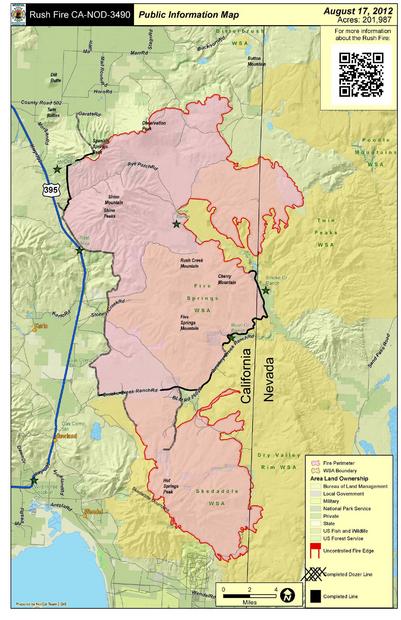
California Twin Peaks range wild horse country ~ Rush Fire map (Twin Peaks HMA) August 25, 2012

November 6, 2012

The BLM Eagle Lake office in Susanville, Ca. is proposing to remove 600 wild horses plus burros from the Twin Peaks HMA for range restoration due to the August wildfire. They are claiming that there are currently 950 horses on the entire HMA.

A recent independent aerial survey estimated that there are less than 400 Twin Peaks wild horses remaining. The BLM so far, has stated to advocates that the proposal will be “full force in effect” once it is signed, without public knowledge or input.

Less than half of Twin Peaks HMA burned. There is over 400,000 acres of unburned range and the burn areas are patchy and still have some forage available for the wild horses and burros. The BLM has failed to consider alternatives like protective fencing, using wild equids to reseed the range or some relocation to the unburned areas. This plan signals the end of California’s last viable herd.

We need EVERYONE to Call and E-Mail Dean Bolstad and Nancy Haug IMMEDIATELY and ask them to reject the proposal to roundup or trap wild horses and burros.

Dean Bolstad’s phone number is 775-861-6611 and his e-mail is dean_bolstad@blm.gov

Nancy Haug’s phone number is 530-224-2100 and her email is <nhaug@blm.gov>,

Sample E-mail to be sent to:

Dean Bolstad dean_bolstad@blm.gov and Nancy Haug nhaug@blm.gov

cc: Ken Collum (Eagle Lake field manager) kcollum@blm.gov
cc: Dereck Wilson (Eagle Lake BLM) dereck_wilson@blm.gov

I am writing to request you refrain from signing a decision to remove wild horses and burros from Twin Peaks. The proposal would prevent wild equids from healing and reseeding the range. The proposal would also reduce herd numbers to well below low appropriate management level (AML) and threaten the continued health and existence of this California herd. There is abundant forage in the burned area and there is the ample opportunity to protect the range through the preferred methods of protective fencing and/or minimal relocation of animals.

I am requesting the BLM reject this proposal – as it threatens the continued existence of California’s treasured herd  This plan has not fully considered the alternatives and has not substantiated that this is an emergency situation. Signing a decision to remove wild horses and burros will be met with significant public opposition. Please assure me that the BLM is not going to proceed with this action. The public has not been given notice and the opportunity to comment on such a proposal.
Sincerely,

Links of Interest:

Twin Peaks independent aerial survey https://www.box.com/s/biov6o31keiuu3y15s65

144 aerial photos from an independent population survey which estimated that less than 400 wild horses and a small population of burros are currently living in the Twin Peaks HMA. http://www.flickr.com/photos/89702311@N03/

Sign and share the petition to DEFUND the Roundups: https://www.change.org/petitions/united-states-congress-de-fund-the-roundups#

Wild horses restore fire damaged ecosystems

Wildlife Biologist Craig Downer (Photo © Cat Kindsfather)


Statement from Craig Downer, Wildlife Biologist, Wild Horse & Burro Expert

SAN FRANCISCO (November 6, 2011)–Esteemed wildlife biologist and wild horse and burro expert, Craig Downer, has given Protect Mustangs a statement explaining how wild horses help reseed the land after a wildfire. The preservation group urges the Bureau of Land Management to keep the remaining wild horses on the Twin Peaks Herd Management Area (HMA) to assist in healing and reseeding the land after this summer’s Rush Fire.

“We oppose rounding up and removing wild horses from the Twin Peaks HMA especially now that they can play a key role in restoring the land,” states Anne Novak, executive director for Protect Mustangs. “It’s time the BLM use good science and cut down on invasive techniques that cause global warming. Wild horses and burros can heal and reseed the range after the wildfire so let them do it.”

Statement from Craig Downer, acclaimed wildlife biologist and wild horse expert:

Wild Horses as restorers of a fire-damaged ecosystem

The wild horses would be the perfect restorers of an ecosystem after an extensive fire, since they would disperse many intact seeds in their feces which would form well-fertilized bed for their germination. The feces of the wild horses more greatly feeds the ecosystem and creates the vital humus component of the soils to a greater degree than is the case with most ruminants, such as cows, sheep, and deer.

Also, after passing through the post-gastric digestive tract of horses and burros, many seeds are perfectly conditioned for germination, as they have their coats made softer and more penetrable by the tender shoots. Many of these same seeds are killed after passing through a ruminant’s digestive tract.

In the Twin Peaks, the wild horses and burros would be the perfect, for natural, agents for ecosystem restoration for the above reasons and also because of their great mobility. They do not camp on wet meadows and around and in water sources as do cattle, for example.

Also most of the Twin Peaks HMA ecosystem did not burn and the wild horses and burros who survived the fire could subsist here then go reoccupying the recently burned areas as they are restored, all the while aiding in this process.

www.ProtectMustangs.org

Protect Mustangs is a California-based preservation group whose mission is to educate the public about the American wild horse, protect and research wild horses on the range and help those who have lost their freedom.  

# # #

Media Contacts:

Anne Novak, 415-531-8454  Anne@ProtectMustangs.org

Kerry Becklund, 510-502-1913  Kerry@ProtectMustangs.org


Shining the light on wild horses and burros

Cynthia Smalley in the field. © Cynthia Smalley

We are going to publish a book and make a short film on the wild horse and burro herds that photographers document. The goal is to bring awareness to these herds and shine the light on them.

Visit our Facebook page to post a photo and let us know which herds you document.

Let us know if you want to be included in this project. Email Contact@ProtectMustangs.org for more information.

100% of the profits will go to help wild horses and burros.

Breaking News: California’s last stronghold for native wild horses threatened with removal

Teen wants Twin Peaks mustangs to remain on the range for educational opportunities

SAN FRANCISCO (November 3, 2012)–Protect Mustangs opposes the Bureau of Land Management’s (BLM) proposal to roundup and remove native wild horses from Twin Peaks–the largest herd management area near Susanville, California. The California-based preservation group is planning a protest against the proposed Twin Peaks roundup. The San Francisco protest date and time will be announced after the Presidential election.

“Americans value California’s treasured herd of native wild horses, with cavalry remount influences, known as the Twin Peaks horses,” explains Anne Novak, executive director of Protect Mustangs. “These mustangs are survivors and play an essential role in creating biodiversity. Native horses heal the land after wildfires and from livestock over-grazing. This ultimately benefits livestock too.”

Native wild horses have survived in nature for hundreds of years and do not need to be rescued after a wildfire when there is forage and water out there. If they need extra forage or water then the BLM can bring them forage. It’s much cheaper than rounding them up and warehousing them in the Midwest–where they risk being sold to a slaughter middle man someday.

If the land needs healing after the fire then engage the latest science to use native wild horses to help heal the land and reverse desertification.

After a wildfire burned through the HMA for days, advocates conducted a study documenting the forage, water and terrain conditions. There is water and forage out there.

“Going to the Twin Peaks HMA is like stepping inside a living wildlife biology museum of the high desert,” says 15 year old Irma Novak, Director of the Discover Mustangs Project. “After the 2010 roundup, it’s hard to find wild horses to observe because the range is so huge and there aren’t many mustangs left.”

“American youth needs to have access to the natural world to round out their education,” adds Novak. “We want the Twin Peaks wild horses to remain on the range. If they need to remove any animals to heal the land after the fire then they should remove the destructive grazers who ruin the riparian areas–the cattle.”

The vast 798,000 acre Twin Peaks HMA is one and a half hours north of Reno and approximately 250 miles from the Bay Area making it an accessible option to observe treasured wild horses in their native habitat.

Irma Novak, Director of Discover Mustangs (Photo © Carolyn Orndorff)

# # #

Media Contacts:

Anne Novak, 415-531-8454 Anne@ProtectMustangs.org

Kerry Becklund, 510-502-1913 Kerry@ProtectMustangs.org

Links of interest:

Native wild horses: http://protectmustangs.org/?page_id=562

Princeton Study: Wildlife and cows can be partners not enemies in search for food: http://www.princeton.edu/main/news/archive/S32/93/41K10/index.xml?section=featured

California Twin Peaks Rush Fire Report: https://www.box.com/s/yf5mucjsowlawk5z3kyn

Discover Mustangs Project: http://discovermustangs.org/

Twin Peaks HMA: http://www.blm.gov/ca/st/en/prog/wild_horse_and_burro/hma-main/HMA-CA-242.html

Letter to BLM asking for Twin Peaks roundup specifics and stating our position to bring them aid in the field as needed but keep them on the HMA: http://protectmustangs.org/?p=2864

Petition to de-fund the roundups:https://www.change.org/petitions/united-states-congress-de-fund-the-roundups

Petition to De-Fund the roundups

Anne Novak with friendly wild horses. (Photo © Irma Novak)

Please sign and share the Change.org petition to De-Fund the roundups.

Wild horses are a native species to America. Rounding up federally protected wild horses and burros has been documented as cruel. Warehousing them for decades is fiscally irresponsible. Clearing mustangs and burros off public land–for industrialization, fracking, grazing and the water grab–goes against the 1971 Free Roaming Wild Horse and Burro Act put in place to protect the living legends of the American West.

We request you de-fund the roundups immediatley.

There is no accurate census and the Bureau of Land Management figures do not add up. We request an independent census because we are concerned there are less than 18,000 wild horses and burros in the 10 western states combined. More roundups will wipe them out.

Kindly allow native wild horses and the burros to reverse desertification, reduce the fuel for wildfires and create biodiversity on public land–while living with their families in freedom.


Petition Letter

De-fund the Roundups

Wild horses are a native species to America. Rounding up federally protected wild horses has been documented as cruel and fiscally irresponsible. Clearing mustangs off public land–for industrialization and fracking–goes against the 1971 Free Roaming Wild Horse and Burro Act put in place to protect the living legends of the American West.

[Your name]

Awaiting confirmation that the BLM will roundup and remove 600 wild horses and burros from Twin Peaks HMA in California

(Photo © Cat Kindsfather, all rights reserved)

We will keep you posted when we get confirmation that the BLM is using the fire as an excuse to roundup and permanently remove 600 wild horses and burros from California’s treasured Twin Peaks HMA.

Independent field studies after the rush fire show there are not 600 wild horses and burros left on the HMA.

We went on the record asking the BLM to bring them aid in the field ie: hay & water as needed. This is a much more cost effective method of helping wild horses and burros.

Here is a copy of the email we just sent out. We are awaiting their reply:

——– Original Message ——–
Subject: Roundup Twin Peaks HMA – REMOVE 600 !!!
From: <anne@protectmustangs.org>
Date: Fri, November 02, 2012 2:35 pm
To: “Retterath, Videll J”
Cc: “Fontana, Joseph J” <jfontana@blm.gov>, “Parsons, John D”
, “Satica, Douglas W” , “Collum, Kenneth R” <kcollum@blm.gov>

Dear Sirs,

Thank you in advance for getting back to me quickly to confirm you plan to roundup and permanently remove 600 wild horses and burros from the Twin Peaks HMA.

For the record, we request you bring them aid in the field ie: hay & water as needed. The public is against removing the Twin Peaks wild horses and sees the fire as an excuse.

We value our California wild horses and are concerned you would consider removing them–especially when there is a storage problem because for years now the BLM has been rounding up more than they can adopt out.

Should you decide to go ahead with the roundup we have heard you are planning you need to understand it will backfire–ignite protests across the country that will increase public awareness around wild horse and burros wipe-outs.

Selling wild horses to pro-slaughter middle men such as Tom Davis, as reported in the Propublica article is heinous and we ask that you stop such sales immediately. Already more than 90 California wild horses were sold to him and others  . . .

Sincerely,
Anne Novak


Anne Novak
Executive Director


Protect Mustangs is a Bay Area-based preservation group whose mission is to educate the public about the American wild horse, protect and research wild horses on the range and help those who have lost their freedom.
California Twin Peaks Rush Fire Report: https://www.box.com/s/yf5mucjsowlawk5z3kyn

California Twin Peaks range wild horse country ~ Rush Fire map (Twin Peaks HMA) August 25, 2012

Breaking News: Outrage over advisory board proposing to sterilize wild mustangs

Photo ©Rachel Anne Reeves all rights reserved

Call for Congressional investigation into conflict of interest on anti-wild horse advisory board catering to livestock and extractive industries

WASHINGTON (October 31, 2012)–Protect Mustangs strongly opposes the Wild Horse and Burro Advisory Board’s proposal to spay wild mustangs due to health risks including death and because no accurate independent headcount has been provided to prove alleged overpopulation is an issue despite multiple requests for this evidence.

“This cruel plan could kill many federally protected wild horses,” explains Anne Novak executive director for Protect Mustangs. “We oppose spaying wild mares in the field because it’s a high risk procedure. The BLM is charged with protecting wild horses not putting their lives in jeopardy. ”

Protect Mustangs is also calling for an independent audit to determine the number of mustangs in the wild and in holding facilities.

“Show us an independent headcount and then let’s talk about overpopulation–if it’s a realistic concern,” continues Novak. “Right now we see the BLM inflating the population numbers to justify rampant million dollar roundups, money dumped into fertility research and funds spent to warehouse 50,000 captive wild horses. Today maybe 17,000 are left in all ten western states. This could be the end for America’s indigenous free roaming wild horse.”

“We are concerned the anti-mustang advisory board is spreading disinformation about reproduction rates,” says Novak. “Life is harsh on the range. Wild horses don’t reproduce like rabbits and many foals die before they are two. Saying the herds double every 5 years is an invented distortion to push through radical policy”

Monday during the Wild Horse and Burro Advisory Board meeting in Salt Lake, the Salazar Plan was pushed into the final phase to wipe out American wild horses living on public land. The Board, stacked to favor the livestock and extractive industries–profiting off public land–recommended spaying wild horses to control an alleged but not proven overpopulation on the range.

Members of the public and wild horse advocates are outraged over the proposal which has at least a 10% death rate and a pandora’s box full of complications.

“It’s a lot more complicated and the potential for complications and side effects is much greater,” said the BLM’s vet, Dr. Al Kane USDA-APHIS, during a report to the Wild Horse and Burro Advisory Board in 2011. “The potential effects on herd behavior or individual mare behavior are an issue.”

Protect Mustangs urges members of the public to contact their elected officials in Congress to request:

  • An investigation into conflict of interest rampant amongst Wild Horse & Burro Advisory Board members.
  • An independent audit to determine the number of mustangs in the wild and in holding.
  • They come to the aid of federally protected wild horses who are at risk of being abused by the agency charged with their care.

“The public loves American wild horses,” says Kerry Becklund, director of outreach for Protect Mustangs. “We want the BLM and their biased Advisory Board to back off and quit trying to wipe them out.

# # #

Media Contacts:

Anne Novak, 415-531-8454, Anne@ProtectMustangs.org

Kerry Becklund, 510-502-1913, Kerry@ProtectMustangs.org

Links of interest:

The Salazar Plan: http://www.utsandiego.com/news/2009/oct/07/us-wild-horses-100709/

October 2012 Wild Horse & Burro Meeting: http://www.slideshare.net/blmnational/wild-horse-and-burro

Advisory Board member endorses slaughter: http://rtfitchauthor.com/2012/10/30/blm-wild-horse-burro-advisory-board-member-endorses-horse-slaughter-during-public-session/#comment-68620

Citizen board recommends BLM sterilize wild horses: http://www.huffingtonpost.com/huff-wires/20121030/us-wild-horses/

Protect Mustangs: http://www.ProtectMustangs.org

Protect Mustangs on Facebook: https://www.facebook.com/ProtectMustangs