
Mustang Monday™
Reply
Wild horses exist in thriving natural ecological balance on public land ~ removals are a sham. Taxpayers are funding their management to extinction while the Bureau of Land management fails to provide the American public with an accurate head count. Inflated estimates do not justify mistreatment of our living legends of the West.
Permission given to use this photo/flyer/poster to raise awareness. Contact us if you want a jpeg.


Helicopter Chasing Wild Horses-Calico (Photo © Cat Kindsfather)
“Send a handwritten letter to your senators and representatives demanding they stop funding roundups and all kinds of mustang and burro removals”, suggests Anne Novak, Executive Director of Protect Mustangs. “Ask them for an independent scientific head count before giving wild horses any more sketchy contraceptives. We don’t know how many mustangs are out there but we know the Bureau of Land Management’s numbers are inflated to justify receiving funding from Congress for their broken program. $78 million American tax dollars are given to BLM annually so they can rip wild horses from their families and their freedom. That’s $780,000,000. in just ten years to remove wild horses from public land set aside for them with the 1971 Free Roaming Wild Horse and Burro Protection Act. Write your politicians who are in office to represent you and ask for the change you want.”
Cross-posted from The Seattle Times
Federal land managers say they will use a new method to remove “excess” wild horses from the range in Nevada and other western states.
By MARTIN GRIFFITH
Associated Press
“The BLM is committed to continuously improving its management of wild horses and burros,” Joan Guilfoyle, BLM wild horse and burro division chief, said in a statement. “Deploying this new method of bait trapping enhances our ability to gather animals more effectively in certain areas of the West, while minimizing the impact to the animals.”
But the agency also still plans to conduct helicopter roundups, she added.
Anne Novak, executive director of San Francisco Bay area-based Protect Mustangs, said bait trapping would only be justified if there really were an excess number of wild horses on the range ruining the natural ecological balance.
“BLM never provides a scientific wild horse head count – only sloppy inflated estimates to justify removals,” Novak told The Associated Press. “When observers go out on the range, we see other factors devastating the land like big business extracting oil, gas and mining and ripping up the terrain, along with the old school methods of overgrazing cattle.”
The BLM already has used bait trapping in densely wooded areas where helicopters can’t easily move animals, and in areas where timeliness isn’t an issue. Bait trapping usually occurs over a period of several weeks or months.
But the use of bait trapping to remove horses over long periods of time in a variety of locations simultaneously is a new strategy for the agency, Guilfoyle said. The concept is to capture smaller numbers of animals over a long period of time, not to gather large numbers of horses in a short period of time, she added.
For the first time, the BLM is soliciting bids for several bait-trapping contracts to remove mustangs in six zones across the West over a one-year period starting July 1.
The government’s wild horse program is intended to protect wild horse herds and the rangelands that support them. About 33,000 wild horses live in 10 Western states, of which about half are in Nevada. Under the program, thousands of horses are forced into holding pens, where many are vaccinated or neutered before being placed for adoption or sent to long-term corrals in the Midwest.
While animal rights advocates complain that the roundups are inhumane, ranchers and other groups say they’re needed to protect fragile grazing lands that are used by cattle, bighorn sheep and other wildlife.
Cross-posted from News at Princeton
Princeton University researchers are leading an effort to put to pasture the long-held convention of cattle ranching that wild animals compete with cows for food.
Two recently published papers — including one in the journal Science — offer the first experimental evidence that allowing cattle to graze on the same land as wild animals can result in healthier, meatier bovines by enhancing the cows’ diet. The findings suggest a new approach to raising cattle that could help spare wildlife from encroaching ranches, and produce more market-ready cows in less time.
The reports stem from large-scale studies conducted in Kenya wherein cows shared grazing land with donkeys in one study and, for the other, grazed with a variety of wild herbivorous animals, including zebras, buffalo and elephants. The lead author on both papers was Wilfred Odadi, a postdoctoral research associate in the lab of Dan Rubenstein, the Class of 1877 Professor of Zoology and chair of Princeton’s Department of Ecology and Evolutionary Biology.
In August, Rubenstein and Odadi reported in the journalEvolutionary Ecology Research that cattle paired with donkeys gained 60 percent more weight than those left to graze only with other cows. The researchers proposed that the donkeys — which were chosen as tamer stand-ins for zebras and other wild horses — ate the rough upper-portion of grass that cows have difficulty digesting, leaving behind the lush lower vegetation on which cattle thrive.

In August, the Princeton researchers reported in the journal Evolutionary Ecology Research that cattle paired with donkeys gained 60 percent more weight than those left to graze only with other cows. The researchers proposed that the donkeys — which were chosen as tamer stand-ins for zebras and other wild horses — ate the rough upper-portion of grass that cows have difficulty digesting, leaving behind the lush lower vegetation. (Photo by Dan Rubenstein)
In September, Odadi and his co-authors on the Science paper reported that other grazers, especially zebras, did remove the dead-stem grass layer and that cattle indeed seemed to benefit from sharing land with wild animals. Cows in mixed grazing pastures took in a more nutritious diet and experienced greater daily weight gain — but this effect was limited to the wet season, the length of which can vary by region. Cattle competed with wild species for food in the dry months.
Nonetheless, the Princeton studies help counter an enduring perception that wildlife is an inherent threat to the food supply of livestock, Rubenstein explained. These results could prove crucial to preserving animals that are increasingly threatened as the human demand for food drives the expansion of land used to raise cattle. Zebras and wild horses are especially vulnerable to the spread of pastures because of their abundance.
“Grazing competition from other animals has been an issue throughout history,” Rubenstein said.
“There’s a fear that if some other animal is eating grass meant for livestock, that hurts the rancher. Those perceived competitors were seen as vermin and exterminated,” he said. “These experiments suggest that in certain cases cattle can actually experience considerable advantages in terms of growth when allowed to graze with other species.”
The studies are the first to experimentally test and prove hypotheses from the 1960s that equines make grazing land more suitable for bovines, a dynamic known as facilitation, Rubenstein said. Observations of zebras and wildebeests had suggested that the zebras’ ability to digest grass stems exposed the leafy grass wildebeests prefer.
Animals in the horse and cattle families both process food through fermentation as microbes in the digestive system break down vegetation. In horse-like animals, this process takes place in an organ located after the stomach that is similar to the human appendix (though humans are not fermenters). For bovines, on the other hand, fermentation happens in the rumen, an organ before the stomach that produces cud, which is regurgitated for the animal to further chew.
As a result of these digestive distinctions, Rubenstein said, equines can eat the rough low-quality grass that would linger and fester in a cow’s slower, more complex gut. The bovines in turn enjoy the lush, easily digestible grass underneath the stems.

For the study published in August, the researchers documented the weight changes and eating habits of the donkeys and cows for 12 weeks. Wilfred Odadi (rear, in hat), a postdoctoral research associate in Rubenstein’s lab based at Kenya’s Mpala Research Center, was lead author on both recent Princeton papers. The project stemmed from the senior thesis of Meha Jain (front left), who earned her bachelor’s degree from Princeton in 2007. (Photo by Dan Rubenstein)
Both Princeton studies showed that the presence of equines resulted in less dry-grass cover and a more nourishing diet for the cows. Although the study in Science matched cattle with other wildlife — including bovines such as buffalo — Odadi and his co-authors largely attributed the removal of the low-quality grass to zebras.
What was not expected was just how much the cattle can benefit, Rubenstein said.
“Scientists had this intuitively pleasing, circumstantial evidence that equines make the landscape more habitable to bovines, but the idea was never tested,” Rubenstein said. “This was the first demonstration that the animals behave accordingly, but also that the performance of the cows as measured by growth is actually enhanced. Previous evidence of the effects we found on the health and development of cattle had been missing.”
Rubenstein conducted the experiment reported in Evolutionary Ecology Research on rangeland in northern Kenya with Odadi, who is based at Kenya’s Mpala Research Center — with which Princeton is a partner — and co-author Meha Jain, who earned her bachelor’s degree from Princeton in 2007 and whose senior thesis was the basis of the project.
The team chose donkeys as surrogates for zebras, which suffer from food and habitat loss due to cattle operations, particularly the endangered Grévy’s zebra. Because donkeys are tame, the researchers could more easily observe, weigh and record the diet quality and health of the individual animals, Rubenstein said.
The researchers constructed six separate grazing areas divided into three high-density and three low-density pastures. Both the high- and low-density areas hosted an all-bovid group of 15 cows; an all-equid group of 10 donkeys; and a mixed group of 15 cows and 10 donkeys, for a total 60 cows and 40 donkeys. The animals grazed seven hours each day.
For 12 weeks, the researchers documented the animals’ weight changes and eating habits. In addition, the excrement of tagged cows in each grazing area was analyzed for protein, parasite and digested-grass content. Study co-authors and ecologists Herbert Prins and Sipke Van Wieren of Wageningen University in the Netherlands validated the effectiveness of these measurements.
At the end of the experiment, cows that fed alongside donkeys had beefed up by an average of 64 pounds (29 kilograms) per animal in the low-density pasture, and slightly less than 37 pounds (17 kilograms) for the high-density group. In comparison, cattle dining only with their own put on an average of 55 pounds (25 kilograms) per cow with more room to roam and only nearly 28 pounds (12.6 kilograms) in tighter confines.
When compared to the weight of the cattle recorded at the experiment’s outset, cows grazing with donkeys gained an average of 60 percent more weight than cows that did not, the authors reported. Moreover, none of the cows in the mixed groups remained at the same weight or lost weight, unlike some of the cows in the bovid-only pastures. Analysis of the protein and grass-remnant content of the cows’ dung showed that the animals consumed a healthier diet when sharing land with donkeys.
A notable feature of the study Odadi conducted with Rubenstein is that it provides some understanding of how the other animals respond to grazing with cattle, Odadi said.
The donkeys did not exhibit the benefits of intermingling to the extent the researchers observed in cattle. Donkeys grazing with cattle gained only 51 percent more weight than donkeys that did not, and dung analysis showed the donkeys in the mixed groups actually took in a less digestible diet.
But the dung of donkeys in the mixed groups also contained lower levels of parasitic worm eggs, possibly due to the cattle taking in some of the parasites during grazing, Rubenstein said. As a result, parasite infection was less debilitating in these donkeys.
For the second study, Odadi and his co-authors on the Science report changed the project’s scope to include large, wild herbivores that share the African savanna with cattle: Grévy’s zebras, African buffalos, elands, hartebeests, gazelles, elephants and giraffes. Odadi worked with ecology professor Truman Young of the University of California-Davis; Moses Karachi of Egerton University in Kenya; and Shaukat Abdulrazak, chief executive officer of the National Council for Science and Technology in Kenya.
The researchers created nine grazing areas of equal size, each with four cows. The pastures fell into three categories: cows only; plots open to medium-sized herbivores and closed to elephants and giraffes; and plots open to all wild herbivores. Each variety was randomly assigned to three grazing areas.
The experiment consisted of two 16-week trials (conducted a year apart) with each trial beginning in the dry season and ending during the wet season. In each trial, the team weighed the cows and examined the animals’ excrement to determine diet quality.
In the wet season, cattle that ate with wild herbivores took in a more nutritious diet and experienced greater weight gain than cows that did not, according to the Science report. In the cow-only enclosures, each animal put on roughly a half-pound (0.25 kilograms) each day. In the other pastures, each cow bulked up by three-fourths of a pound (0.35 kilograms) daily. The experiment coincided with 18 weeks of Kenya’s wet season. For that period, daily weight gain translated to 69 pounds (31.5 kilograms) for each animal in the cow-only enclosures, versus 97 pounds (44 kilograms) per cow in the other areas.
The dry season and resulting scarcity of grass turned that dynamic on its head, however, as Odadi and his co-authors expected. Cows grazing without other animals gained more than a half-pound per day. Weight gain for cows in the mixed enclosures plummeted to roughly one-third of a pound each day. A future direction of the project may be to determine if adjusting cattle-to-wildlife density based on the season would reduce competition when food is scarce, Odadi said.
The Princeton researchers make an important contribution to the study of how to reconcile the demand for grazing land with ecosystem conservation, said Michael Coughenour, a senior research scientist at the Colorado State University Natural Resource Ecology Laboratory.
The research not only shows that facilitation between livestock and wildlife is possible, but also suggests the mechanisms — for example, the removal of dry stems — that provide that benefit, he said. Naturally, Coughenour said, many questions remain, such as if the mere presence of many grazers results in more robust plant growth, as existing research has suggested might occur.
But the results should nonetheless prompt researchers to investigate the existence of facilitation in other regions and ecosystems, as well as the livestock-to-wildlife densities that make it possible, Coughenour said. For instance, the United States and other temperate-zone countries do not have a distinct wet and dry season. Also, it cannot be assumed that grass in the American West would respond to mixed grazing in the same way as savanna grass, nor that a similar concentration of zebras and American wild horses would benefit cattle in the same way in their respective environments.
“These findings add to the dialogue by providing evidence that interactions between wild equids and livestock are not necessarily negative, as would commonly be assumed among ranchers and commercial pastoralists,” Coughenour said.
“Clearly, blanket statements that wild equids invariably compete with livestock can no longer be accepted. Facilitation is a very real possibility that should be considered and investigated,” he explained. “However, it would be equally invalid to assume that the extent and mechanisms of facilitation are universal. Research is required to clarify the relationship so as to gain a more precise understanding of the conditions under which neutral or positive interactions occur.”
In the Evolutionary Ecology Research paper, Rubenstein, Odadi and Jain delved into how the weight gain they observed in cows grazing with donkeys could translate to economic gain for ranchers by producing cattle that are ready for market sooner.
As an example, they imagined a farmer beginning with a cattle herd with an average weight of 660 pounds, or 300 kilograms, that he intends to sell after the animals put on an extra 200 pounds, or 100 kilograms. In their scenario, they first substituted the 10 donkeys in the experiment with 10 more cows to make up a herd of 25 cattle. These cows would take nearly 18 months to reach the target weight of 400 kilograms if the animals packed it on at the rate of roughly 0.2 kilograms, or a half-pound, a day, as many of the cows in the researchers’ single-species pastures did.
Replacing 10 cows with donkeys, however, would bring the remaining 15 cows to the preferred weight in about 11 months. The researchers assumed those cows would gain weight at the average of nearly 0.3 kilograms, or 0.66 pounds, a day seen in the mixed-group cows in the experiment.
“Time has a cost. If cows grow faster per day, they can get to market sooner and the landowner can preempt the costs of cattle dying from predation or disease as the animal is exposed to the elements for longer periods ,” Rubenstein said.
“From the perspective of the rancher and the people awaiting the food from his cattle, the cows develop better if there are hind-gut fermenters like zebras present,” he said. “So, by our observations, competition becomes facilitation and expands to become mutualism as both species actually benefit each other.”
Cows with a few extra kilograms of weight could be a “huge” benefit to ranchers and pastoralists, particularly in Africa, as well as to the preservation of natural lands, said Joshua Ginsberg, senior vice president for the Wildlife Conservation Society’s Global Conservation Program. Ginsberg, who received his Ph.D. from Princeton in 1988, focuses his research on conservation and animal-human interaction.
“A few kilograms is a major increase,” Ginsberg said. “If the cattle are managed well, and the markets exist and are used, it would allow for greater income, greater protein and the ability, at least in theory, to reduce cattle-stocking rates because of increased productivity.
“Many pastoralists think that zebras compete for food and this study suggests that in many circumstances, that may well not be the case,” Ginsberg said. “The authors clearly suggest that the expansion and recovery of zebra populations in lands that are focused on traditional grazing practices is potentially a benefit, rather than a cost, to these societies.”
At the Mpala Research Center, Odadi has presented his findings to local farmers, but understands the difficulty of overturning long-held views about the livestock/wildlife competition.
“The farmers we have presented these findings to are generally surprised that zebras and other wildlife can facilitate cattle,” Odadi said. “However, we have not been able to determine whether and to what extent their perception that grazing wild animals are detrimental to livestock production has actually changed.”
The first study, “Facilitation Between Bovids and Equids on an African Savanna,” was published in Evolutionary Ecology Research in August 2011, and supported by grants from the National Science Foundation, the Keller Family Trust and Wageningen University, the Netherlands.
The second study, “African Wild Ungulates Compete With or Facilitate Cattle Depending on Season,” was published in Science on Sept. 23, 2011, and supported by grants from the National Geographic Society, the National Science Foundation, the U.S. Fish and Wildlife Service, and the International Foundation for Science.

Captured wild horse weanlings calling for help (Photo © Anne Novak, all rights reserved.)
“We are concerned the BLM’s new proposal to bait trap, over long periods of time, will zero-out wild horses in the West. The agency will continue helicopter roundups as well. There is no proof to justify the alleged “excess” amounts of wild horses. Princeton science has proven wild herds heal cattle grazing lands for cattle, so let’s find the win-win and stop wasting tax dollars on irresponsible mustang removals.” ~Anne Novak, Executive Director for Protect Mustangs.
Read about the issue and our comment in the Associated Press article here.
If you don’t like what’s going on then take action to protect America’s wild horses and burros. Get creative . . .
“The profiteering pro-slaughter gang wants to eliminate our wild horses of the West . . . kill and cut them up into meat for wealthy foreigners to eat . . . sell them to China and elsewhere. I say NO!” ~Anne Novak, Executive Director of Protect Mustangs
Petition to Stop USA Horse Slaughter
“America’s wild horses are particularly vulnerable to slaughter. They live in remote regions where they can be rounded up and sold by thieves to slaughter,” explains Novak. “They aren’t filled with chemicals like domestic horses so their meat could be in high demand abroad. There isn’t enough manpower in the BLM to prevent thieves from taking advantage of plants opening in the West. We must stop horse slaughter.”
Join us to petition President Barack Obama and Congress to pass the American Horse Slaughter Prevention Act of 2011, S.B. 1176/H.R. 2966—to make sure all horses in America are treated humanely.”

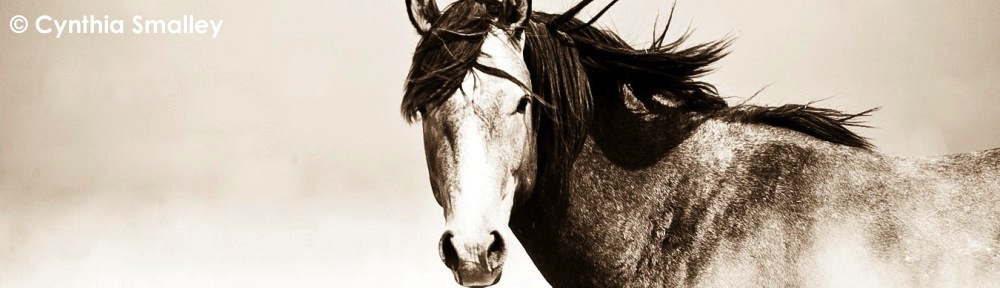
Wise wild stallion (Photo © Cynthia Smalley, all rights reserved.)
Saving wild horses through music.
Music 4 Mustangs‘ is a Protect Mustangs project. The mission is to raise awareness to protect American wild horses today and for future generations. Through concerts and recorded music, we will be raising money to fund various projects on and off the range.
If you are with a band and want to get involved to play a benefit concert to save the mustangs contact us: Info@Music4Mustangs.org
Find us on Facebook: http://www.facebook.com/Music4Mustangs
On the web: http://www.Music4Mustangs.org
We also need volunteers.

Fundraiser for Protect Mustangs ~ Matthew Rockwell portrait of Elizabeth Taylor, signed 1964.
We are pleased to announce the stunning Matthew Rockwell portrait of Elizabeth Taylor was donated to Protect Mustangs to fundraise for our outreach work educating the public about the mustang crisis. It is signed by the artist, the nephew of Norman Rockwell, and dated 1964. Please contact us if you would like additional information about the painting or information about the requested donation. You may also email us at Contact@ProtectMustangs.org .

(Photo © Cat Kindsfather, all rights reserved)
The slaughter profiteers—backed with foreign money—want to open a plant in Missouri to kill up to 400 horses a day for human consumption abroad. See one news report here and another here.
Please sign and share: http://www.change.org/petitions/stop-usa-horse-slaughter
We ask President Barack Obama and The United States Congress to pass the American Horse Slaughter Prevention Act of 2011, S.B. 1176/H.R. 2966, which amends the Horse Protection Act (HPA) to prohibit the sale or transport of horses or equine body parts in interstate or foreign commerce with the intent to process for human consumption. This Act will put an end to horse slaughter for human consumption in the United States, and put an end to the transportation of horses to slaughterhouses across our borders (typically to Mexico and Canada).
(1) Horses helped build the United States of America. Wild horses are living treasures and symbols of freedom. Most domestic horses are pets. Some have even become icons—such as Secretariat—who uplift the spirit and foster the American dream.
(2) In the U.S.A., horses are not raised for human consumption. Consequently horses are medicated with toxic substances that often do not pass FDA standards, making them unsafe to eat.
(3) We are against wasting tax dollars to fund horse meat inspections at slaughterhouses.
(4) Horse slaughter is animal cruelty—not humane euthanasia. When horses are slaughtered, they are often semi-conscious while the butchering begins.
(5) Humane euthanasia is a kinder way to end a horse’s life.
This Act will protect America’s horses and protect Americans against unhealthy and dangerous horse meat.
Members of Congress: We ask you to pass the American Horse Slaughter Prevention Act of 2011, S.B. 1176/H.R. 2966, when it comes up for a vote.
President Barack Obama: We ask you to push for passage of the Act and to sign it when it reaches your desk.