Sheldon National Wildlife Refuge in Nevada to remove all wild horses, burros within 5 years

Cross-posted from The Republic

  • MARTIN GRIFFITH  Associated Press
  • September 02, 2012 – 8:04 pm EDT

RENO, Nev. — Federal officials have approved a final management plan for the Sheldon National Wildlife Refuge in northwestern Nevada that calls for the removal of all wild horses and burros from it within five years.

The move is being made because the refuge was created for pronghorn antelope and other native wildlife, and horses and burros have a negative effect on habitat, said Joan Jewett, spokeswoman for the U.S. Fish and Wildlife Service in Portland, Ore.

“They trample the habitat and overgraze and disturb the water sources,” she told The Associated Press. “We’re required by law to manage our refuges in accordance with the purposes for which they were established, and Sheldon was primarily for pronghorn antelope.”

Horse advocacy groups sharply criticized the refuge’s comprehensive conservation plan, which will guide its management over the next 15 years. It was publicly released late last month.

They say horses and burros lived in the area long before the refuge was created in 1931, and the animals actually heal the land and help prevent wildfires through grazing.

“We are extremely disappointed that the federal government has chosen to eradicate wild horses and burros from the lands where their ancestors have lived for more than a century and a half,” Suzanne Roy, director of the American Wild Horse Preservation Campaign, said in a statement.

An aerial survey in July showed the 575,000-acre refuge along the Oregon border is home to at least 2,508 antelope, 973 mustangs and 182 wild burros, said Aaron Collins, a park ranger at Sheldon.

“We’re recording the highest numbers of pronghorn antelope since we began counting them in 1950,” he said.

Federal officials began the planning process on the refuge’s management plan in 2008, and received several thousand comments from individuals, organizations and government agencies during it, Collins said.

The final plan will be signed sometime after Sept. 24 by the regional director of the Fish and Wildlife Agency, he added.

Under federal law, only horses and burros removed from lands managed by the Bureau of Land Management and the Forest Service are protected from slaughterhouses if they can’t be adopted.

“Rounding up indigenous wild horses is wrong — especially when they can be sold to the meat buyers at auctions,” said Anne Novak of California-based Protect Mustangs. “These horses are vulnerable to ending up going to slaughter … The Sheldon plan to wipe out wild horses is nuts and goes against the public’s wishes.”

Activists said the final management plan rejected a more humane alternative to phase out horses and burros over 15 years using fertility control, an option that would have allowed unadoptable animals to live out their lives at the refuge.

(Story distributed by The Associated Press)

Link to the original article: http://www.therepublic.com/view/story/9d2599146ac04731ae3b93a918db2c59/NV–Refuge-Wild-Horses

California BLM RAC Meeting June 13-14

Bureau of Land Management
Northeast California Resource Advisory Council
Field Tour and Meeting
June 13-14, 2012, Cedarville, California

Summary Minutes

June 13

Council members toured recently acquired lands in the Homecamp Area.  At Boulder Reservoir and Divine Springs they discussed proposed recreation site improvement projects.  They also discussed proposed grazing management strategies.  The lands were acquired through the Southern Nevada Public Lands Management Act.

June 14

Vice Chairman Skip Willmore convened the meeting at 8 a.m.

Attendance

Category One:  Ken McGarva, John Erquiaga, Jack Razzeto, Skip Willmore.  Absent: Todd
Swickard.

Category Two:  Frank Bayham, Judy Oliver, Louise Jensen, Gale Dupree, Alan Cain.

Category Three:  Brad Hansen, Sean Curtis, Carol Montgomery.  Absent:  Nancy Huffman, Jim Chapman.

There is a quorum.

BLM Staff:  District Manager Nancy Haug, Eagle Lake Field Manager Ken Collum, Alturas
Field Manager Tim Burke (also acting field manager for Surprise), Public Affairs Officer Jeff
Fontana.

Guests:  Jackie McGarva, Likely; Carla Bowers, Volcano.

Opening Business

Vice Chair Skip Willmore chaired the meeting in Nancy’s absence.

Approvals:  The agenda for this meeting was approved.  The minutes from the February meeting were approved.

Bureau of Land Management
Northeast California Resource Advisory Council
Summary Meeting Minutes, June 13-14, 2012, Cedarville, California

2

Field Tour Comments

Tim asked for comments and suggestions about proposed recreation developments at Boulder Reservoir and Divine Campground, and proposals for temporary non-renewable grazing use or trailing permit grazing use on the acquired Homecamp lands.  RAC comments:

Ken McGarva:  There should be more irrigation in the meadows at mare field.  Work
should be undertaken on irrigation system improvements for the meadows.

Skip Willmore and Ken repeated comments made during the field tour that grazing
stubble height should be less than six inches to keep the grasses healthy and to prevent
rodent damage.  The lower grass height also attracts more birds.  John Erquiaga said
grazing is far preferable to burning.

Carol Montgomery questioned the rationale for campsite development at Boulder
Reservoir.  She said remote camping areas should be left undeveloped, and that users are
generally respectful of primitive use areas and refrain from littering and damage.
Developed camping spaces, vault toilets and other developments would make the area
less desirable for those who prefer a primitive camping experience.

Frank Bayham agreed that fencing cattle out of the reservoir is a good idea.  He said
campground development would detract from the dispersed recreation experience.  A
fence and water trough project to manage cattle would protect the cultural site at the
reservoir.

Louise Jensen:  Fencing the lake is a good environmental idea to protect the water quality
of the reservoir.  Redirecting the water for cattle use would be a good idea.

Gale Dupree:  Supported fencing cattle away from the reservoir.  A pit toilet is a good
idea to prevent pollution from human waste.  Fire rings would help prevent spread of
indiscriminate fire rings and camping areas.  BLM should visit the primitive campsites on
the Sheldon National Wildlife Refuge and ask users there what they prefer in primitive
camping areas.

Tim noted there are proposals to dredge the pond and cap the archaeological site.

Frank suggested there should be more archaeological testing before those projects are
done.  It would provide information on the extent and quality of the cultural resource
information there.

Skip agreed that the site should be left in a primitive condition.  It is too remote to put
much money into. Development would require more money and staff time for
maintenance.

Bureau of Land Management
Northeast California Resource Advisory Council
Summary Meeting Minutes, June 13-14, 2012, Cedarville, California

3

State Director’s Report

Nancy Haug delivered a statewide status report from State Director Jim Kenna:

Leadership Team in Washington/State Office:  BLM Director Bob Abbey has retired
as of May 31, 2012. Associate Director Mike Pool has assumed the Acting Director role
beginning June 1.

Legislative – Just six months remaining in the 112th Congress. Focus still remains on
jobs and the economy. It’s going to be a busy summer for the California delegation as
they prepare for election season. We expect some changes in Congressional districts in
the Northeast part of the state with Congressman Herger retiring and the redistricting of
the new District 01.

Hill Visits Recap – The State Director recently completed his annual trip to Washington
to brief Congressionals. Jim met with 13 members/staffs of the California delegation
including Senators Feinstein and Boxer and Representatives Herger (CA-2) and
McClintock (CA-4). Jim emphasized BLM-CA priority issues (new energy frontier, sage
grouse conservation, economic benefits to communities and America’s Great Outdoors.
He also discussed BLM-CA emphasis on sustainability, heritage and community. Overall
he received positive feedback about BLM-CA and the good work by field offices and
many partners.

Budget – The FY2012 funding level for BLM-CA was $1,127,839 million compared to
the FY2013 request of $1,127,335.

BLM Priorities:  Our priorities continue to be renewable energy and America’s Great
Outdoors, including the National Landscape Conservation System, youth initiatives and
recreation. Sustainability, Heritage, Community.

Wild Horse and Burro – Adoption season is underway. An adoption in Clovis earlier
this month resulted in the adoption of seven horses and one burro.

Promoting Economic Growth BLM-California is an engine of economic activity and
raises more revenue each year for American taxpayers than it spends. Special areas bring
tourism dollars to local communities, and royalties for use of public lands amount to
millions of dollars each year.

BLM-California brings in $117 million in oil and gas royalties, $1.8
million from wind projects, and $8.6 million from geothermal projects
statewide each year. Approved solar projects will contribute nearly $23 million in annual rent and royalties, once built out

Bureau of Land Management
Northeast California Resource Advisory Council
Summary Meeting Minutes, June 13-14, 2012, Cedarville, California

4

District Manager’s Report

For the Northern California District, Nancy updated the group on the status of management changes in the Surprise Field Office, and development of conservation strategies for sage grouse west-wide, including involvement of local governments in developing management alternatives.  A sage grouse decision to amend land use plans is due by September 2014.

Surprise Field Office Management:  Nancy told the RAC that Allen Bollschweiler had taken a position in Grants Pass, Oregon, as field manager. For the foreseeable future, she has assigned Tim Burke, Alturas field manager to oversee the Surprise Field Office. Nancy has also asked Tim to assess workload and staffing at the Surprise Field Office as well as the Alturas office and determine if there are ways to achieve efficiencies.

John Erquiaga said that this looks like an attempt to close the Cedarville office. Nancy responded that no decisions have been made and that is not a consideration at this point. She said that the BLM is taking this opportunity to see if there are areas where we can share workload or staffing. She also said that Tim would be talking with our partners and the counties about the ongoing work and partnerships and possibilities for future management of the two offices.

Sage Grouse:  Nancy reminded the group that the BLM’s development of sage grouse
conservation strategies will result in amendment to the Alturas, Eagle Lake and Surprise resource management plans. Because they were completed in 2008 she said they are in “fairly good shape” regarding conservation of sage grouse habitat.  There will likely be some changes, however.

Monitoring Program: Nancy also reported on the soil, water and air monitoring project
involving Utah State University.  The RAC heard information on the topic at their February
meeting.  The work is designed to develop quantitative data upon which to base defensible livestock grazing decisions for all three northeast California field offices.

Wild Horse and Burro Management

Nancy Haug reported:

Director’s Challenge Project:  The Eagle Lake and Surprise field offices were allocated
$25,000 in the Director’s Challenge Initiative to support volunteer work to gather data on
resource conditions in wild horse and burro herd management areas.  Volunteers will work in the Twin Peaks, High Rock and Nut Mountain HMAs.  BLM can help cover volunteer expenses.  The volunteer announcement has been posted online at Volunteer.gov, announced through the news media and through other venues.

Alan Cain, who represents wild horse and burro interests, said he likes the idea of providing opportunities for people to study range conditions first hand.  Volunteers will also have the hance to learn about range effects of horse populations.

Bureau of Land Management
Northeast California Resource Advisory Council
Summary Meeting Minutes, June 13-14, 2012, Cedarville, California

5

Upcoming Gathers:  Nancy also reported that the Surprise Field Office is working on a range of alternatives in an environmental assessment being prepared for the proposed Coppersmith, Buckhorn and Carter Reservoir gathers.  Coppersmith and Buckhorn are anticipated this fall; Carter is proposed for next summer.  The environmental assessment will be released soon for public comment.

Sean Curtis urged the BLM to consider the ability to help the Modoc National Forest with their plans to gather the Devil’s Garden herd territory.

Carol Montgomery suggested that the RAC should receive more information on actions and recommendations of the national Wild Horse and Burro Advisory Board.  Public Affairs Officer Jeff Fontana agreed to forward information on web links to current information as it becomes available.

Action:  The RA unanimously recommended that its wild horse and burro subcommittee
(Todd Swickard, Alan Cain, Sean Curtis and Chair Nancy Huffman) review the EA for
the upcoming Surprise Field Office gathers and develop recommendations for the full
RAC.  A RAC conference call, open to the public, should be scheduled for the RAC
review of the recommendations.

Medicine Lake Geothermal Development

Tim Burke updated the council on the history and current status of proposals for geothermal leasing and development in the Medicine Lake Highlands in Siskiyou County.  Leases were first issued in the 1970s, and development projects for 49-megawatt power plants at locations called Telephone Flat and Four Mile Hill were approved by the BLM and Forest Service in the 1990s.  Subsequent court actions invalidated the leases at the Four Mile Hill project site.  The development company, Calpine Corp., is now proposing developing at least one 49-megawatt power plant at the Four Mile Hill project site, and is considering the possibility of developing up to 480 megawatts of geothermal power in the entire Known Geothermal Resource Area (KGRA). The BLM will need to complete new environmental analysis to extended the leases, an action that is required if the company is to pursue development plans.  The company has not yet informed the BLM about its preferred course of action.

During the previous environmental analysis on proposed developments there was opposition from Native American tribes, environmental groups and a homeowners association at Medicine Lake.  There was also support expressed.

Legal questions remain about the validity of leasing at the Telephone Flat project site.

The item was informational only.  The RAC took no action.

Bureau of Land Management
Northeast California Resource Advisory Council
Summary Meeting Minutes, June 13-14, 2012, Cedarville, California

6

Infernal Caverns Acquisition

Tim discussed the historic significance of the 1868 battle site in the Likely area where local
tribes and settlers clashed. The site contains memorial markers for the six U. S. Cavalry members who died.

Mitigation funds from the Reno-Alturas Intertie powerline project were used to buy part of the property and it was donated to the BLM for management.  An adjacent parcel is privately owned; BLM is negotiating acquisition.  There are mitigation funds still available that could be used.

Discussions and negotiations are continuing about possible acquisition, including the possibility of a land exchange.

Eagle Lake Field Office Projects

Ken Collum updated the council on the status of two projects:

Horse Lake Wind:  Invenergy has submitted a plan of development for a 50-megawatt wind energy development on Fredonyer Peak, near Horse Lake, east of Eagle Lake.  The
environmental review process has not yet begun.  The field office has advised the company about concerns with proposed wind turbine locations within priority sage grouse habitat, where developments must follow BLM’s interim guidance for habitat conservation.  BLM has asked the company for an alternative that includes turbine placement outside of grouse habitat to avoid conflicts with interim sage grouse habitat management.

The Eagle Lake Field Office also asked the company for more extensive analysis of bald eagle and golden eagle use of the project area to determine possible wind energy impacts on the birds.

Another year of analysis could be required.

The BLM will not move forward with environmental analysis until the two requirements are met.

Bly Tunnel:  There is no water flowing from the tunnel. The field office closed a controversial bypass valve last February.  There has been no action on five appeals filed with the Interior Board of Land Appeals, including one request for a stay of the BLM action.

Public Comments
 
Carla Bowers: Presented information on allocation of forage allocation to wild horses and burros, wildlife and livestock. She stressed that nationally, wildlife receive 51 percent, livestock 45 percent and wild horses two percent of available forage.  Carla presented several handouts.  She said horse numbers are comparatively low compared to wildlife and livestock.  She was concerned with BLM aiming for low AML during gathers.  If achieve nationwide, she said there will be about 18,000 animals on the range instead of the 26,500 that BLM says is the national AML.   She was also concerned that under the BLM’s population target 78 percent of wild herds would be under 150 animals, a number that threatens viability.  She expressed concern that BLM has not managed wild herds with consideration for protection of their family units.  She cited Bureau of Land Management Northeast California Resource Advisory Council Summary Meeting Minutes, June 13-14, 2012, Cedarville, California
 
7
 
information from Karen Sussman, president of the International Society for the Protection of Mustangs and Burros, in saying that small herd numbers damage  the educational structure wild herd family units  and leads to higher than normal reproduction rates.
 
She also recommended that the BLM use more water and bait trapping, particularly for smaller herds, where there is a need to gather excess animals.
 
Carla also summarized a proposal for a special management approach for the Carter Reservoir Herd that roams public land east of Cedarville.  She noted these horses have “old world” Spanish markers, making them unique.  She was concerned with the low AML currently in place, and said it is important to increase the AML to preserve the line of horses.  At a minimum, she said the currently population level of 55 should be maintained.
 
She expressed support for expanding HMAs west wide and said wild horse activists are
interested in working with Congress to expand ranges.  Carla expressed support for cooperation among wild horse interests and livestock operators.

Public Land Access Issues

Skip Willmore said some of his constituents are concerned that agencies are closing down road access to public lands.  Sean Curtis noted that the BLM took a more user friendly approach to travel route designations than did the Forest Service when it established travel route designations in the Alturas, Surprise and Eagle Lake resource management plans.

Skip said there are constituent concerns that closures would extend to BLM-managed lands. Managers said there are no efforts underway to expand route designations beyond those contained in the resource management plans.

There was discussion about management of public lands that are surrounded by private lands, and processes that can be used to address the issue.  Managers said the process differs by location and access issues are addressed on a case by case basis. In some cases, the BLM negotiates for public access to isolated parcels.  They can also be designated for disposal from public ownership or retained for various natural resource values.

Socio-Economic Draft Strategy

The RAC reviewed the BLM’s draft national socioeconomic strategy developed earlier this year.  Members received copies in advance.

Nancy Haug summarized that BLM capability in socioeconomic analysis has declined over the years, while need for the analysis has become increasingly important.  This draft strategy is recognition of this, and an attempt by the BLM to increase capability in analyzing socio economic effects of its land management decisions.

RAC Comments:

Bureau of Land Management
Northeast California Resource Advisory Council
Summary Meeting Minutes, June 13-14, 2012, Cedarville, California

8

Sean Curtis:  The RAC should have had the opportunity to comment on the goals and strategies – – the meat and potatoes of the document.  Ideally, socio-economic data should be as important in BLM decision making as the natural resource data.  BLM decisions can have dramatic local socio-economic impacts, but these effects would be insignificant on a national basis.  Analysis of socioeconomic data needs to be part of the decision-making process rather than just a box to be checked.  What is missing now is the ability to interpret socio-economic data collected during planning.  There are sources of data, but it needs to be interpreted in context.  BLM needs to better analyze long range and broad socioeconomic implications of its decisions. For example, how a local school system would be impacted by as a result of widespread reductions in federal
land livestock grazing.  Aside from this draft report, socioeconomic data is needed for local
communities to make the case for the importance of commodity based programs.

Louise Jensen:  There has to be flexibility to customize this for local communities.  That layering to create a local toolbox for socioeconomic analysis does not appear to exist here. There is no good modeling to measure unintended consequences of an action.  The BLM needs to have control over the modeling and the data that are used.  It would be important that all field offices used the same standards for modeling and data analysis.  The data collected has to be easily used by staff.

Frank Bayham:  Good socioeconomic information is important in BLM decision making  He was concerned that this document is a prelude to restructuring of the BLM in some way, positioning political and economic considerations above other needs and thus impacting the agency’s natural resource expertise and capability on the ground.  It appears this could become a major entity within the BLM.  There is value in some of the information addressed in the document.  He said expertise is sometimes needed to gather the correct information in the correct way to be most useful in an agency decision making process.  In principle he supports the document, but feels it is too loaded with unnecessary specifics.

Judy Oliver:  She feels the BLM is doing socio-economic work already, but doesn’t doubt more data could be used.  She suggested there are outside sources of information and data collection, such as universities.  She sees this as a response to BLM’s need to address increasing competition for rangeland use and resources.

Jack Razzeto:  Jack questioned whether the socioeconomic data will really affect the agency decision making process.

Ken McGarva:  It will cost money to hire people to study the topic and there is no money to take care of what we have now.  This looks like a plan to spend more money.

Skip Willmore:  The BLM appears to be “fishing” to so something it does not need to do.   There is BLM expertise on the ground to answer the socioeconomic questions.

Action:  The RAC unanimously agreed to consolidate their opinions in several statements, as follows:

Bureau of Land Management
Northeast California Resource Advisory Council
Summary Meeting Minutes, June 13-14, 2012, Cedarville, California

9

— The document writing is not clear, too complex.  The document is jargon laden and
cryptic which obfuscates the intent.

An example:  Some of the tools referenced might not even exist yet.

— The RAC should have been consulted in development of the document goals and
strategies prior to the narrative being developed.

— An omission:  There is no standard among the natural resource agencies about how to
measure and analyze socioeconomic data in the context of ecosystem management. This
exercise seems premature until there is a standard.

— Omission:  There is no idea or assessment of the costs to the BLM of implementing
most of the proposed actions.  Specific actions in strategy 2.2 are one example.

— Omission:  There is no BLM commitment expressed to use socioeconomic data in the
BLM decision making process.

— Omission:  There is no timeframe for implementation and no indication for a plan to
evaluate the effectiveness of the proposed actions.

–Omission:  Strategy 1.1 needs to include stakeholder involvement.  This is solely in-
house.

–The RAC had difficulty prioritizing proposed actions because of the notes listed above.

Field Managers’ Reports:

Tim Burke presented a written report for the Alturas and Surprise field offices (attached)

Comments/Questions:  Tim said he will bring RAC comments on the Boulder Reservoir proposal back to the staff for consideration.  For example, he will reflect support for the buck and pole fencing and dredging proposals.  He will ensure that the RAC receives a copy of the decision.

Ken Collum reported for the Eagle Lake Field Office (attached)

There were no comments or questions.

Bureau of Land Management
Northeast California Resource Advisory Council
Summary Meeting Minutes, June 13-14, 2012, Cedarville, California

10

Closing Business

Next meeting: November 7-8, Alturas

Location:  Field Trip to Little Valley area

Topics Status report on Bly Tunnel, status of Horse Lake Wind proposal, status of sage grouse conservation strategy, updates on proposed wild horse gathers in the Surprise Field Office, update on management of Surprise Field Office, status of Alturas Field Office PG&E lands acquisition, status of Medicine Lake geothermal development proposals, update on Homecamp decision/Boulder Reservoir project.

Summary notes compiled by
Jeff Fontana
Public Affairs Officer
BLM Northern California District

How many California wild horses and burros will be left after the fire?

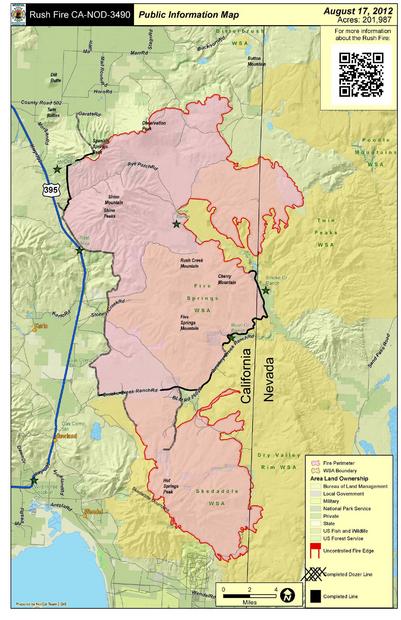
California wild horse country ~ Rush Fire map (Twin Peaks HMA) updated August 25, 2012


How many wild horses and burros were trapped by fencing in the fire?

Fire approaching Deep Cut area by Robin Blair 8.15.12


Rush Fire update in the Twin Peaks HMA

Susanville, Calif., Aug. 26, 7 a.m.–On Saturday, firefighters successfully held fire lines in the northeast part of the Rush fire in spite of gusting winds. Large dust devils were common and firefighters remained very busy fighting fire.

The threat from dust devils has led firefighters to go to the unusual length of mopping up for 500 to 1000 feet from fire lines into the burned area.  This tough work involves finding each and every hot spot and cooling them off.

In spite of the winds on Saturday, firefighters were able to hold the existing fire perimeter for the fourth day in a row.

The northeast flank is where the fire is most active.  This part of the Rush fire is in Nevada, about 25 miles northeast and east of Ravendale, Calif., near SOB, Garden and Burnt lakes, the Buffalo Hills, Antelope Basin, and Cottonwood Creek.

Helicopters with buckets dropped water on hot spots in the Cottonwood Creek area on Saturday.  In the southern and southwestern flanks of the fire on Saturday, firefighters continued repairing damage from fire-fighting activities.

The National Weather Service issued a red-flag warning for Sunday from noon to 10 p.m. because of low humidity and gusting winds.  The winds have the potential of fanning any remaining embers and hot spots.  Winds can also form dust devils that could carry hot material over containment lines into extremely dry unburned vegetation.

On Sunday, firefighters will continue their efforts to hold the fire to its current perimeter, to mop up and to make repairs on the western side of the fire.

Area and Road Closures in Effect: Public lands bounded by Highway 395 on the west, the Sand Pass road and Nevada 447 on the east, the Wendel Road on the south, and Juniper Ridge road to Buckhorn road on the north are closed. The Buffalo Meadows road in Washoe Co., Nev., is also closed.  The Ramhorn Springs and Dodge Reservoir campgrounds remain closed.

Remarks:   NOTE:  Use of chainsaws on public lands managed by BLM in northeast California and far northwestern Nevada is suspended because of extreme fire danger.  Fire officials remind residents and visitors that fire restrictions are in effect for public lands and national forests in northeast California and far northwest Nevada.  Campfires are permitted only in posted recreation sites.

For additional fire information, please go to InciWeb @ http://inciweb.org/incident/3151/


Started:  8/12/12 at 6:42 pm Expected Containment: 8/28/2012
Cause:  Lightning Committed Resources: 755 people
Fuels:  Fire is burning sagebrush, juniper,and grass Structures Threatened: 39 (20 residences; 1 commercial; 18 outbuildings)
Estimated Size: est. 320,793 acres (275,650 acres in California and 45,143 acres in Nevada) Structures Damaged or Destroyed: 1 (barn)
Containment: 66% Injuries: 3 minor


Stop the wipe out!

Permission given to share

“The proposed ‘final’ management plan is outrageous,” says Anne Novak, executive director of Protect Mustangs. “They want to wipe out all the wild horses and burros at the Sheldon Refuge. They have no respect for the stakeholders or biodiversity.”

Help California’s last wild horses stay on the range

Fire endangers wild horse habitat

Rush Fire photo August 20, 2012 (Photo © Phil Perkins)

Close to 300,000 acres of the Twin Peak wild horse range have burned as of midnight August 20th.

We are very grateful to the Rush fire crews working to contain the fire, protect the land, livestock, wild horses and burros and especially the community.

We ask the BLM to find a way to help the wild horses on the range by bringing them food and water as needed–until the forage grows back.

Rounding up California’s last herd of wild horses and removing them from their herd management area is wrong. We don’t want them to lose their legally designated range to livestock, energy and mining use. These other forms of public land use can move elsewhere for a while, if needed, but California’s wild horses need their home on the range.

Photo © Cynthia Smalley, all rights reserved

Rush fire info and map: http://inciweb.org/incident/3151/

Twin Peaks fire update


Twin Peaks HMA Rush Fire on Rye Patch Road August 18, 2012 (Photo by BLM)


Magic’s family in the Twin Peaks HMA ~ Rush Fire location (Photo © Grandma Gregg, all rights reserved.)

Rush Fire Update

August 20, 2012   8 am

   Turman’s Northern Rockies Incident Management Team

Fire Information Office:

530-710-8568

Staffed: 8:00 am to 6:00 pm

Started:  August 12, 2012 at 6:42 pm

Cause:  Lightning

Fuels:  Fire is burning in sagebrush, juniper, and grass

Estimated Size: 270,683 acres

Containment: 50%

Expected Containment: 8/25/2012

Committed Resources: Approximately 677 people

Structures Threatened: 9 (6 residences; 1 commercial; 2 outbuildings)

Structures Damaged or Destroyed: 1 (barn)

Injuries: 2 (both in fire camp)

Location: The fire is located on Bureau of Land Management (BLM), Northern California District (BLM-CA-NOD,) Eagle Lake Field Office, approximately 15 miles southeast of Ravendale, California.  The fire is burning near a major natural gas line and transfer station, and power transmission lines that supply the Reno area and adjacent to Highway 395.

Summary:   Line construction and suppression efforts will continue along the north eastern edge of the fire along the Buckhorn Road. The fire remains active along this edge. Burning operations on the southern edge of the fire near Wendel Road were successfully completed yesterday, and crews worked late into the night.  Today, crews will concentrate suppression efforts along the north eastern flank, south of Buckhorn Road; the eastern edge east of the Rush Creek Ranch, and in the Wendel Road area.  Additionally, crews will continue mop up and fire line construction along other areas of the fire’s perimeter.  Air support will available and used as needed.

Tomorrow there is a Fire Weather Watch forecasted for afternoon winds from the SW approaching 30 to 35 mph.

Today at 0600 the Northern Rockies Incident Management Team assumed command from NorCal Team 2.  Transitions of this sort are common, and operations should remain seamless.

Area and Road Closures in Effect: On August 17, the BLM issued a closure order for public lands in the fire area to protect public health and safety.  The closed area is bounded by Highway 395 on the west, the Sand Pass Road on the east, and the Wendel Road on the south.  The new northern boundary for the public land closure is the Juniper Ridge, Tuledad, Stage Road, Marr Road, and Buckhorn Road extending to Nevada Highway 447 in Washoe County. Routes closed within this closure area include the Ramhorn Springs, Rye Patch Road, Buckhorn, Shinn Ranch, Stoney, Deep Cut, Smoke Creek, Skedaddle Ranch, Dry Valley, and Brubeck roads. The Ramhorn Springs Campground and the Dodge Reservoir Campground also is closed.

Travelers along the Highway 395 corridor, please use caution where fire crews and equipment are working in the fire area.

Remarks: Fire officials remind residents and visitors that fire restrictions are in effect for public lands and national forests in northeast California.  Campfires are permitted only in posted recreation sites.  Chainsaws may not be used after 1:00pm daily.

For additional fire information, please go to InciWeb @ http://inciweb.org/incident/3151/

###

Ranching mentality that feels entitled to public land

America’s open range was often used by free grazers (nomadic cowboys with herds of cattle) until ranchers put up fences and threatened free grazers. Ranchers felt entitled to public land that they did not own but used.

Kevin Costner’s film OPEN RANGE illustrates the mentality that continues today–the mentality against sharing public land with America’s indigenous wild horse.

We encourage you to watch this film.


Desatoya roundup begins with foal abuse

“Hogtieing a young foal and leaving it in the middle of a stampede of wild horses shows how inhumane and incompetent the BLM’s roundup contractor is,” states Anne Novak, executive director of Protect Mustangs. “They should be fired immediately.”

“We are grateful Holly Hazard witnessed the alleged abuse,” Novak explains. “If she hadn’t seen this, the public would not have known that the cruel roundups are continuing despite the BLM’s promise for a ‘new normal’ by bait trapping.”

“We need more eyes on roundups to protect mustangs,” says Novak.

Read more about the incident here: http://rtfitchauthor.com/2012/08/17/problems-arise-at-desatoya-wild-horse-gather-in-nevada/

Immunocontraceptives: Tomorrow’s birth control?

Protect Mustangs is against using PZP and other immunocontraceptives on wild horses and burros at this time because it has not been proven that the herds are overpopulating nor damaging the thriving natural ecological balance and it appears to be risky.

The Bureau of Land Management’s (BLM) Appropriate Management Level (AML) is skewed ridiculously low to appease the public land mining, ranching and energy interests. Livestock is permitted on wild horse rangelands with livestock outnumbering wild horses and burros at more than 50 to 1.

We are very concerned about the low wild horse and burro population levels–estimated at less than 18,000 for the entire West–due to 3 years of roundup rampage.

Roundups will continue in order to administer fertility control unless they are permanently sterilizing the wild horses during roundups now.

Darting is not only a biohazard but is also impractical on rough terrain unless the BLM or their agents are chasing wild horses in helicopters to shoot them with the drug. Chasing herds is cruel.

The 1971 Act made it illegal to chase wild horses and burros with aircraft. Sadly The Act has been whittled away by enemies of the American wild horse and burro. Protect Mustangs is against helicopter roundups and terrorizing wild herds by chasing them over rough terrain where foals have their feet run off and die.

Predators, such as mountain lions, are reducing the population the way nature intended. We support allowing predators on the range.

Immunocontraceptives appear to have many drawbacks that you will read about in the article below. Most studies are paid to prove the drugs are OK so it’s important to notice the negative aspects for a more accurate perspective.

Fertility control is a billion dollar business for the human market. One must question the ethics of using America’s icons as lab rats.

 
Cross-posted  from Pennmidwifery

By Bonnie Urquhart, R.N.

Native Wild Horses in Utah (Photo © Cynthia Smalley, all rights reserved)

Feral mares grazing on Assateague, a barrier island off the Maryland coast, benefit from a contraceptive strategy that would leave many women envious. Their fertility is curbed by a method that employs neither hormones nor devices, but instead convinces the immune system to target reproductive components and render them inactive. Derived from the ova of pigs, the porcine zona pellucida (PZP) vaccine has been administered annually via dart gun to regulate the fertility of these fast-breeding animals since 1988.

An immunized mare comes into come into heat and mates as usual, but as soon as she ovulates, her immune system considers her endogenous zona pellucida foreign and spackles it with antibodies, blocking fertilization with an effectiveness rate of 90-100 percent (Kirkpatrick, Turner, Liu, Fayrer-Hosken, & Rutberg, 1997). Immunocontraception does not alter the normal reproductive behavior of these horses, is usually reversible if used for less than seven years, and does not appear to harm unborn foals if the mother is accidentally injected while pregnant. Until this approach was developed, feral horse overpopulation was a chronic headache for wildlife biologists determined to keep the large animals from outstripping their food supply and outcompeting native wildlife.

Vaccination against pregnancy is itself a unique concept. Traditional vaccines are derived from foreign proteins that sensitize the body to fight off microbial invaders. Immunocontraceptives reprogram the body to attack part of itself by attaching it to a foreign, non-tolerated molecule (Sprenger, 1995) (Schrater, 1995). By focusing on different target molecules, researchers can prime the immune system to thwart the production and transport of gametes, disturb the interaction of the gametes that leads to fertilization, or interfere with implantation. Zona pellucida vaccines focus on what may be the ideal target-the translucent glycoprotein extracellular matrix, surrounding all mammalian ova, that sperm must penetrate to achieve fertilization.

Nearly 100 species have been successfully contracepted with PZP vaccines, including rabbits, dogs, deer, elephants, gray seals, and non-human primates, as well as amphibians and fish. “Its application to wildlife…has been spectacular. We are fourteen years down the road with wildlife and it comes close to being the perfect agent,” says Dr. Jay Kirkpatrick, reproductive physiologist and developer of the PZP vaccine used today for wildlife management (personal communication, October 23, 2001).

Zona pellucida vaccines were being for considered for human contraceptive use long before Kirkpatrick’s research group adapted it for wildlife. Around the time it gained favor with wildlife biologists, researchers seeking human application were becoming quite discouraged. Native pig protein was not suitable for human use, and researchers were unable to develop an effective recombinant or synthetic form of human ZP (Kirkpatrick, 2001). Molecular biologists could synthesize the protein backbone of the molecule, but not the carbohydrate components. Without the carbohydrates, the vaccine would trigger immune response, but could not block fertilization.

Another problem is the vaccine’s tendency to become irreversible over time. Immature eggs within the ovaries are also surrounded by zona pellucida. An agent that sensitizes the woman against zona pellucida not only would cause her body to attack its mature ova at ovulation, but could also provoke an immune attack on her immature egg cells and inflammatory destruction of the ovary itself, causing permanent infertility (Feng, Sandlow, Sparks, & Sandra 1999) (Richter, 1996).

Adverse autoimmune reactions resulting in disruption of folliculogenesis and depletion in the primordial follicle pool have been observed in the ovaries of mice (Patterson, Jennings, van Duin, & Aitkin, 2000). Mares, rabbits, and dogs maintained on long-term PZP have sometimes shown abnormal hormonal profiles and altered estrus cycles. A wild mare vaccinated for three years might take between one and six years to regain fertility. After seven years, she may become permanently infertile. Women who desire a reversible method would find this effect unacceptable, but clinicians might someday find zona pellucida vaccines an attractive option for women who have finished childbearing.

Human immunocontraceptive research is not new. At least twelve studies in the 1920s and 1930s evaluated immunocontraception in the human female, but the trials were not successful and “unspecified ethical restrictions” ended the research (Richter, 1996). Better understanding of immune function and molecular biology has revived interest in immunocontraceptive research over the past two decades.

The most suitable candidates for contraceptive vaccine development are molecules on the surface of the gametes or on the fertilized ovum and early embryo and the hormones hCG and GnRH. Anti-gamete vaccines are the most attractive option because they do not disrupt an embryo after fertilization or alter the hormonal balance, but researchers have so far been unable to reliably block fertilization without introducing cross-reactions with other tissues (Schrater, 1995).

Bringing a product from the laboratory to the pharmacy is a long and expensive process, and funding sources are limited (Klitsch, 1995). After selecting a target molecule for study, biologists must isolate, characterize, and synthesize effective molecules from sperm or ova; understand mechanisms by which the immune system blocks fertility; develop an effective, benign adjuvant; create reliable, inexpensive tests to monitor fertility status in immunized individuals; and carefully evaluate the product for immunological and other side-effects (O’Rand & Lea, 1997) To market an effective immunocontraceptive, developers must progress from creating the vaccine in the laboratory to preclinical studies to clinical trials (Feng, Sandlow, Sparks, & Sandra 1999).

Because research and development are costly and regulatory obstacles to new drugs are forbidding, any pharmaceutical company that puts an immunocontraceptive on the market is likely to emphasize its effectiveness, play down adverse findings, and energetically court clinicians with free samples and gadgets. Artfully crafted advertisements will spark public excitement over this innovative contraceptive method, and as a result patients will request the medication without understanding much about its action. The CNM will serve as intermediary between hyperbole and hope, keeping clients grounded in reality as they discuss benefits and possible adverse outcomes.

Vaccines targeting human chorionic gonadotropin (hCG) show a higher likelihood of success than many other immunocontraceptive projects. Produced by the embryo to sustain progesterone production, hCG allows the pregnancy to establish and maintain itself. If antibodies disable the hCG molecule, progesterone drops and uterine endometrium sheds, preventing implantation. Because the result is loss of an early pregnancy, anti-abortionists strongly oppose developing an effective hCG vaccine and block U.S. government grants that would speed research (Klitsch, 1995). By 1995, three prototype hCG vaccines had undergone limited clinical trials in women (Schrater, 1995). The initial three injections lasted about 6 months, and did not affect menstrual cycles.

Unfortunately, the chemical similarity of hCG to luteinizing hormone (LH), follicle-stimulating hormone (FSH), and thyroid-stimulating hormone (TSH) apparently induces cross-reactions elsewhere in the hormonal system. Blocking some hormones and interfering with feedback mechanisms could conceivably wreak endocrine havoc, perhaps irreparably damaging the thyroid and the pituitary glands (Feng, Sandlow, Sparks, & Sandra 1999) (Richter,1996). The vaccinated woman would produce and then attack reproductive hormones, continuously creating immune complexes that could cause tissue damage. Or perhaps this reaction would prove to be benign; in short-term clinical trials of the hCG vaccine, all subjects developed cross-reactive antibodies to LH, and all continued to cycle normally. Female rhesus monkeys immunized repeatedly for seven years with ovine (sheep) LH became infertile but continued to ovulate, had regular menstrual cycles, and maintained normal pituitary function (Schrater, 1995).

Higher on the hypothalamic-pituitary-ovarian axis is gonadotropin- releasing hormone (GnRH), the hormone that spearheads the production of sex steroids in both men and women. The National Institute of Immunology and the Population Control Council have tested a GnRH vaccine on human subjects, including breastfeeding women (Schrater, 1995). The result is effective-but dramatic. The GnRH vaccine essentially effects non-surgical castration, halting testosterone production in men (with accompanying impotence and loss of body hair) and effecting menopause in women (Richter,1996). Hormonal supplements could remedy the deficit, but consumers are unlikely to find this approach acceptable. This technology would be more applicable to veterinary medicine, making possible non-traumatic spaying and castration and in wildlife biology the reduction of, say, deer herds in suburban neighborhoods where hunting is not feasible. Trials of GnRH vaccines on Norway rats resulted in 100 percent sterility in both sexes (Miller, 1997).

Potentially promising are experimental vaccines that target male FSH receptor proteins, inducing men to produce low-quality sperm incapable of fertilization but sparing them the need for exogenous testosterone supplementation. Other biologists have targeted prostaglandinF2, oxytocin, and structural placental antigens (Feng, Sandlow, Sparks, & Sandra 1999). It is the advanced practice nurse who must serve as the intermediary between technology and the client, translating technical information and exploring treatment options while considering the safety of the product.

Vaccines triggering an immune response against sperm could be used by either men or women. Laboratories have experimented with structural and functional antigens on the sperm itself, and with spermatic enzymes. Target specificity is the stumbling block-an immune response that incapacitates sperm also tends to induce the immune system to attack other organs and tissues as well.

With immunocontraceptives, there is often a reciprocal relationship between specificity and effectiveness. If a vaccine is very specific to one small antigen, there is little danger that the immune system will attack similar targets, but contraceptive action is ineffective. An agent that targets several components is much more effective, but the immune response is likely to involve other tissues. The immune system is intimately connected to every part of the body. The potential for an untoward autoimmune response is great, and tissue injury may be difficult to prevent. But perhaps this damage is purely theoretical: anti-sperm antibodies frequently occur in vasectomized men and some women spontaneously become immune to sperm with no identifiable systemic damage (Schrater, 1995) (Diekman & Herr, 1997). Women sometimes develop immune responses against their own zona pellucida as well, and seem to suffer no other ill effects (Schrater, 1995).

Kirkpatrick reports that Assateague mares, freed from the stress of pregnancy and lactation, have enjoyed improved health since the vaccine program started (Barber &Frayer-Hosken, 2000). Studies in horses and dogs show that although ovarian damage occurs, the PZP antibodies in a vaccinated animal do not cross-react with major organ systems such as the brain, heart, and urinary tract (Barber & Frayer-Hosken, 2000). Research with horses and other animals indicates that offspring born to previously contracepted mares, and even mares who were accidentally vaccinated while pregnant, appear normal and go on to produce normal foals themselves. Damage to human fetuses might be more subtle, perhaps manifesting in a chronically overstimulated or sluggish immune system or in hormonal anomalies that might not appear until puberty. We just do not know.

Potential lawsuits make domestic pharmaceutical companies reluctant to engage in immunocontraceptive research, but several companies around the world are optimistic. Canadian biotech firm Immucon has a patent for a male immunocontraceptive vaccine that neutralizes sperm fertilizing capacity by targeting a crucial zona pellucida sperm-binding protein at the level of the epididymus. The company expects to market the vaccine between 2005 and 2007. Immucon believes that reversible male immunocontraceptives will be an $850 million-a-year industry worldwide, and female immunocontraceptives will be worth $990 million a year (Immucon, 2001). Liability reform may encourage the pharmaceutical industry to conduct more contraceptive research (Klitsch, 1995).

Researchers are also exploring injectable agents that could render a man or woman permanently sterile. This could eliminate the pain and expense of tubal ligation or vasectomy while effectively ending childbearing.

Four out of every ten pregnancies in the world are unplanned-80 million a year (AGI,1997). The World Health Organization estimates that between eight million and 30 million unplanned pregnancies are the result of inconsistent or incorrect use of contraceptive methods or from method-related failure, and 120 to 150 million married women want to limit or space their pregnancies but lack the information and services to do so. Worldwide, 55,000 unsafe abortions take place every day, 95 percent of them in developing countries. Every day, more than 200 women die from these procedures (http://www.who.int/archives/whday/en/pages1998/whd98_10.html.). Optimally spaced and planned pregnancies benefit the health of both mothers and children. World population is expected to reach 10 billion by the year 2050, and overpopulation can lead to poverty, famine, disease, depletion of resources, and environmental degradation (Feng, Sandlow, Sparks, & Sandra 1999).

A safe, reliable immunocontraceptive agent could be the family planning strategy of choice for women in developing countries. Proper implementation, however, could strain resources. Clinicians must perform pregnancy tests before immunization and periodically screen recipients to verify that the vaccine is still effective.

If the perfect immunocontraceptive is developed, there would be tremendous potential for misuse and coercion by population-control programs to reduce the birth rate of the poor, non-whites, and people in Third World countries (Richter,1996). (Schrater, 1995). Judith Richter writes in The Ecologist “within this conceptual framework, birth control is regarded as a weapon of war against the ‘teeming multitudes,’ a war in which people are treated as mere numbers or statistics to be controlled, manipulated reduced and dispensed with” (Richter,1996, page 58). The reproductive rights of individuals could become secondary to the perceived need of the population as a whole.

There have been many documented cases of IUD insertion and sterilization procedures carried out without a woman’s knowledge or consent. Immunocontraception would make it much easier to surreptitiously render a woman infertile. Clinics could administer long-acting contraceptive vaccines to uninformed, unaware patients who think the injection is for protection against disease. Some immunocontraceptive agents, such as anti-sperm vaccines, could sensitize a woman for life, and it is likely she would never know that her inability to conceive was artificially induced. (Richter,1996).

Population-control programs usually focus on women because they are the ones who become pregnant. The subordinate status of women in much of the world makes them less likely to resist coercive fertility regulation policies. Conversely, state-imposed vasectomy programs in China and India led to social unrest and the downfall of a government (Schrater, 1995).

Immunocontraceptive clinical trails show great variability in effectiveness although research subjects are healthy, well-nourished individuals in supervised health-care settings. How effective will these vaccines be when used on anemic, malnourished people with little access to care? Immune response varies greatly between individuals and even within an individual, and the duration of protection from pregnancy may be difficult to predict. Individuals with the tendency towards allergies and autoimmune disease could experience an exaggerated reaction that might render them permanently infertile (Richter,1996). Diseases that suppress immunity might reduce the effectiveness of the vaccine.

Researchers talk of developing a finger-stick kit that could be used in the home so that vaccine recipients could monitor their own fertility status and use additional protection if titers are low. It is unclear how feasible these kits would be in Third World counties with few health care supplies.

The ideal immunocontraceptive would be a highly effective, fully reversible vaccine effective for a predictable period. Today’s immunocontraceptives are prototypes in need of improved formulation that will give longer acting, reliable responses with little chance of cross reaction, and offer a high level of protection against pregnancy. Our knowledge of molecular biology grows daily. New vaccine technology may soon isolate target antigens that are much different from the substances synthesized now, creating a safe, effective product that will change the lives of millions. The leadership of nurse midwives will help clients process information and make informed decisions about contraceptive vaccines when they begin to reach the market.

References

Alan Guttmacher Institute. (1997). Issues in Brief: The Role of Contraception in Reducing Abortion. New York: Alan Guttmacher Institute.

Barber, M. Frayer-Hosken, R. (2000). Possible Mechanisms of Mammalian Immunocontraception. Journal of Reproductive Immunology 46 (2): 103-24.

Diekman, Herr, J. (1997). Sperm antigens and their use in the development of an immunocontraceptive. American Journal of Reproductive Immunology 37(1): 111-117.

“Contraception Update” (1998). FHI’s Contraceptive update: Experimental male methods inhibit sperm Quarterly Health Bulletin Network

Feng, H. Sandlow, J. Sparks, A., Sandra, A. (1999). Development of an immunocontraceptive vaccine: current status. Journal of Reproductive Medicine 44 (9): 759-765.

Kirkpatrick, J., Turner, J.W., Liu, I.K., Fayrer-Hosken, R., Rutberg, A.T. (1997). Case studies in wildlife immunocontraception: Wild and feral equids and white-tailed deer. Reproduction, Fertility, and Development. 9 (1): 105-110.

Kirkpatrick, J. (October 23, 2001) Personal communication with author.

Klitsch, M. (1995). Still waiting for the contraceptive revolution. Family Planning Perspectives 27 (6).

Miller, L., Johns, B.E., Elias, D.J., Crane, K.A,. (1997). Comparative efficacy of two immunocontraceptive vaccines. Vaccine 15 (17-18): 1858-62.

Moudgal, N.R., Jeyakumar, M., Krishnamurthy, H., Sridhar, S., Martin, F. (1997). Development of a male contraceptive vaccine-a perspective. Human Reproduction Update 3 (4): 335-46.

O’Rand, M., Lea, I. (1997). Designing an effective immunocontraceptive. Journal of Reproductive Immunology 36: 51-59.

Patterson, M. Jennings, Z.A., van Duin, M., Aitkin, R.J. (2000). Immunocontraception with zona pellucida proteins. Cells Tissues Organs 166 (2): 228-32.

Richter, J. (1996). “Vaccination” against pregnancy: The politics of contraceptive research. The Ecologist 26 (2): 53-61.

Schrater, A. (1995). Immunization to regulate fertility: biological and cultural frameworks. Social Science and Medicine 41 (5): 14.

Sprenger, U. (1995). Challenging the immune system, the development of anti-fertility vaccines. Biotechnology and Development Monitor 25: 2-5.

World Health Organization. (1998). World health day/Safe motherhood, 7 April 1998: Address unsafe abortion [Online] http://www.who.int/archives/whday/en/pages1998/whd98_10.html.

2001 Bonnie S. Urquhart

dawnhorse3@home.com
www.eohippus.net