Marilyn wanted to stop the mustang killings too
Reply
With slow, gentle training and love, an adopted wild horse can easily get his feet trimmed. This horse is part of the Discover Mustangs project. If you are considering adopting a wild horse and have any questions feel free to contact us.

Captured wild horses Nevada Jan 2012 (Photo © Anne Novak, all rights reserved.)
In the news on 1/15/12 Reno Gazette-Journal Sunday Edition BLM not gelding stallions now in wild horse roundup, but doesn’t rule it out http://on.rgj.com/wydWBC
Anne Novak, executive director of the California-based Protect Mustangs, said she and other wild horse advocates oppose castrating stallions as a method of birth control. She said the use of birth control drugs “is definitely something to look at,” but said the BLM’s wild horse policy is fatally flawed because the agency has no accurate count of wild horses on the range.
“Before we talk about birth control, we need to know how many wild horses are out there,” Novak said. “We need an accurate individual head count.”
She said the BLM’s estimates are inflated and result in taking so many wild horses off the range that genetically viable herds will vanish. The disagreement between the BLM and horse advocates, she said, is whether the animals are overpopulating the range or facing extinction because of the agency’s frequent roundups.
Frank Mullen did a story on this wild horse death last week in the Reno Gazette-Journal. Here’s the follow-up by Mark Robison. Warning: The photos are horrific. How would the kids, allegedly responsible for this, feel if they saw the photos?
The story and photos: http://on.rgj.com/wirJHl

Reno's wild horses (Photo © Anne Novak, all rights reserved.)
We drove around the outskirts of town looking for wild horses with photographer Cynthia Smalley. After locating a single mare, stud and foal band we continued our suburban boarder safari. Finally we found them in a small meadow near a stream. We parked at the end of a housing development, crossed a stream and found very friendly free roaming wild horses.
When we arrived, people were feeding the mustangs apples. This must be why they came right up to us. We never feed wild horses but we do enjoy taking their photos and connecting with them when they are used to people.
Photographer Cat Kindsfather joined us later in the field to share the beauty of the light and the wild horses.
Thumbs up to Reno for an awesome nature experience!
The Bureau of Land Management (BLM) has the legal right–under the 2004 Burns Amendment passed by Congress–to dispose of America’s legendary wild horses through “unlimited sales”. People buying truckloads of wild horses generally sell them to slaughter. In August 2011 one such truckload was busted on it’s way to slaughter.
BLM claims it does not sell wild horses to slaughter directly at this time. . . In effect, the middle man buys the truckloads of wild horses and sells them to the slaughterhouse.
It’s time for more eyes on roundups and more eyes on wild horses in holding.
The public wants to re-protect America’s wild horses especially with horse slaughter plants scheduled to reopen in the U.S.A.
Ask Congress to STOP the roundup$ now.

OBAMA poster © Lise Stampfli 2009
Thank you Lise Stampfli for creating the popular poster for the Stop the Roundups! launch of nationwide and international protests, conceived of and organized by Anne Novak, in San Francisco, December 2009, outside of Senator Feinstein’s office.
Wild horse supporters may use this poster at peaceful protests.
Young wild horses are getting injured or killed after being rounded up. Stop the Roundup$.
Share the video, write letters to your senators and representatives to ask for what you want and make a donation so we can save some Calico Complex wild horses.
Let’s end this tragedy and have a Happy 2012!
RENO, Nev. (AP) — The head of the U.S. Bureau of Land Management in Nevada is appealing to agency employees to step up and blow the whistle on any abuse of mustangs.
Amy Lueders said that’s the best way to stop horse protection advocates from undermining the agency’s roundup policies with video footage of the mistreatment of the animals and making it harder for federal land managers to win the public’s trust.
“Regardless of title, whether you are a contractor or law enforcement or public affairs, that’s everyone’s responsibility,” she said in an interview with The Associated Press.
In the past year, BLM has been taken to task by its own internal auditors, independent reviews, a U.S. district judge and camera-toting horse advocates.
A BLM task force that reviewed a roundup near the Nevada-Utah line in July found some mustangs were whipped in the face, kicked in the head, dragged by a rope around the neck and repeatedly shocked with electrical prods.
Twice this year, BLM has issued reports or statements pledging reforms to ensure humane treatment only to have videos of new incidents of mistreatment surface within days.
In the most recent case, this month, Ginger Kathrens was pointing her camera at the wranglers who appeared to be repeatedly shocking several burros with an electric prod.
The practice, called “hot-shotting,” is used to help move them into a pen or trailer and it was being employed the same day BLM chief Bob Abbey issued a report pledging more changes.
Among other things, the report said electrical prods should be used only as a last resort when human or animal safety is in jeopardy, and that they should never be used on a horse’s head or genitals.
“I thought it was ironic that while Bob Abbey was announcing the reforms I was filming the hot-shotting of the burros,” said Kathrens, an Emmy-award winning filmmaker who is the executive director of the Colorado-based Cloud Foundation, a nonprofit horse advocacy group.
Kathrens said she was about the length of two football fields away when, zooming in with her professional lenses, she captured the footage. The video showed the end points on the prods producing a shock when a wrangler lifted it into the air.
Most disturbing to Kathrens was that officials for the U.S. Agriculture Department and BLM were standing near the wranglers and witnessed the shocks but did nothing to interfere.
Kathrens said BLM officials told her privately they shared her concerns in that regard.
That’s where Lueders said agency workers have to do a better job.
Lueders delivered that message to several dozen employees in a video teleconference involving all of Nevada’s BLM offices last week, saying there’s no excuse for turning the other way if they get wind of any inhumane treatment of animals.
Lueders said, however, that it may be easier said than done when it comes to persuading workers to step up in what is often a controversial, and emotionally charged, situation.
But she said she believes her message got through.
“I made it very clear that is my expectation,” she said. “We have a lot of committed, passionate people here who care very much about the resource and the animals themselves. You can tell by that passion and professionalism that everyone takes it very seriously.”
Lisa Ross, a public affairs specialist for the BLM in Winnemucca, said Lueders’ words have been well received and will be taken seriously.
“It’s a very important message to hear,” Ross said. “It doesn’t mean that everything was wrong and now we are making it right. It’s just that it is important and everybody needs to be on the same page on this.”
About 33,000 wild horses freely roam 10 Western states — about half in Nevada. Another 41,000 are kept in government-funded facilities, including one in Herriman, Utah, that came under fire as a result of more video footage taken by horse protection advocates last spring.
A BLM task force asked to investigate issued a report in September confirming “unacceptable” conditions at the overcrowded facility where horses were forced to stand in a 4- to 8-inch deep mixture of mud and manure. BLM has since moved those animals elsewhere.
It was videotape of a helicopter either nudging or getting extremely close to a mustang in August during a roundup in northeast Nevada near the Utah line that prompted U.S. District Judge Howard McKibben to give BLM a stern lecture.
McKibben granted a temporary restraining order requiring helicopters to keep their distance from the galloping mustangs.
Lueders said it is important to remain open to criticism.
“I think we all learn more from each gather,” she said. “Each gather gives us another opportunity to improve what we do.”
Kathrens is among those who believe BLM officials are sincere and is optimistic real reform may soon follow on the range.
But Anne Novak, executive director of Protect Mustangs, based in Berkeley, Calif., isn’t so sure. She said there should be a moratorium on roundups until the agency proves they have mechanisms in place to guarantee safe and humane treatment of the horses.
“The BLM must take responsibility to train their contractors before turning wranglers loose with whips and cattle prods,” she said.
Copyright © 2011 The Associated Press. All rights reserved.

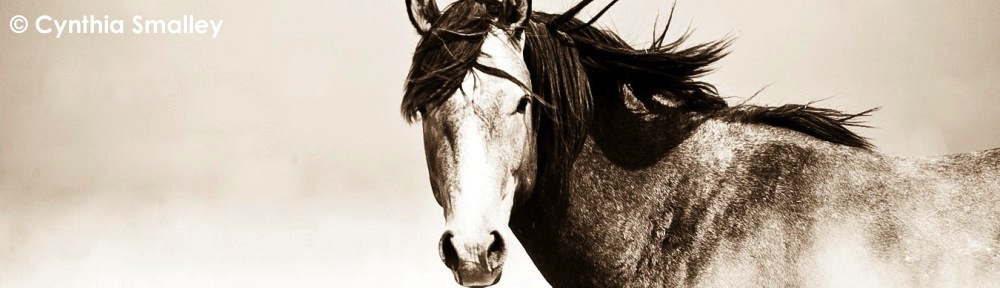
Wild War Horse (Photo © Cynthia Smalley, all rights reserved.)
California is home to some wild horses blended with ancestors of WW1 cavalry remounts. These treasured herds are found east of the Sierra Mountains, between Susanville and the Nevada border.
“We want to see horses treated humanely–they have carried us in battle and helped us plow the fields–just like in the movie WAR HORSE,” explains Anne Novak, Executive Director of California-based Protect Mustangs. “American wild horses deserve humane treatment. BLM needs to revamp their protocol to ensure the horses’ safety as well as create transparency within the Wild Horse and Burro Program. Right now too many bad things are funded with taxpayer dollars.”
Protect Mustangs’ mission is to educate the public about the American wild horse, protect and research wild horses on the range and help those who have lost their freedom.