| Via email: blm_ut_fm_swasey@blm.gov
December 4, 2012
Michael D. Gates, Field Manager
Bureau of Land Management
Fillmore Field Office
95 East 500 North
Fillmore, UT 84631
Attention: Eric Reid
Subject: Swasey Herd Management Area Wild Horse Gather Plan EA
Document ID: DOI-BLM-UT-W020-2012-0024-EA
In response to the subject Wild Horse Gather Plan Preliminary Environmental Assessment (EA), I am submitting my observations and recommendations as an interested party in behalf of the wild horses of the Swasey Herd Management Area (HMA). The document in question is linked below:
http://www.blm.gov/pgdata/etc/medialib/blm/ut/natural_resources/wild_horses_and_burros/swasey.Par.89274.File.dat/SwaseyEA2012.pdf
The Agency’s Preferred Alternative
Fillmore Field Office (FFO) proposes reduce and contracept, in January 2013, the population of the Swasey wild-horse herd. Of the 350 wild horses (including foals born this year) that FFO estimates-extrapolates to be present at this time …
262 — would be rounded up (75 percent gather-efficiency),
162 — would be removed per strategies designed to suppress population growth,
100 — would be released back after contracepting the mares, and
88 — would be assumed to have eluded capture, leaving …
——-
188 — in the Swasey HMA.
Of the 100 horses released, 50 would be stallions while the other 50 would be mares contracepted with PZP-22. However, the gender ratio would, evidently, either be assumed to be 60:40 in favor of stallions, or to eventually reach that level after subsequent roundups.
Based on my review of the plan outlined in the PEA, I urge FFO to …
- Select the “No Action” Alternative,
- Cancel plans to remove any horses from this HMA, and
- Abandon plans to contracept any mares.
No population control efforts are warranted. On the contrary, the Swasey herd needs to grow.
The Plan Would Require Certain Actions — How Much Do They All Cost?
The EA does not address the costs that would be incurred in carrying out the proposed actions that would be required by the Plan:
- Population inventories and monitoring flights via contract aircraft services,
- A helicopter roundup of hundreds of wild horses,
- Fertility-control treatments administered to mares,
- Removal of scores of horses,
- Transport of those horses,
- Short-term holding to prepare horses for adoption, and
- Long-term holding for the horses that are not adopted.
The proposed expenditures of government funds have not been estimated and justified. FFO must complete an analysis of all costs, both immediate and long-term, of the action it proposes.
The cost-benefit analysis needs to crunch the numbers to ensure that public funds are spent prudently. A thorough analysis will bring clarity to the decision process. You may very well determine that a better use of those funds would be for range improvements and rain-catchment projects. The documentation supporting the cost-benefit analysis must be incorporated as an attachment to the environmental assessment (EA).
The Agency’s Action Goal
The PEA states that the goal of the proposed roundup and removal action is to protect the range from overgrazing. Another goal is to reduced the wild horses’ alleged competition with livestock and wildlife.
Many Goals, One Solution
To achieve all of the above goals, here is the solution: Leave the wild horses on the range, allow their numbers to rise to scientifically-valid levels that ensure genetic viability, and increase livestock grazing — using Holistic Management. This solution will restore the range and increase the effectiveness of the area’s rainfall, promoting spring and stream vitality.
The Range Is Under-Grazed
Like most everyone else, I too assumed that the rangeland needed to be protected from over-grazing by limiting the number of herbivores and letting the land rest. Such an approach seemed like the logical management solution. Apparently, however, that theory was wrong.
Eminent biologist, environmentalist, and farmer Allan Savory has developed what he calls the “Holistic Management” approach to grazing. Savory has made important discoveries about both the cause of, and cure for, desertification. He demonstrates how to prevent or reverse degradation of the rangeland using increased numbers of grazing animals — up to 400-percent more. I was skeptical at first, but forced to consider the method, given its success and the abysmal failure in our own western states to restore rangeland health using seemingly “logical” methods.
The upshot is that in “brittle” landscapes such as those of the American West, the correct — albeit counter-intuitive — recommendation is to increase the number of grazing animals to create more “disturbances.” Thus, rather than reduce the number of wild horses — and/or the number of livestock — the answer seems to be to raise those numbers. Given the decline in the beef-producing sector, the trend of not using, or under-using grazing slots can be expected to continue. The Swasey wild-horse herd should be encouraged to flourish to make up for the lack of livestock. Biodiversity is key. You don’t want a mono-culture.
At the link below is the video of Allan Savory’s lecture “Keeping Cattle: Cause or Cure for Climate Crisis?” There’s an excerpt first, to sample.
http://www.feasta.org/events/general/2009_lecture.htm
Recommendations: FFO should send staff members that deal in range management to the next Holistic Management workshop sponsored by the Savory Institute. By learning this range-management approach and then implementing it, FFO could very well succeed in achieving harmony and cooperation among the various grazing animals and their stakeholders …
- Livestock — permit-holders,
- Wildlife — ecologists, hunters, photographers, and
- Wild horses — photographers, recreational visitors, advocates
… while at the same time improving the rangeland. Wouldn’t those be good things?
Below is the link to the Holistic Management International site. Disclaimer: I have no connection with this organization.
http://holisticmanagement.org/
Commensals Don’t Compete — Equids Enhance Livestock Production
Commensals are animals that eat “at the same table” — without competing. New research has disclosed that cattle gain more weight when grazed with equids. Please see the Princeton University report, linked below. It is time to stop the range war. Forage-grazing is not a zero-sum game. Everybody can win without anyone losing, if the range is managed holistically. There can be more grazing and more grass.
http://www.princeton.edu/main/news/archive/S32/93/41K10/index.xml?section=featured
Grazing animals have a cooperative relationship to one another. FFO would do well to emulate Nature.
Symbiosis — Wild Horses LIke Old Growth — Cattle Prefer New Growth
Wild horses utilize coarse, old-growth forage. Horses are like lawn mowers. They take off the top growth — the dry, unpalatable upper layer. The equine grazing method enables the plants to put down deeper roots, and it prevents weeds from maturing to produce seeds. Grasses are encouraged by the horses’ frequent “mowing.” In addition, the fuel-load is reduced, helping to prevent wildfires.
Livestock, in contrast, prefer tender new growth. They will even return to patches previously grazed — not rested — to get at that new growth.
http://msucares.com/livestock/beef/stocker_apr2011.pdf
Thus, wild horses make the range better for livestock. You need more horses, not fewer. The way to help the livestock industry is by improving the range through holistic management.
Drought — A Man-made Disaster from Under-Grazing
It might be pointed out that water is ultimately the limiting factor in how many animals can be grazed. Savory says just the opposite is the case. Increased grazing increases the effectiveness of the rainfall and leads to the restoration of previously dried up seeps and streams. Here’s the link to the article.
http://www.savoryinstitute.com/wp-content/uploads/2012/07/U.S.-Drought-Manmade-Natural-Disaster-July-20121.pdf
Aerial Mark-Resight Method — Counts Wild Horses Over and Over
It is nearly impossible to accurately count mustangs by means of a helicopter flyover, hard to tell horses apart and to know for sure that they haven’t been counted already. Due to wild horses’ wandering nature — they are known to roam up to 50 miles a day — many instances of counting the same animals is probable, especially when the inventory is performed over the course of a few days. Therefore, it is likely that horses are double-counted, and not per the “simultaneous double-count” or the “mark-resight” methods BLM touts, but literally by counting many horses twice, perhaps even more than twice. Indeed, the wild horses may have been particularly mobile, frightened into fleeing the deafening roar of the helicopter.
An aerial inventory also tends to include cows, deer, and “rock horses,” which fool the eye particularly when one is high above the landscape in an aircraft traveling at relatively high speeds. Related to this phenomenon is observer fatigue, which sets in after hours in a cramped, stuffy aircraft cabin, craning one’s neck to peer out the grimy windows, counting and photographing what look like they might be horses. The process repeats. And repeats. It gets tiresome. Airsickness may become an issue. The aircraft contractor and the census-takers know what they are supposed to find: Excess horses. Funds have been budgeted for a roundup, and with government allocations, it’s either “use ’em or lose ’em.” Why, even the worst-case modeling projections say there should be excess horses — just like the estimates predicted and the extrapolations seemed to show. So, excess horses are “found.” Confirmation bias at work.
FFO needs an accurate method of taking inventory. The current approach has proven unreliable. Impossibly-high estimates of wild horse populations have led to unnecessary removals, costly holding, and impaired relations with grazing permit-holders (who become alarmed by reports of a mustang population explosion) and wild-horse advocates (who know there cannot be even half the number of mustangs on the range that BLM claims).
Recommendations: FFO should contract the census-taking function to independent experts, ideally ones associated with a university that has a strong animal sciences program. FFO should research new technologies for remotely tracking wild horses and then procure the telemetry system that best serves the purpose. There might even be a way to link the tracking devices to a data-base that would store comprehensive information on each animal. By employing technological approaches to tracking, FFO will secure accurate, reliable data for management purposes, including a complete demographic breakdown of the wild horses in the HMA along with every equid’s genetic profile and personal history.
No Horse Left Behind
The helicopter contractors who, in addition to the flat-fee-for-service, earn a per-horse-fee, leave no horse ungathered. Indeed, just weeks ago, during the Wassuk HMA roundup, we saw how determined the contractors were to get their per-horse payment. We also observed how the attending USDA veterinarian and the BLM official did nothing to stop the abuse.
http://www.youtube.com/watch?v=pemjKJX8Muc&feature=youtu.be
Aircraft Census and Gather Contractors — Apparent Conflicts of Interest
The helicopter contractors used by BLM for conducting inventories and roundups know the score. If “excess” horses are found and/or if “outsider” horses are spotted, a roundup will be scheduled and they can make some serious money. Thus, they are motivated to find — or create the appearance of — an over-population and horses outside the HMA’s boundaries.
Doing so is easy. During inventory, they can criss-cross the same area multiple times, deceiving the census-takers into counting the same horses over and over. In fact, just flying over a herd with a chopper can spook the horses into a stampede, sending them fleeing outside their HMA, which would again target them for removal. Such tricks accomplish four things that inure to the financial benefit of the helicopter contractor. They …
- Gin up the number of horses that appear to populate the HMA,
- Cause horses to be counted over and over — one or more times inside, at least once outside,
- Automatically target “excess” and “outsider” horses for removal, and
- Result in the appearance of a need for a roundup — and the need to remove more horses.
Thus, the helicopter inventory method presents an apparent conflict of interest. The potential conflict pertains to the incentive to increase revenues through providing billable services and more billable horses.
A second conflict of interest arises at roundup. The helicopter pilot flies off alone across an area spanning many square miles. When he returns with a band, all he has to do is tell the agency officials that the horses were found outside the HMA boundaries in order to collect his fees.
Recommendations: First, reform census methods as earlier advised. Then, reform roundup procedures by abolishing the helicopter-stampede method and instead, employing bait trapping. These corrective actions should eliminate the conflicts of interest.
Outsiders? Maybe Not
It has come to my attention that the boundary lines of this and other HMAs may have originally been drawn inaccurately. Further, I understand that seasonal migration routes may have been omitted. These errors have never been corrected. Thus, wild horses accused of overcoming fences and stepping over the line may be innocent. Their removal would be wrongful.
Recommendations: FFO needs to investigate how the boundary lines of the Swasey HMA were first set and promptly correct any errors and omissions. The HMA boundaries must conform to their proper configuration and must provide corridors for the horses’ seasonal migrations.
Outsiders — Dealing with Roving Equids
Horses will roam. It is their nature. It is management’s duty to keep them from places they should not be. Prevention is key. However, removing horses that have wandered outside the boundaries of an HMA — “outsiders” — just creates a vacuum for “insider” horses to fill. Thus, removing “outsiders” is an ineffective population-control strategy. The elimination of mustangs from an open, accessible habitat results in repeated colonization by more mustangs. The process begins almost immediately, as horses roam into the area and see that it is attractive and vacant. Thus, removal is not a true solution — it just perpetuates the situation and leads to the elimination of more mustangs than necessary. Moreover, the outsiders may be only temporary visitors or refugees, not permanent residents. Worse yet, they may have been driven outside by the helicopter.
Recommendations: Management should first encourage the outsiders to return to their proper place, then address those factors that caused the animals to leave home. Do fences need repair? Do gates need to be checked frequently and closed? Would palatable plantings draw the wild horses to the areas FFO wants them to use? What about siting mineral licks inside the HMA? Have guzzlers been installed to provide water sources within the boundaries? FFO should specify preventive measures in this regard as part of its management approach. Return outsiders to the HMA. Fence the HMA perimeters — after expanding them to correct all boundary-line discrepancies, migration routes, and any herd-area land previously taken away.
Minimum Feasible Level of Management — Means Hands Off to the Max
The Federal Regulations at 43 CFR 4710.4 “Constraints on management” state, in part: “Management shall be at the minimum feasible level necessary to attain the objectives identified in approved land use plans and herd area plans.”
The plain meaning is that FFO should intervene only minimally — that is, to manage only to the degree necessary to meet standards. Thus, assuming a correctly set AML, management would need to lower the herd level to the high bound of the AML to be considered in compliance.
This point has been misconstrued. Many BLM offices interpret it to mean that the Agency is required to reduce herd size to the low — or below the low — AML. Thus, BLM strives to keep a herd at the very tipping point beyond which it would go extinct. This is what could be called “brinksmanship management” — gambling to see how low a herd can go. If there is to be a self-sustaining herd, it needs to be of a robust size in case of random catastrophic events.
BLM’s misinterpretation of “minimum feasible level” results in managing at the maximum feasible level — in other words, too much. For the herd in question, there is no justification to reduce its population at all at this time because its numbers have yet to reach science-based levels. Reducing the herd anyway, is excessive. The regulations in question are not for BLM’s administrative convenience and cost savings, but to ensure viable herds that are minimally disturbed.
Genetic Health of the Swasey Wild Horses
Removing horses without regard to their genetic status is not responsible management.
Recommendations: The correct order is to test first, then — supplied with the necessary stud-book data — make informed decisions. FFO needs to conduct a 100-percent evaluation of the Swasey herd’s genetic health before taking any action on removals or contraception. Armed with those results and guidance from the Equine Genetics Lab, FFO must then develop management actions to maintain gene-pool diversity and herd viability.
Wild Horses — Vulnerable to Inbreeding When Herd Size Is Small
The draconian removals FFO contemplates would amount to “over-harvesting” of the wild-horse population. The sudden loss of most herd-members would be experienced as a random — stochastic — disaster from the herd’s perspective. True reform is urgently required.
With wild horses, herd-size does matter. In a study report provided to USFS and BLM, US Geological Survey researchers cautioned:
Wild horses may be more vulnerable than many mammals to inbreeding depression at low population levels due to: (1) a harem breeding structure that limits breeding males mostly to harem holding stallions, and (2) a dominance hierarchy that usually delays harem holding and breeding in males until six to seven years of age or older.
http://www.blm.gov/pgdata/etc/medialib/blm/wo/Planning_and_Renewable_Resources/wild_horses_and_burros.Par.91906.File.dat/Strategic%20Research%20Plan.pdf
FFO needs to ensure an optimal number of horses to keep the Swasey herd genetically viable.
Species-Level Extinctions v. Regional, Local Extinctions
Some might be tempted to argue that if the Swasey herd went extinct, the species equus caballus would still exist — that replacement horses from other HMAs could be translocated, instantly recreating the herd.
No. Only the herd name would be the same. The new horses wouldn’t have been molded by natural selection to be best suited for survival in this particular ecological niche. Valuable traits, well-worth conserving, would have been lost.
The fundamental questions are: Would it be acceptable to planfully exterminate the regional or local population of any species for convenience, merely because others of that species exist elsewhere and could be reintroduced to take their place? Is it okay for humans to create deliberate extinction events? If those humans have been given stewardship responsibility over a population of a particular species, do they not have the duty to preserve and protect its unique genetic profile? Would not keeping the population well below minimum standards, putting it on the brink of extinction, then contracepting all the females, be irresponsible management? Would not a refusal to allow a flourishing, self-sustaining population be deemed unethical or even criminal?
Suggested New Approach for Establishing Correct Herd Sizes
The concept of “appropriate management level” — formerly referred to as the “AML” — has outlived its usefulness and needs to be reformed and renamed. A replacement term and acronym are desirable. The low levels to which herds are being held are “appropriate” only in the sense of being administratively convenient for BLM. The limits placed on herd size are unscientific. Even the upper bounds — the high ends of the ranges — are typically insufficient for wild horse herds to be genetically self-sustaining.
To remedy both issues, it is herein proposed that herd size be determined per the “proper population parameter” — PPP or P³ –“P-Three.” Each P³ would have a baseline — a starting point — of at least 500 or 2,500 horses. Where do these numbers — 500 and 2,500 — originate? They are the recommendations of the International Union for Conservation of Nature (IUCN), the world’s oldest and largest global environmental organization. The IUCN is a neutral forum for practical solutions to conservation challenges and a leading authority on the preservation of genetic diversity in wild equids, including feral horses and burros.
The IUCN notes that the selective pressures wild equids have endured in the wild are likely shaping them genetically to be hardy stock that could prove useful as a genetic resource. The recommended population sizes for the conservation of genetic diversity fall into one of two approaches:
- Captive populations — minimum size: 500 individuals, a studbook, and careful genetic management; or
- Wild populations — minimum size 2,500 individuals (no studbook, no genetic management).
I could find no indication that FFO maintains a studbook of wild horses under its jurisdiction or practices any true genetic management. Hopefully, FFO is ready and willing to comply with the requirements that would allow each herd to be maintained at only 500 individuals. To do so, it would need to:
- Perform a complete genetic evaluation of the herd as it stands now,
- Create and maintain a studbook for the herd, and
- Practice careful — timely, accurate, responsible — genetic management.
Lacking the above, then herd size needs to grow to at least 2,500. Note that 2,500 is not a maximum but a minimum size. Higher numbers would be better. Because the subject herd has an exaggerated / estimated / extrapolated population (350) that fails to reach the minimal threshold of 2,500 individuals, lacks a studbook, and has not been carefully managed genetically, it is under-populated. Therefore, the HMA at issue needs to increase its wild horse herd-size baseline accordingly.
To summarize, the P³ for the wild horses of the Swasey HMA should be, according to the management model selected, at least either …
500 with a stud book and careful genetic management — or —
2,500 wild horses without maintaining a stud book and careful genetic management.
By increasing the herd population, the HMA would be brought into compliance with up-to-date scientific thought concerning adequate herd size. These proper population parameter — the P³ — would be foundational to FFO’s best management practices relative to protecting and preserving the Swasey wild-horse herd. Here is the link:
http://data.iucn.org/dbtw-wpd/edocs/1992-043.pdf
Minimum Viable Population (MVP) — Meta-Analysis Says ~ 5,000
Just when you think the answer to MVP has been found, a newer study is published. The latest conclusions regarding MVP arose from a meta-analysis of the scientific literature spanning the preceding 30 years. The researchers filtered hundreds of studies and selected 141 sources covering 212 unique species whose distribution was skewed toward heavier animals, particularly mammals.
Across all species, the median MVP was 4,169. The “bootstrapped 95% confidence bounds” MVP for all species ranged from 3,577 to 5,129.
With regard to mammals, the median MVP was 3,876. The “bootstrapped 95% confidence bounds” MVP for mammals ranged from 2,261 to 5,095.
The conclusions: In general, conservation practioners should aim for an MVP of approximately 5,000. Specifically, the authors state: “… we recommend the upper 95% confidence limit of MVP….” Hence, we get a round number — a numerical threshold of approximately 5,000 — to inform conservation management practices.
The link below takes you to an article discussing the meta-analysis’ findings. It provides some additional information per an interview with the lead author: A minimum population of 500 could guard against inbreeding. This figure corresponds to the IUCN-recommended level that also requires maintenance of a stud book and close genetic management.
http://www.americanscientist.org/issues/pub/a-magic-number/
Here is the link is to the meta-analysis report itself.
http://coreybradshaw.files.wordpress.com/2011/03/traill-et-al-2007-biol-conserv.pdf
How Would the New Levels Look?
Here are some numbers for you to compare and contrast. Those for the Serengeti Ecosystem have been provided for an interesting comparison and are sourced from the IUCN report.
Swasey HMA
Size: 134,965 total acres
Current Maximum Management Level: 100 wild horses.
Acres per horse: 1,350
P³ IUCN Herd Size (with management): 500 wild horses
Acres per horse: 270
P³ IUCN Herd Size (no management): 2,500 wild horses
Acres per horse: 54
P³ Meta-Analysis Prescribed Herd Size: 5,000 wild horses
Acres per horse: 27
Serengeti Ecosystem — home to 70 large mammal species (eg., wildebeest, gazelle)
Size: 7,680,000 acres
Estimated equid population: 256,562 wild zebras
Acres per zebra: 30
Recommendations: Aim to implement a Plan that raises the wild-horse proper population parameter to 500 for the Swasey herd, choosing to adopt the strict management approach. Remove no horses. Contracept no mares. Impose no skewed gender ratios.
Reasons: The current appropriate management level, set 26 years ago, has been invalidated by subsequent scientific studies. Herd size must increase significantly over the current AML. Genetic diversity is more likely to result from an optimal population level rather than a minimal one. The P³ approach will comply with the Act and the CFR et al. regarding a thriving, self-sustaining herd.
Drastic Reductions in Herd Size Leads to a Non-Viable Gene Pool
I would urge the FFO to study the topic of “genetic drift.” An excellent resource is linked below. Please note that stochastic events — random, chance happenings — can eliminate important survival-supporting, adaptive genes from a population. BLM’s sudden, draconian removals and mass contraceptive application could randomly wipe out certain traits that are valuable and well-worth conserving.
Please study the danger of creating a “population bottleneck,” which is especially risky when a population is small, as is the case with the mustang herd in question. Please also review the topic of the “founder effect” — which occurs when a new colony is started by a few members of the original population. It too would apply to the planned action. Refreshing your understanding of these evolutionary impacts will surely make it clear that the planned roundup and the drastic level of removals are contraindicated. Here is that link:
http://evolution.berkeley.edu/evosite/evo101/IIIDGeneticdrift.shtml
Suspend Contraception until the Swasey Herd Reaches Robust Size
In line with the aim of growing the herd, contraception should not be administered. There should be an immediate suspension of PZP contraceptive treatments until …
- The Swasey wild horse population is definitively proven to have at least 500 individuals of breeding status (with the maintenance of a stud book and close genetic management), and
- Test results from the Equine Genetics Lab establish that high genetic variability has been achieved for the herd members.
Only when these benchmarks are met should contraceptive measures be considered — and then only if natural “green” population control measures (mountain lions, wolves, coyotes, bears) on their own are not yet enough. Should disaster strike the subject herd, fertility needs to be quickly restorable. The best candidates — fillies and mares with strong immune systems that keep them healthy — could, ironically, be unavailable for herd restoration due to sterility caused by over-reaction to PZP or from repeated treatments. Unfortunately, PZP tends to select for immuno-compromised mares, who foal despite contraception because their weak systems under-react to it.
Gender-Ratio Skewing — a Bad Idea
FFO should drop the idea of sex-ratio skewing. Gender skewing is not natural. It causes behavioral disruption, which is incompatible with the principle of a thriving natural ecological balance. Moreover, given that any wild horses that elude capture are likely to be males, the ratio will be further lopsided. A herd with too many stallions vying for a few mares is a recipe for chaos and injuries. Especially if PZP is used.
Riparian Areas — Protect Them, Add Guzzlers
Although wild horses get blamed for damaging riparian areas while seeking drinking water, surely livestock do more damage, given their peculiar habit of hanging out in streams. Mustangs, on the other hand, are known to range nine times as far away from water as cattle. Wild horses are constantly on the move. They don’t linger at riparian areas and defecate in watering holes like cattle do. Although there may be water developments in the HMA, FFO is remiss in not establishing alternative water sources for the current proposed consumers — livestock — as well as for the wild horses and other wildlife. As landlord of the multiple-use range, BLM is responsible and accountable for providing water sources and maintaining them. If exclosures remove a riparian area as a water source, or if water developments outlive their usefulness, FFO must provide replacements.
Recommendations: Rain and snow catchment devices, commonly referred to as “guzzlers,” should be strategically installed throughout the HMA. Guzzlers capture, conserve, and release water, much like cisterns. Such systems are long-lived and require little maintenance, especially if constructed of cement. Their covers reduce evaporation — a beneficial feature that provides an advantage over open reservoirs. The covers also prevent small creatures from falling in and becoming trapped. Guzzlers also reduce the need to haul water into wilderness areas, should there be a severe drought.
Guzzlers come in all sizes and configurations. Those with a 10,000-gallon storage tank can support herds of big game animals — and wild horse bands. Such large guzzlers can be buried underground, thus preserving wilderness vistas. Construction materials can be hauled into remote areas by helicopter, which will be a “constructive” use of the aircraft services contract. Guzzlers can even be used by humans.
More Water Options Keep Livestock Out of Streams and Riparian Areas
Research evidences that providing a second, non-stream source of water significantly decreases the time cattle spend in a nearby stream — 1.6 minutes with a second source versus 25.6 minutes without. This finding would appear to support guzzler installation throughout the HMA.
http://ucanr.org/sites/uccelr/PollutionAndWaterQuality/FactSheets/ReducingStreamImpacts/
Wild Horses v. Wildlife — Specifically, Elk
As for wild horses’ supposed competition with wildlife, the species thought to seek out similar forage is elk. However, elk are increasing in Utah, with the latest data point to an estimated population of more than 72,000.
Wild Horses and Bighorn Sheep — No Competition
USGS scientists found no competition between wild horses and bighorn. Wockner, Singer, and Schoenecker (2004) reported that …
” … our data suggested no obvious negative effect of horse grazing or the presence of wild horses on bighorn sheep. Bighorn sheep demographic patterns did not differ between the wild horse-bighorn sheep and bighorn-only areas. We found no differences in pregnancy rates, lambing rates, or lamb survivorship in bighorn sheep inhabiting areas on versus off the wild horse range (pregnancy rate of ewes (± s.e.) was 77 ± 4%, and lambing rate was 68 ± 5%, overall), although our sample sizes were small. This finding is in general agreement with those of Kissell and others (1996) and Coughenour (2000), who found little overlap in use of resources. Kissell and others (1996) and Coughenour (2000) found considerable spatial and habitat separation. Even where habitats were shared, diets tended to be largely different between the two species.”
The researchers found spatial and habitat separation between bighorn and horses during all seasons.
http://www.fort.usgs.gov/Products/Publications/21300/21300.pdf
Bighorn sheep typically inhabit precipitous mountainous areas and reside in the higher, more rugged terrain. Wild horses are unlikely to follow the bighorn to their rocky lairs.
Recreation and Wild Horse Viewing
As it is, most wildlife-tour visitors have to search long and hard to find any wild horses to view and photograph in the Swasey HMA. Post-roundup, with the herds drastically reduced, the foals and yearlings removed, gender-ratios imposed, and the mares contracepted, there would be few families, and especially, few darling “babies” frolicking on the range. Baby animals delight tourists. Adult horses — lonely bachelor studs, along with forelorn childless mares disfigured with huge freeze brands on their rumps — are not what the public is after.
Recommendations: A herd needs reproductive capacity in order to have foals for the public’s wild-horse viewing pleasure. FFO must ensure that the Swasey herd is self-sustaining. By increasing the number of horses present, recreation will be enhanced. Build the herd, and the visitors will come.
Healthy Predators, Healthy Ecosystems
Conservation Researcher Dr. Corey Bradshaw emphasizes “… just how important predators are for healthy ecosystems. Long story short – if your predators are not doing well, chances are the rest of the ecosystem is performing poorly.”
Bending to pressure from livestock and hunting interests that mistakenly view predators as pests, it has been BLM’s practice to exterminate native predators outright or to allow them to be hunted on a massive scale. However, on the contrary, predators at all levels function to keep the system in balance. Without them, prey species decline, as do the forage-production species on which the prey-animals feed. Dr. Bradshaw warns: “Without predators, our feeble attempts to conserve ecosystems are doomed to fail.” Here’s the link to his timely article:
http://conservationbytes.com/2012/11/21/essential-predators/#more-8024
Predator Protection
The Swasey HMA is home to predators that can serve as wild-horse population-control agents.
There can be no true “thriving natural ecological balance” without apex predators. Therefore, FFO should ensure the protection of native predators, including a prohibition on hunting them. Conservation measures will work to enable the right number of predators to establish themselves. Promoting and protecting such large carnivores will keep a wild horse population in check. Such an approach would favor survival of the fittest, the best genetic adaptations, and keep the herd’s population in equilibrium with minimal human interference, just as the Act envisioned. Longitudinal studies have shown that mountain lions alone successfully controlled the wild-horse population of the Montgomery Pass Wild Horse Territory (Turner and Morrison, 2001) and the Nevada Wild Horse Range (Greger and Romney, 1999).
Recommendations: FFO should concentrate on promoting and then protecting native predators to enable natural control of the wild-horse population on the range. A puma, bear, wolf, and coyote protection program would actually tend to strengthen the wild-horse herd and would save costs. FFO should work with the Utah Division of Wildlife Resources to prohibit hunting of predators in the HMA. Concerned livestock operators should be encouraged to use guardian dogs to protect their animals. There are several specialty breeds that have been developed just for this purpose, and they are reportedly effective. FFO might even consider buying a number of trained guardian dogs, which could be placed, upon permit-holder request, with herds or flocks experiencing attacks.
Inhumane Roundup Method
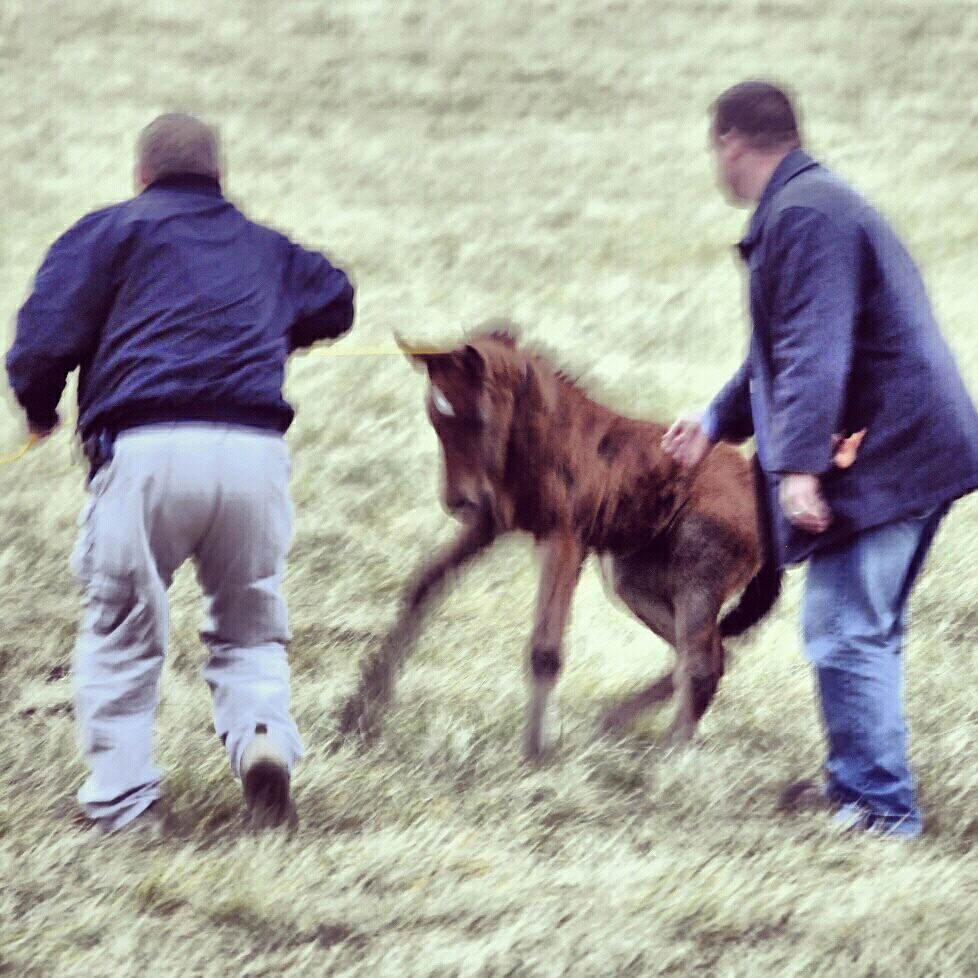
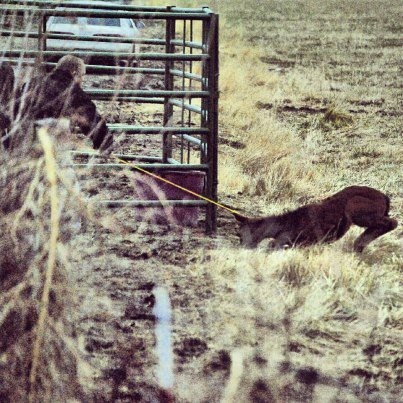
BLM’s use of helicopters to round up the wild horses is inhumane. The horses are terrified by the thunderous, high-intensity noise and chaos as they are pursued by the low-flying helicopter. They are blasted with sand, dirt, and gravel from the rotor wash. Panicked, they stampede, injure themselves, and become separated from their babies and bandmates. Mares miscarry. Foals become orphans. Many horses die from stress, even more have to be euthanized. Helicopter-style roundups are abusive, especially to foals, older horses, and pregnant mares. They are examples of worst management practices.
As has been documented on video, helicopter pilots conducting these roundups appear in a hurry to gather as many horses as quickly as possible, presumably to maximize profits — they are paid a flat fee plus a per-horse amount. Frustrated by the wild horses’ lack of cooperation and impatient to get them moving faster, the pilots ram the horses with the aircrafts’ landing skids, in some cases even flipping the animals into a somersault. There is video documentation of such abuses, and a court recently found that they had indeed occurred. There has also been documentation of contractors whipping wild horses in the face, kicking them in the head, dragging them by the neck with ropes, using electric prods on them. This abuse must stop.
Recommendations: Helicopter-style roundups must be abolished. BLM should institute the kind, bait-trapping approach to gathering wild horses — when truly necessary, which they are not at this time in regard to the Swasey herd.
Helicopters Emit Exhaust Gases that Contribute to Ozone and PM-10
Aircraft engines “emit water vapor, carbon dioxide (CO2), small amounts of nitrogen oxides (NOx), hydrocarbons, carbon monoxide, sulfur gases, and soot and metal particles formed by the high-temperature combustion of jet fuel during flight.” (Please see the last paragraph on page 2 at link below.)
http://www.af.mil/shared/media/document/afd-051013-001.pdf
The EPA notes that ground-level ozone has many detrimental health effects, which is why it monitors that form of pollution and regulates it. Fuel combustion, transportation, and fugitive dust — all of which are operative in a helicopter roundup — contribute to ozone.
http://epa.gov/air/emissions/basic.htm
Except for one aircraft-services contractor who still flies a B47G-3B-2 helicopter whose reciprocating engine uses 100-octane low lead fuel (100LL), all the other contractors fly turbine-engine helicopters, which use jet fuel. Although basically kerosene, jet fuel contains many additives, except lead. According to one source (link below), in addition to 70 or so proprietary compounds whose identity is withheld as being confidential business information (CBI) and which might even include mercury, here are some of the compounds emitted in the exhaust of combusted jet fuel:
Freon 11, Freon 12, Methyl Bromide, Dichloromethane, cis-l,2-Dichloroethylene, 1,1,1-Trichloro-ethane, Carbon Tetrachloride, Benzene, Trichloroethylene, Toluene, Tetrachloroethene, Ethylbenzene, m,p-Xylene, o-Xylene, Styrene, 1,3,5-Trimethyl-benzene, 1,2,4-Trimethylbenzene, o-Dichlorobenzene, Formaldehyde, Acetaldehyde, Acrolein, Acetone, Propinaldehyde, Crotonaldehyde, Isobutylaldehyde, Methyl Ethyl Ketone, Benzaldehyde, Veraldehyde, Hexanaldehyde, Ethyl Alcohol, Acetone, Isopropyl Alcohol, Methyl Ethyl Ketone, Butane, Isopentane, Pentane, Hexane, Butyl Alcohol, Methyl Isobutyl Ketone, n,n-Dimethyl Acetamide, Dimethyl Disulfide, m-Cresol, 4-Ethyl Toulene, n-Heptaldehyde, Octanal, 1,4-Dioxane, Methyl Phenyl Ketone, Vinyl Acetate, Heptane, Phenol, Octane [referring to the saturated hydrocarbon not the short form of the term “octane rating”], Anthracene, Dimethylnapthalene (isomers), Flouranthene, 1-methylnaphthalene, 2-methylnaphthalene, Naph-thalene, Phenanthrene, Pyrene , Benzo(a)pyrene, 1-nitropyrene, 1,8-dinitropyrene, 1,3-Butadiene, sulfites, nitrites, nitrogen oxide, nitrogen monoxide, nitrogen dioxide, nitrogen trioxide, nitric acid, sulfur oxides, sulfur dioxide, sulfuric acid, urea, ammonia, carbon monoxide, ozone, particulate matter (PM10, PM2.5).
http://www.lead.org.au/Lanv7n3/L73-4.html
If the piston-engine aircraft is used, pollution also occurs. The 100LL “avgas” fuel, when combusted, emits lead, a dangerous neurotoxin. The EPA advises: “Lead emissions to air undergo dispersion and eventually deposit to surfaces. Lead deposited to soil and water can remain available for uptake by plants, animals and humans for long periods of time.” The EPA further states: “Lead is a persistent, bioaccumulative and toxic (PBT) pollutant listed among EPA’s 12 priority PBT pollutants.” Please see page 11 at link below.
http://www.epa.gov/ttnchie1/net/tsd_avgas_lead_inventory_2002.pdf
Why would FFO even consider polluting the environment just to round up some horses?
Helicopters and Green-House Gas (GHG) Emissions
At the link below is a compare-and-contrast analysis of the GHG emissions produced by a passenger van versus by a helicopter transporting those same passengers. Interestingly, the aircraft in question, a B206 L4, is a model that one of the contractors uses. From other documents, we know that the roundup helicopter may refuel as many as four times a day. Such a frequency brings its own dangers of pollution from spills. Bottom line: helicopters use much more fuel and, consequently, release many times the GHGs that a motor vehicle does. Which begs the question: Why would FFO employ such a polluting vehicle to round up equids when safe, humane alternatives are available? In fact, since there is no need for a roundup at all, the cost, waste, and pollution are all the more indefensible.
http://www.enn.com/pollution/article/23533
Helicopters and Noise Pollution
An HMA is a designated space for wild horses and burros. It should be a place of peace and quiet. Using helicopters is a violation of that environment, disturbing the peace with the deafening roar of the chopper flying at very low altitude. It is unacceptable to use such a vehicle in a wild-horse area, polluting the environment with high-decibel noise and vibrations.
http://www.youtube.com/watch?v=gYOI7gFzK0M
In its Report to Congress on Nonmilitary Helicopter Urban Noise Study, the Federal Aviation Administration noted that “a helicopter may be much more noticeable than a fixedwing aircraft because of the impulsive blade-slap sound.” Members of the public have a heightened reaction to helicopter-generated, low-frequency noise. This distinct “impulsive” (spontaneous changing) pattern is referred to as the “unique noise character” of helicopters. The FAA’s report explained:
When throbbing occurs at low-frequencies, the actual loudness is greater than that predicted by the equivalent level. Stated another way, even though the equivalent level of a sound may be below the threshold of audibility, the sound is audible.
The report further noted:
Rate of response is defined as the ratio or relative order of magnitude of percent average noticeability comparing two unique sources of noise. In this case, helicopter noise was compared to fixed-wing airplane and train noise. The rate of response function for helicopter sounds grew at three times the rate of response functions found for airplanes and trains. This paper showed that sound noticeability may be a significant variable for predicting human response to noise. The character of the sound was a key ingredient to noticeability. Helicopters, with their distinctive sound character, appeared to be more noticeable than other sounds for the same A-weighted sound exposure level.
http://www.faa.gov/regulations_policies/policy_guidance/envir_policy/media/04Nov-30-RTC.pdf
Surely, wild horses will be similarly disturbed as well as traumatized by the roar, thunder, and rattle of the helicopter. In addition, they will suffer the brutality of being rammed by the landing skids to prod them into moving faster, as ample video documentation has revealed. Such cruelty took place in plain view of observers with video cameras. Imagine what went on out of their sight and scopes.
Helicopters and Decibel Readings
The following link contains a chart of decibel readings taken by a person that lived near a site in East Hampton, NY where helicopters operated out of the nearby airport. Note that for helicopters flying at “dangerously low, tree-top level,” readings of 85 to 90 decibels were common. Depending on the species, trees can be 30 to 60 feet tall or taller, and the helicopter would have been higher still to be above the tree tops.
http://www.ehhelicopternoise.com/files/Helicopter%20Sound%20Levels.pdf
At the link below, we learn that a Bell J-2A helicopter at 100 feet above ground level (AGL) reaches 100 dB. This reading is similar to those recorded by the private citizen referenced above.
http://www.industrialnoisecontrol.com/comparative-noise-examples.htm
According to another source, the decibel reading for helicopters reaches 105 dB, or louder than a jackhammer. Altitude: 100 feet AGL.
http://stophelipad.org/noise_levels.shtml
The following chart indicates that, at just 85 dB, hearing loss can occur. At 100 dB, the maximum safe exposure time is just 15 minutes. A roundup of a single band of wild horses can take much longer than 15 minutes.
http://www.nidcd.nih.gov/health/hearing/pages/ruler.aspx
http://home.earthlink.net/~dnitzer/4HaasEaton/Decibel.html
BLM documents note — and we have seen for ourselves that — when herding equids, the roundup helicopter “would drop as low as 5 or 6 feet when turning the animals.” At this extremely low altitude, the noise level is likely well over 100 decibels, producing pain and suffering that is surely injurious to the acutely sensitive hearing of the equids. Combined with tremendous vibrations and the blasting rotor wash, the process is cruel and pitiless.
It is unacceptable to subject sentient creatures to such torment. America’s wild horses must be handled with care and concern. The agencies’ administrative convenience is the least important consideration.
Helicopters — Adverse Effects on the Wilderness, on the Wildlife
The impacts of using helicopters for roundups include the blowing of soils, injury to plants, and stress and possible injury to wildlife. The noise, pollution, stampeding of wild horses for miles on end would negatively impact the environment.
The current estimated wild-horse population (which, as discussed above, is bound to be an exaggeration) indicates a density of about two horses per square mile. Surely such dispersion does not call for the drastic level of removals FFO proposes, given the adverse effects on the environment.
Helicopters — Crash-Prone
Helicopters are notorious for crashes. Indeed, in the past year alone — July 1, 2011 to June 30, 2012 — the National Transportation Safety Board (NTSB) investigated 143 major helicopter accidents that occurred in the United States. Here’s a summary of the accident data for that period:
143 — Helicopter crashes in the USA — of which …
124 — Resulted in non-fatal injuries and
19 — Involved fatalities, in which
39 — Persons died.
At the link below, you can perform the search to verify these data.
http://www.ntsb.gov/aviationquery/index.aspx
Ironically, helicopter pilots are typically more mature, more experienced, and have higher ratings than the average pilot. They tend to maintain their currency in time and type. Yet despite their seeming advantages, they have more accidents — 46-percent more. If a crash occurred during a helicopter-roundup, the pilot, BLM staff, observers, and the wild horses could be hurt or killed.
Similarity to Aerial Hunting
Of particular note, over one hundred crashes have occurred of helicopters and planes conducting aerial hunting, whose procedures closely resemble those involved in rounding up wild horses. Just as with BLM gathers, aerial-hunting pilots fly only a few feet off the ground and perform risky maneuvers from which they may not be able to recover.
http://www.commondreams.org/news2008/0422-15.htm
Moreover, the long hours involved, and the frustrations of working with frightened, unpredictable animals, can lead to pilot error. Video documentation is plentiful of helicopter pilots ramming horses and burros with their landing skids, seemingly intentionally.
Helicopter Accident and Incident Record during Wild Horse Roundups
Helicopters have crashed while rounding up wild horses. BLM admits to approximately 10 helicopter accidents and “hard landings” during wild-horse gathers over the past 30 years or so. That’s about one crash every three years. What airline would stay in business with such a safety record?
Using helicopters for gathering wild horses and burros is inherently risky, with no greater purposes than administrative convenience and “efficiency.” Such purposes do not justify the risks. There is no imminent threat to life or property that would require the use of helicopters to roundup some horses. BLM is wrong to continue this dangerous activity when a safe alternative is available: bait trapping.
Helicopter Census Method Puts BLM Personnel at Risk
A number of EAs I reviewed this year have alluded to the use of “multiple experienced observers” (whom I suppose to be BLM staff) to count and photograph wild horses — or what they think are wild horses — while being flown in grid patterns over the range.
Given the crash-proneness of helicopters, BLM could face a tragedy — with loss of several key personnel, friends, and colleagues in an accident. I submit that counting wild horses does not justify this risky method. Instead, consider bait-and-or-water trapping every member of each herd — without removals. Fit them with telemetry collars, and track them.
Why Helicopters Crash
Below is the link to the slide presentation “Human Factors in Helicopter Accidents” that accompanied the keynote address given by NTSB Board Member Robert Sumwalt at the Fifth International Helicopter Safety Symposium.
http://www.ihst.org/portals/54/ihss/Execs_and_Sumwalt/NTSB%20Sumwalt.pdf
Mr. Sumwalt’s talk focused on a crash that occurred in New Mexico during a search-and-rescue flight. Note the similarities between the factors that led to the crash in question and the conditions, standard operating procedures, and observed pilot behavior in BLM helicopter roundups. The factors deemed to have played a significant role in the New Mexico accident included:
Flight conditions
- Remote, mountainous terrain
- Windy conditions
- Twilight, less than 2 hours of daylight
Organizational
- Culture that prioritized mission execution at all costs
- Weak requirements for risk assessment during the mission
- Actions and attitudes detrimental to safety
- Lack of a “safety-focused culture”
Pilot
- Fatigue
- Self-induced pressure to conduct the flight
- Situational stress that “… distracted him from identifying and evaluating alternative courses of action”
- Inadequate pilot staffing
- Personal temperament — “very aggressive, high-speed type”
- Long work hours and sleep disruptions due to work-related phone calls at night
BLM Helicopter Roundups Involve Additional Risks
The factors listed above could have been said of most BLM helicopter roundups. However, there are additional risks inherent in a BLM wild-horse gather:
BLM Roundup — Flight Conditions
- Low and slow
- Desert-type environments — brownout potential
- Winter roundups — whiteout potential
- Dealing with unpredictable animals
- High potential for loss of situational awareness
BLM Roundup — Organizational
- Need to stick to the scheduled time-frame for completing the roundup
- Pressure to appear to reduce exaggerated estimated herd levels to low-AML
- Culture of secrecy and deception regarding helicopter roundup flights
- COTR/PI failure to stop the pilot’s pitiless harassment of exhausted horses
BLM Roundup — Pilot
- Financial incentive to round up as many horses as fast as possible
- Motivation to earn the per-horse fee in addition to the flat-fee for service
- Preoccupation, seeming fixation, to capture every last horse
- Evident haste to bring the bands in, forcing them to gallop over rough ground
- Divided attention — multi-tasking — while monitoring aircraft systems
- Showing off, trying to impress onlookers that he has the “right stuff”
- Aggressive, relentless prodding and ramming of horses with the landing skids to make them move faster, but often knocking them down instead
- Impatience, anger, frustration, recklessness, and vindictiveness reflected in the roundup pilot’s patterns of behavior — egregious emotions that can lead to unwise decisions and result in an accident
Below is the link to a report that aired on HLN about the recent Jackson Mountains roundup in Nevada. Most of the still-photos are of those operations. There is also video footage from previous roundups, documenting the pilot sadistically ramming animals with the half-ton helicopter’s landing skids, even flipping one little burro upside down. (There is a 30-second ad first. The news clip’s run-time: 2 minutes, 54 seconds.)
http://www.hlntv.com/video/2012/06/11/jvm-horse-roundup
Pilot Error — The Cause of Most Helicopter Crashes
According to studies, human error remains the causal factor in 65 to 90 percent of helicopter mishaps. BLM has been gambling that the risky behavior involved in its wild-horse roundups can continue without further disasters. But the odds are against it. Such roundups are tragedies waiting to happen. BLM is negligent in continuing to use helicopters when a safe, superior gather-method is available.
Brownouts in the Desert, Whiteouts in the Winter
When helicopters maneuver at low altitude, the rotors’ down-wash may create brownout — conditions of reduced visibility for the pilot due to blowing and recirculating dust and sand. Whiteout is the corresponding phenomenon with snow. Visual cues become obscured, and the horizon can disappear. Brownout can result in spatial disorientation — the pilot loses awareness of the orientation of the helicopter with respect to the earth. Engulfed in a swirl of dust, the pilot might not be able to tell whether the helicopter is flying level or drifting into an object. In the visually-degraded environment of a brownout, a pilot can become spatially disoriented and crash.
Here is the link to a news report on how the Military is studying the problem of brownout. (It’s short — the video’s run-time: 1 minute, 41 seconds.)
http://www.youtube.com/watch?v=wYuQcZ3Vp3E
BLM helicopter roundups have taken place under both brownout and whiteout conditions.
Commercial Considerations — Economic Viability Factors
The definitive helicopter-accident study, “Root Causes of Helicopter Pilot Error Accidents,” which is posted on the Federal Aviation Administration’s Website (link below), notes the economic pressures that affect the safety of helicopter operations. Helicopter pilots work under stress. They strive to maintain high utilization rates, make flights when requested, complete flights as planned, meet schedules, please people, and … make money.
http://www.faa.gov/library/online_libraries/aerospace_medicine/sd/media/adams_r.pdf
BLM contract helicopter pilots appear in a big hurry to gather as many horses as quickly as possible, presumably to maximize profits — they are paid a per-horse fee in addition to their flat-fee for service. They push the horses to gallop, even as the band approaches the wings of the corrals. The horses, lathered in sweat and heaving, come to an abrupt halt in the crowded pens, contrary to horse-care standards. However, it must be noted that the entity in charge — BLM — has allowed the pilots to behave in this manner.
Complacency — A Root Cause in 55 Percent of Helicopter Crashes
When a pilot has repetitively — and so far without incident — engaged in an activity that is dangerous, he may become complacent. Such a pilot would lose a sense of the risks that are inherent in what he is doing, becoming casual instead of careful. Boredom may also be a factor. With less vigilance, the pilot relaxes his standards, becomes careless, and puts himself and others at risk. Complacency leads to pilot error. The FAA-cited study found complacency (as well as its fellow-traveler, overconfidence) to be a root cause of 55 percent of helicopter accidents. From the observed behavior of the BLM-roundup pilots, it can be inferred that they have become complacent. They appear to have lost awareness of the riskiness of their endeavors.
Here is an anonymous quotation that was included in the “Root Causes” report:
A Superior Pilot is One Who Stays Out of Trouble By Using Superior Judgment to Avoid Situations That Might Require The Use of Superior Skill.
BLM contract helicopter pilots cannot be said to meet this superior standard.
In the Event of an Accident, Rescue Efforts Would Be a Challenge
In a helicopter roundup, the pilot flies off alone looking for bands of horses to bring back from across a herd management area that can encompass many square miles. Should a crash occur in rugged terrain at a remote location, medical help might not get there in time. While the pilot may be willing to accept this risk, surely BLM should not be putting a contractor in situations that could endanger his safety — and his life — merely to round up horses.
Possibility of a Post-Crash Fire’s Leading to a Wildfire
Especially in these times of drought, when there is an abundance of dry brush, the crash of a roundup-helicopter could set off a wildfire. Thus, even the environment is at risk from the use of helicopters to round up wild horses. Because herd management areas are typically in remote locations, it would be difficult to put out a post-crash fire and keep it from getting out of control. A fuel spill from a crash could really make matters worse.
Potential for Increase in Transmission of West Nile Virus
This year has seen many persons catching — and even dying from — the West Nile Virus. There have been cases all over the country. Helicopter-stampedes can result in horses’ trampling riparian areas, setting up conditions ideal for mosquito breeding. Proceeding with a helicopter roundup is not worth the risk, especially this year. Utah has seen West Nile Virus cases in humans this year.
Cruelty-Free Methods — No Helicopters, No Whips, No Electric Prods
I urge FFO to renounce the use of helicopters, whips, and electric prods in gathering and maneuvering wild horses. It is time to implement cruelty-free, whip-free, prod-free operations.
Bait Trapping Only
I urge FFO to adopt the kind method of gathering wild horses — bait trapping. This method is a true best management practice. In an article about a herd in New Mexico that is gathered by this method, much is made about this high-tech but gentle and effective approach. Because it has already been proven effective, it makes sense to adopt it — after the Swasey herd reaches IUCN size.
http://westernhorseman.com/index.php?option=com_content&task=view&id=491&Itemid=77
Recommendations: Use bait trapping exclusively. The goal is for bait-trapping to replace helicopter roundups. Bait-trapping should not be just another method of gathering horses but the method. I urge FFO to embrace the superior bait-trapping approach.
Bait Trapping and Public Observation — Transparency, Accountability
The public is interested in observing wild-horse roundups. Even though bait trapping is safe and kind to the horses, we wish to see the process in action. But because this method is slower, and requires waiting for the horses to enter a trap, observing in person will be challenging to arrange.
Recommendations: Install real-time video cameras — “caval-cams” — at the trap sites and corrals Live-stream the video on your website. That way, any member of the public can monitor a gather online. Think of the public-relations advantages of video-cams over the current practice of keeping observers unhappily far away from the site. Of course, there may still be some observers that prefer to visit the traps and corrals. That option should still be available. However, it will no longer be a contentious matter. Bait trapping is a gentle process, so most of the safety precautions currently necessary due to the dangers of low-flying helicopters chasing stampeding horses will be eliminated.
When to Gather
Autumn (before the snowfall season) is the appropriate time to gather wild horses. Foals are older, and temperatures are cooler. Small-scale, annual fall events will mean fewer horses coming up for adoption, and they will be available just in time for the holidays. The horse adoption market won’t be overwhelmed — as it is now — and fewer mustangs will need to be placed in sanctuaries, preserves, or long-term holding. Such an approach will prove cost-effective, enabling FFO to redirect its budget to rangeland improvements and other purposes.
Learning the New Method
If FFO staffers do not feel qualified to conduct bait trapping, there are trained units that could be brought in to do it or to show staff how it is done. Learning something new is an opportunity for personal as well as professional growth. The Modoc National Forest Office (California) reportedly has all necessary equipment on hand to conduct bait-trapping operations in a humane manner. Modoc seems like a good resource. BLM’s Billings Field Office (Montana) also eschews helicopters in favor of bait trapping. Externally, the American Wild Horse Preservation Campaign and The Cloud Foundation can refer you to an an expert in water trapping that works with the USFS and, thus, is an approved contractor.
Value All Comments — Publish All Results — Strive for Consensus
I urge FFO to publish the number of persons that respond to the EA. Show that you value every response on its own merits rather than labeling some as “form letters.” The Constitution provides for the right of citizens to petition the Government for a redress of grievances. The Constitution does not require each complainant to draft a unique letter. Indeed, the very word “petition” connotes one document that multiple parties sign in agreement and solidarity regarding a particular issue. At court, there are even class-action suits, wherein many plaintiffs join together to seek justice regarding a matter of mutual concern.
FFO should just state the facts:
- How many responses were received,
- How many and what percentage favored each alternative course of action and why,
- What different alternatives were proposed, and
- What modifications, corrections, improvements ERD could make per the public input.
BLM is supposed to build consensus. The public involvement component is designed to get feedback from those persons interested enough to participate in the decision-making process. Disregarding feedback leads to decisions that are not supported by the majority of stakeholders.
Recommendations: Each and every comment must be honored fully, individually, and collectively, with the numerical results published.
Consultation and Coordination with Wild-Horse Stakeholders
BLM field offices with wild-horse-and-burro programs need to establish an advisory committee of mustang advocates and to work with them to formulate policy.
Recommendations: FFO should cultivate partnerships with wild-horse advocates. Per the adaptive managment model, implement coordinated resource management (CRM) with regard to your wild horse stakeholders — cooperating, consulting, and coordinating with them, just as FFO does with its grazing permit-holders and other constituents. The CRM approach will result in consensus-based decisions and the development of best management practices concerning wild horses.
Conclusions
I urge FFO to choose the No Action alternative. Cancel all plans to remove or contracept the Swasey wild horses. I urge FFO to update and revise its Resource Management Plan to provide for an AML that is per IUCN guidelines. FFO should implement Holistic Management and develop a sound, proactive system for managing the Swasey wild horses on the range. FFO should consider implementation of the other improvements outlined herein. Thank you.
Sincerely,
Marybeth Devlin |