Climate report erroneously calls for removing native wild horses

Cattle grazing (Photo © Anne Novak, all rights reserved

Statement from Anne Novak, executive director of Protect Mustangs:

“This report has glaring errors. It avoids classifying America’s wild horses as natives to justify removing them from large areas of public land. Commercial livestock is the problem not wild horses. We object to the proposal to remove native wild horses and request they rectify the error calling them ‘feral horses’. Native wild horses heal the wild land–they can replenish the biodiversity in the West.”


November 26, 2012 News Release from The Center for Biological Diversity

Climate Report Calls for Grazing Reductions on Public Lands

TUCSON, Ariz.— A newly published report in the journal Environmental Management describes how climate change threatens to worsen impacts on public lands, watersheds and wildlife by grazing of domestic and feral livestock and unnaturally large native ungulate populations. The report calls on federal agencies to protect large tracts of public lands from livestock grazing to restore ecosystems, help lands and wildlife adapt to climate change, and provide ecological services and future benchmarks for grazed lands. It details how grazing reductions are within the legal authority of the U.S. Forest Service and Bureau of Land Management, which together administer livestock grazing across 258 million acres of public wildlands.

“We want to be able to rely on healthy, resilient wild places in this era of climate change, so that our country’s heritage wildlife can survive. That’ll mean cutting back on harmful land uses like cattle grazing; it’ll mean bringing back the carnivores that keep native populations of elk and deer in check,” said Taylor McKinnon of the Center for Biological Diversity, which has worked for more than 20 years to reduce overgrazing on western public lands. “By looking at the combined impacts of grazing and climate change, this report is the first of its kind, and it underscores the need for immediate action from federal agencies.”

Domestic livestock are grazed across 258 million acres of western land administered by the Forest Service and Bureau of Land Management — 81 percent of the land administered by the two agencies in the 11 western states. Those lands provide critical refuge for native biological diversity and offer vital ecological services like clean air, water and recreation to society. There are approximately 23,600 public-lands ranchers, representing about 6 percent of all livestock producers west of the Mississippi River.

The report concludes that:

  • In the western United States, climate change is expected to intensify even if greenhouse gas emissions are dramatically reduced; threats facing ecosystems as a result of climate change are invasive species, more frequent wildfires and declining snowpack.
  • Climate impacts are compounded from heavy use by livestock and other grazing ungulates, which causes soil erosion, compaction, and dust generation; stream degradation; higher water temperatures and pollution; loss of habitat for fish, birds and amphibians; and desertification.
  • Encroachment of woody shrubs at the expense of native grasses and other plants can occur in grazed areas, affecting pollinators, birds, small mammals and other native wildlife.
  • Livestock grazing and trampling degrades soil fertility, stability and hydrology, and makes it vulnerable to wind erosion. This in turn adds sediments, nutrients and pathogens to western streams.
  • Reestablishing apex predators in large, contiguous areas of public land may help mitigate any adverse ecological effects of wild ungulates.

Livestock grazing is one of the most ubiquitous and destructive uses of public land. It is also a contributing factor to the imperilment of numerous threatened and endangered species, including the desert tortoise, Mexican spotted owl, southwestern willow flycatcher, least Bell’s vireo, Mexican gray wolf, Oregon spotted frog, Chiricahua leopard frog and dozens of other species that occur on western public land.

Public-lands livestock grazing is also a primary contributor to unnaturally severe western wildfires, watershed degradation, soil loss and the spread of invasive plants — as well as annual greenhouse gas emissions equivalent to that of 705,342 passenger vehicles.

The Center for Biological Diversity is a national, nonprofit conservation organization with more than 450,000 members and online activists dedicated to the protection of endangered species and wild places.

http://www.biologicaldiversity.org/news/press_releases/2012/grazing-11-26-2012.html


Press Release: Protests to stop roundups and sales to kill buyers

(Photo © Cat Kindsfather, all rights reserved)

For immediate release

Call for peaceful protests to stop the roundups and stop the BLM from selling federally protected wild horses to kill-buyers

American public outraged at cruel ‘management’

WASHINGTON (October 6, 2012)–Protect Mustangs announced on Facebook Friday their call for nationwide protests to stop the roundups and stop the Bureau of Land Management (BLM) from selling federally protected indigenous wild horses to kill buyers.

“We are calling for peaceful protests as well as candlelight vigils so no more wild horses will die from roundups, be tortured by the helicopters or sold to kill buyers for delicacy meat abroad,” states Anne Novak, executive director for California based Protect Mustangs “The public is outraged.”

Last week ProPublica exposed the BLM selling at least 1,700 federally protected wild horses to known pro-slaughter buyer, Tom Davis, and the public is furious. The BLM is charged with managing and protecting wild horses–not selling them for $10 a head to a pro-slaughter middle man to reduce the numbers in holding due to years of fiscally irresponsible roundups.

“Members of the public who are active in their communities must let their friends, family and neighbors know they can contact Congress if they don’t like their tax dollars used to fund cruel roundups,” says Tami Hottes, Protect Mustangs’ outreach coordinator for the Midwest and South. “People are upset to learn about the BLM selling all those historic wild horses to a guy like Tom Davis. It’s disgusting.”

This week the Antelope roundup, in northeastern Nevada, started under the pretense of saving the wild horses from a drought stricken area.

“We are concerned the BLM is jumping on the drought opportunity to zero out herds for industrialization of public land–especially massive energy projects that could pollute the water,” explains Novak. “Our indigenous wild horses are environmental barometers. If they die from drinking the water then that’s a red flag something is poisoning the water out there.”

Novak continues,”If there is a real problem on the range then bring them aid in the field–don’t round them up and warehouse them at taxpayer expense. It won’t cost much to bring them hay and water for a few months to get them through a difficult time.”

In watching videos from the roundup it should be pointed out that these wild horses were actually in excellent shape and there is no sign they have been suffering from lack of water or forage this summer. They are efficient browsers.

Even though the BLM announced last spring they would bait trap, they are not keeping their word to the American public. The BLM continues with cruel helicopter roundups.

The contractor has been criticized in the past for deadly incidents that could have been prevented. Despite objections from advocates and members of the public, the BLM continues to hire the contractor.

At the Antelope roundup advocates from The American Wild Horse Preservation Campaign (AWHPC) recorded videos showing healthy horses stampeded into traps, foals terrorized by choppers and a terrified stallion jumping out of the capture corral breaking his leg and running away. He was then euthanized by the BLM.

During the roundup wild horses were traumatized with whips and a wild mare broke her neck and died in transport.

If these historic wild horses had not been rounded up surely they would be alive with their families roaming in the West.

Outraged members of the public are calling BLM officials requesting the roundups stop. Officials downplay the cruelty and trauma, claiming these were rare incidents and touting that roundups, also known as “gathers”, only have a 1% death rate.

“We disagree with their whittled down death rate,” states Novak. “For years we have caught the BLM avoiding the correct death count and misleading Congress about the true number of horses painfully dying in roundups. During winter 2010 more than 180 wild horses died or were euthanized as a result of the roundup but the BLM tried to rewrite the numbers.”

The federal agency, funded by Congress to manage wild horses and burros, attributes the gross majority of roundup deaths to pre-existing conditions when they are obviously roundup related. If the horses weren’t rounded up they surely would not have died at that time.

The BLM often kills indigenous wild horses for being “old” and claims it was a pre-existing condition. They also kill baby horses claiming they have leg deformities. The foals can’t tolerate being stampeded for many miles on their undeveloped baby feet and legs and suffer severe injuries and are euthanized. BLM resists taking responsibility for their heinous actions.

At roundups since 2009, advocates as well as members of the press and public have been pushed back from the trap site and the holding corrals. It appears the BLM wants to hide the cruel roundups and injured animals from public view.

“The Wild Horse and Burro Program avoids transparency because of their disgusting secrets,” states Novak. “The public has a right to know what’s happening at roundups and afterwards. The public wants to know how many federally protected wild horses have been sold to the slaughter middle men since 2005.”

In 2004, a stealth rider known as the Burns amendment was attached to the Congressional Appropriations Bill to allow unlimited sales of captive wild horses over the age of ten or those who have been presented at adoption venues (live or Internet) three times–even pregnant mares and one-year-olds called yearlings.

The recent ProPublica article, written by Dave Phillips, highlights a corrupt program and interviews a pro-slaughter middle man. According to ProPublica, ‘Tom Davis buys 100s of mustangs at a time, sight unseen, for $10 a head. BLM has sold him more than 1,700 wild horses and burros since 2009.

“Hell, some of the finest meat you will ever eat is a fat yearling colt,” he says.

“. . . but BLM’s Sally Spencer said it would be unfair for BLM to look more closely at him based on the volume of his purchases. “It’s no good to just stir up rumors,” she said.’

In 1997 Associated Press investigative journalist, Martha Mendoza, uncovered BLM’s internal corruption wherein adopted wild horses were quickly being sold to slaughter even by BLM employees who adopted them.

‘A multimillion-dollar federal program created to save the lives of wild horses instead is channeling them by the thousands to slaughterhouses where they are chopped into cuts of meat.

Among those profiting from the slaughter are employees of the Bureau of Land Management, the federal agency that administers the program.’

Mendoza’s Freedom of Information Act (FOIA) research and the story she exposed, forced the adoption program to change their protocol and only give title to the mustangs after one year to prevent the wild horses from being sold into the slaughter pipeline.

Today the BLM sends America’s living treasures to slaughter by selling them to the middle men who sell them to slaughter. Protect Mustangs asks Congress for a freeze on roundups, a freeze on sales and a full investigation into the ‘sale authority program’ since 2005.

The roundups ramped up in 2009 with the stimulus package push for the New Energy Frontier on public land and a new mandate to wipe out the wild herds of the West known as The Salazar Plan.

Despite nationwide protests in 2009-10 against the Secretary of the Interior’s plan, the majority of wild horses and burros were ripped from their family bands, taken off their land and the stallions were sterilized. President Obama ignored public outcry and Congress eventually fell for the BLM pleas for funding to ‘help the wild horses’.

In 2010, 54 members of Congress joined Congressman Raul Grijalva requesting a moratorium on roundups and a National Academy of Science (NAS) investigation into the broken program. Somehow the BLM has taken charge of the NAS investigation now called a “study” and is feeding the NAS the information instead of the Academy conducting independent research.

Today more than 52,000 wild horses and burros are living in captivity–mostly in the Midwest as specified in the Salazar Plan. Last year the controversial Wild Horse and Burro Program cost the American taxpayer 78 million dollars. Next year the cost will increase.

Protect Mustangs requests that Congress work with advocates to find a way to return wild horses to their wild lands in the West–to create biodiversity on the range–a win-win for wild horses, livestock, landowners, tourism and energy development on the New Energy Frontier. Their presence also helps greatly to reduce wildfires.

“Shrinking the numbers of wild horses left on public land today could be dangerous,” explains Kerry Becklund, director of outreach for Protect Mustangs. “Giving already small herds fertility control will ruin genetic viability and could create inbreeding.”

The BLM’s reproduction rates don’t account much for mortality within the herd. Often foals don’t live to be two years old but the BLM spin on population has them multiplying like rabbits.

Studies show predators such as mountain lions and coyotes reduce the wild horse foal population. Last summer several young foals were killed by coyotes at a BLM holding facility near Sparks, Nevada. Even so, the BLM hides the truth about predators reducing the population and continues to repeat they have no natural predators despite the fact they do.

“Show me a real independent headcount before we talk about fertility control,”says Novak. “There aren’t enough wild horses left on the range any more. The truth is that the BLM will continue to roundup wild horses to treat them with fertility control. Roundups have been deadly so far. Roundups are NOT the answer. Biodiversity is the answer.”

Novak continues, “More than 52,000 indigenous wild horses have been captured and are warehoused in government holding. Selling ‘excess’ wild horses to kill-buyers is a heinous act and must stop now as well as the gluttony of roundups”

# # #

Media Contacts:

Anne Novak, 415-531-8454, Anne@ProtectMustangs.org

Kerry Becklund, 510-502-1913, Kerry@ProtectMustangs.org

Links of interest:

AP reports & Protect Mustangs speaks out against the roundups: 3,500 Wild horses going to loose their freedom starting October 1st Federal roundup of wild horses burros starts today http://www.lvrj.com/news/federal-roundup-for-wild-horses-burros-starts-today-172056591.html

ProPublica reports: All the missing horses: What happened to the wild horses Tom Davis bought from the government  http://www.propublica.org/article/missing-what-happened-to-wild-horses-tom-davis-bought-from-the-govt

Brutal report for day 1 of Nevada’s Antelope roundup. Two horses die. AWHPC video. http://www.youtube.com/watch?v=ne3ppBnbr7g&feature=youtu.be

Day 3 of Antelope roundup. Foals are terrorized by the helicopter and chased too long on their tender hooves. AWHPC video. http://www.youtube.com/watch?v=-N9LDAwZqyU&feature=youtu.be

Buffalo News (January 5, 1997) US effort to save wild horses leads thousands to slaughter as workers profit by Martha Mendoza http://nl.newsbank.com/nl-search/we/Archives?p_product=BN&p_theme=bn&p_action=search&p_maxdocs=200&p_topdoc=1&p_text_direct-0=0EAF99E45C1DF5CF&p_field_direct-0=document_id&p_perpage=10&p_sort=YMD_date:D&s_trackval=GooglePM

The Burns amendment http://en.wikipedia.org/wiki/Conrad_Burns#The_Burns_Amendment

Huffington Post (October 17, 2009) Ken Salazar’s wild horse plan fuels accusations that he’s in the pocket of ranchers by Martin Griffith http://www.huffingtonpost.com/2009/10/17/ken-salazars-wild-horse-p_n_324799.html

News 4 KRNV Reno BLM selling to kill buyer? http://www.mynews4.com/news/local/story/BLM-selling-to-a-kill-buyer/s7svkl_zd0i1NVKHbd0ceA.cspx

Oct 5th Facebook announcement~Call to Stop the Roundups: https://www.facebook.com/photo.php?fbid=418628774862814&set=a.240625045996522.58710.233633560029004&type=1&theater

Protect Mustangs on the web http://www.ProtectMustangs.org

 

How many California wild horses and burros will be left after the fire?

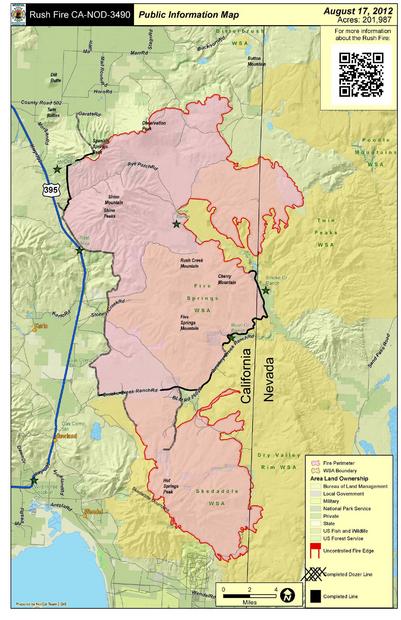
California wild horse country ~ Rush Fire map (Twin Peaks HMA) updated August 25, 2012


How many wild horses and burros were trapped by fencing in the fire?

Fire approaching Deep Cut area by Robin Blair 8.15.12


Rush Fire update in the Twin Peaks HMA

Susanville, Calif., Aug. 26, 7 a.m.–On Saturday, firefighters successfully held fire lines in the northeast part of the Rush fire in spite of gusting winds. Large dust devils were common and firefighters remained very busy fighting fire.

The threat from dust devils has led firefighters to go to the unusual length of mopping up for 500 to 1000 feet from fire lines into the burned area.  This tough work involves finding each and every hot spot and cooling them off.

In spite of the winds on Saturday, firefighters were able to hold the existing fire perimeter for the fourth day in a row.

The northeast flank is where the fire is most active.  This part of the Rush fire is in Nevada, about 25 miles northeast and east of Ravendale, Calif., near SOB, Garden and Burnt lakes, the Buffalo Hills, Antelope Basin, and Cottonwood Creek.

Helicopters with buckets dropped water on hot spots in the Cottonwood Creek area on Saturday.  In the southern and southwestern flanks of the fire on Saturday, firefighters continued repairing damage from fire-fighting activities.

The National Weather Service issued a red-flag warning for Sunday from noon to 10 p.m. because of low humidity and gusting winds.  The winds have the potential of fanning any remaining embers and hot spots.  Winds can also form dust devils that could carry hot material over containment lines into extremely dry unburned vegetation.

On Sunday, firefighters will continue their efforts to hold the fire to its current perimeter, to mop up and to make repairs on the western side of the fire.

Area and Road Closures in Effect: Public lands bounded by Highway 395 on the west, the Sand Pass road and Nevada 447 on the east, the Wendel Road on the south, and Juniper Ridge road to Buckhorn road on the north are closed. The Buffalo Meadows road in Washoe Co., Nev., is also closed.  The Ramhorn Springs and Dodge Reservoir campgrounds remain closed.

Remarks:   NOTE:  Use of chainsaws on public lands managed by BLM in northeast California and far northwestern Nevada is suspended because of extreme fire danger.  Fire officials remind residents and visitors that fire restrictions are in effect for public lands and national forests in northeast California and far northwest Nevada.  Campfires are permitted only in posted recreation sites.

For additional fire information, please go to InciWeb @ http://inciweb.org/incident/3151/


Started:  8/12/12 at 6:42 pm Expected Containment: 8/28/2012
Cause:  Lightning Committed Resources: 755 people
Fuels:  Fire is burning sagebrush, juniper,and grass Structures Threatened: 39 (20 residences; 1 commercial; 18 outbuildings)
Estimated Size: est. 320,793 acres (275,650 acres in California and 45,143 acres in Nevada) Structures Damaged or Destroyed: 1 (barn)
Containment: 66% Injuries: 3 minor


Twin Peaks HMA wildfire ~ 300K acres burned already

Twin Peaks HMA Rush Fire (Photo © Phil Perkins)

Rush Fire Update

Tuesday, August 21, 2012   8 pm

   Northern Rockies Incident Management Team – Doug Turman, IC

Fire Information Office:

530-710-8568

Staffed: 8:00 am to 6:00 pm

Started:  August 12, 2012 at 6:42 pm

Cause:  Lightning

Fuels:  Fire is burning in sagebrush, juniper, and grass

Estimated Size: 313,911 acres

Containment: 50%

Expected Containment: 8/28/2012

Committed Resources: Approximately 832 people

Structures Threatened: 9 (6 residences; 1 commercial; 2 outbuildings)

Structures Damaged or Destroyed: 1 (barn)

Injuries: 2 (both in fire camp)

Updated Rush Fire Map in Twin Peaks HMA

Location: The fire is located on Bureau of Land Management (BLM), Northern California District (BLM-CA-NOD,) Eagle Lake Field Office, approximately 15 miles southeast of Ravendale, California.  The fire is burning near a major natural gas line and transfer station, and power transmission lines that supply the Reno area and adjacent to Highway 395.

Summary:   Today firefighters made excellent progress in continuing line building and mop-up around the perimeter of the Rush Fire.  Fortunately the predicted critical fire weather conditions occurred for only a short time and fire spread was minimal.  Most of the growth occurred in the northeast part of the fire where firefighters made progress, but have not completely encircled the fire in the SOB/Burnt Lake areas. Crews will continue line building in that area tonight and tomorrow.  Tomorrow, aircraft (small air tankers and helicopters) will be used to help firefighters in this effort.  The remainder of the fireline will be patrolled and any heat found next to the fireline will be put out.  Suppression repair (mainly smoothing and water barring dozer lines) will begin on some cool portions of the fireline.

Area and Road Closures in Effect: On August 17, the BLM issued a closure order for public lands in the fire area to protect public health and safety.  The closed area is bounded by Highway 395 on the west, the Sand Pass Road on the east, and the Wendel Road on the south.  The new northern boundary for the public land closure is the Juniper Ridge, Tuledad, Stage Road, Marr Road, and Buckhorn Road extending to Nevada Highway 447 in Washoe County. Routes closed within this closure area include the Ramhorn Springs, Rye Patch Road, Buckhorn, Shinn Ranch, Stoney, Deep Cut, Smoke Creek, Skedaddle Ranch, Dry Valley, and Brubeck roads. The Ramhorn Springs Campground and the Dodge Reservoir Campground also is closed.  Today, August 21st Washoe County closed the Buffalo Meadows Road to public use.  This will allow firefighters better access and help protect firefighter and public safety.

Travelers along the Highway 395 corridor, please use caution where fire crews and equipment are working in the fire area.

Remarks:   NOTE:  Use of chainsaws on public lands managed by BLM in NE California and far northwest Nevada is suspended effective Monday, Aug. 20, due to extreme fire danger.  Fire officials remind residents and visitors that fire restrictions are in effect for public lands and national forests in northeast California and far northwest Nevada.  Campfires are permitted only in posted recreation sites.

For additional fire information, please go to InciWeb @ http://inciweb.org/incident/3151/

###

Understanding grazing rights

Cross-posted from Wikipedia

Grazing rights

Grazing rights is a legal term referring to the right of a user to allow their livestock to feed (graze) in a given area.

Though grazing rights have never been codified in United States law, the concept of such rights descends from the English concept of the commons, a piece of land over which people — often neighboring landowners — could exercise one of a number of traditional rights, including livestock grazing.[1] Prior to the 19th century, the traditional practice of grazing open rangeland in the United States was rarely disputed due to the sheer amount of unsettled open land. However, as the population of the western United States increased in the mid-to-late 19th century, range wars often erupted over ranchers’ perceived rights to graze their cattle as western rangelands deteriorated with overuse.[2]

In 1934, the Taylor Grazing Act formally set out the federal government’s powers and policy on grazing federal lands by establishing the Division of Grazing and procedures for issuing permits to graze federal lands for a fixed period of time. The Division of Grazing was renamed the U.S. Grazing Service in 1939, and then merged in 1946 with the General Land Office to become the Bureau of Land Management, which along with the United States Forest Service oversees public lands grazing in 16 western states today.[3] However, grazing was never established as a legal right in the U.S.,[4] and the Taylor Grazing Act authorized only the permitted use of lands designated as available for livestock grazing while specifying that grazing permits “convey no right, title, or interest” to such lands.[5] Although the regulations stipulated by the Taylor Grazing Act apply only to grazing on Bureau of Land Management lands, the Chief of the Forest Service is authorized to permit or suspend grazing on Forest Service administered property, and many Forest Service grazing regulations resemble those of the Taylor Grazing Act.[6]

References:

  1. ^ Merrill, K.R. 2002. Public Lands and Political Meaning: Ranchers, the Government, and the Property Between Them. Berkeley: University of California Press, p. 183.
  2. ^ Fleischner, T. L. 2009. Livestock grazing and wildlife conservation in the American West: historical, policy and conservation biology perspectives. Wild Rangelands: Conserving Wildlife While Maintaining Livestock in Semi-Arid Ecosystems (eds J. T. du Toit, R. Kock and J. C. Deutsch). Chidester, UK: John Wiley & Sons, Ltd, p. 235-265. pdoi: 10.1002/9781444317091.
  3. ^http://www.blm.gov/wo/st/en/prog/grazing.html
  4. ^ Donahue D. 2005. Western grazing: the capture of grass, ground, and government. Environmental Law 35:721-806.
  5. ^ United States Code of Federal Regulations 4130.2 (c) Retrieved from http://ecfr.gpoaccess.gov/cgi/t/text/text-idx?c=ecfr;sid=65dfe1cec94944c989e83b4eb39cd3ba;rgn=div5;view=text;node=43%3A2.1.1.4.92;idno=43;cc=ecfr#PartTop
  6. ^ United States Code of Federal Regulations 36 § 222.1-54.


Link to original Wikipedia article: http://en.wikipedia.org/wiki/Grazing_rights

Desatoya roundup begins with foal abuse

“Hogtieing a young foal and leaving it in the middle of a stampede of wild horses shows how inhumane and incompetent the BLM’s roundup contractor is,” states Anne Novak, executive director of Protect Mustangs. “They should be fired immediately.”

“We are grateful Holly Hazard witnessed the alleged abuse,” Novak explains. “If she hadn’t seen this, the public would not have known that the cruel roundups are continuing despite the BLM’s promise for a ‘new normal’ by bait trapping.”

“We need more eyes on roundups to protect mustangs,” says Novak.

Read more about the incident here: http://rtfitchauthor.com/2012/08/17/problems-arise-at-desatoya-wild-horse-gather-in-nevada/

BLM experiments on wild horses with SpayVac®

By U.S. Government [Public domain], via Wikimedia Commons

Unedited Press Releasefrom the BLM   August 27, 2011

The Bureau of Land Management and the United States Geological Survey (USGS) have begun a five-year wild horse contraceptive study at the BLM’s short-term holding facility in Pauls Valley, Oklahoma.  The pasture breeding study will test the effectiveness of two formulations of the investigational contraceptive vaccine SpayVac® to determine if the treatment can reduce foaling rates in wild horse mares.

The goal is to see if SpayVac®, a novel formulation of a glycoprotein called porcine zona pellucida (PZP), will provide a longer-term effect than other PZP vaccines currently used by the BLM.  If the vaccine is found to reduce foaling in this controlled setting, it will be considered for use with free-roaming horses to help control population growth rates on the range.

As the primary agency responsible for management of wild horses on U.S. public lands, the BLM has a need for a long-lasting contraceptive agent to control herd growth rates. Given the protection afforded by the Wild Free-Roaming Horses and Burros Act of 1971 and a general lack of natural predators, wild horse populations increase at an average rate of 20 percent a year and can quickly exceed the carrying capacity of their ranges.

The BLM, as part of its development of a new wild horse and burro management strategy, has been stepping up its efforts to reduce population growth rates in wild horse herds using contraceptive agents. A main limitation of the agents currently available is that they are of relatively short duration or need to be administered annually. Maximizing the duration of contraceptive effectiveness is especially important in wild horses, which in most cases must be captured in order for the treatment to be successfully administered.

In the BLM-USGS study, 90 mares have been treated with either one of two formulations of the vaccine or a placebo.  The mares will be followed for five years to measure anti-PZP antibody levels and compare the foaling rates between treated horses and controls.  Although breeding is not usually allowed to occur in BLM facilities, a clinical trial in this controlled environment will provide critical information on how well SpayVac® works as a contraceptive.

The mares and stallions enrolled in the study were selected from horses already in BLM holding facilities.  They are being housed in three 30-acre pastures and will be together during the next five breeding seasons.  Foals that are born during the study will be offered for adoption each fall after they have been weaned. At the conclusion of the study, all adult horses will be returned to the BLM’s Adopt-A-Horse Program or placed in long-term pasture facilities.

The BLM has an interagency agreement with the USGS for research and scientific support, and this study is a collaborative effort with scientists from the USGS, veterinarians with the Department of Agriculture’s Animal and Plant Health Inspection Service (APHIS), and TerraMar Environmental Research LLC.

Contacts: Paul McGuire , 405-794-9624
Heather Emmons , 775-861-6594
Tom Gorey , 202-912-7420
Related Articles

Send comments against roundup and SpayVac® for Wyoming wild horses

Release Date: 07/06/12
Contacts: Sarah Beckwith
307-347-5207

BLM Releases Preliminary EA for North Lander Complex Wild Horse Gather

The Bureau of Land Management (BLM) Lander Field Office announces that a preliminary environmental assessment (EA) analyzing a proposed wild horse gather in the North Lander Wild Horse Herd Management Area Complex is now available for review.The North Lander Complex is located east of Riverton within Fremont County, Wyo. The proposed gather is expected to take place in fall, 2012.The preliminary EA analyzes four alternatives and is available by visiting the BLM website at: www.blm.gov/wy/st/en/info/NEPA/documents/lfo/N-Lander-gather.html.The 30 day comment period runs from July 9 through August 7, 2012. Comments may be emailed to: BLM_WY_North_Lander_Gather@blm.gov(please include “North Lander Gather EA Comments” in the subject line). Comments may also be mailed to BLM Lander Field Office, Attn: Scott Fluer, 1335 Main Street, Lander, WY, 82520.For more information, visit: www.blm.gov/wy/st/en/info/NEPA/documents/lfo/N-Lander-gather.html, or contact BLM Wild Horse Specialist Scott Fluer at 307-332-8400.
The BLM manages more than 245 million acres of public land, the most of any Federal agency. This land, known as the National System of Public Lands, is primarily located in 12 Western states, including Alaska. The BLM also administers 700 million acres of sub-surface mineral estate throughout the nation. In Fiscal Year (FY) 2011, recreational and other activities on BLM-managed land contributed more than $130 billion to the U.S. economy and supported more than 600,000 American jobs. The Bureau is also one of a handful of agencies that collects more revenue than it spends. In FY 2012, nearly $5.7 billion will be generated on lands managed by the BLM, which operates on a $1.1 billion budget. The BLM’s multiple-use mission is to sustain the health and productivity of the public lands for the use and enjoyment of present and future generations. The Bureau accomplishes this by managing such activities as outdoor recreation, livestock grazing, mineral development, and energy production, and by conserving natural, historical, cultural, and other resources on public lands.
–BLM–Lander Field Office   1335 Main Street      Lander, WY 82520
Last updated: 07-06-2012