Protect Mustangs is an organization who protects and preserves native and wild horses.
GonaCon™ is an EPA-registered, immuno-contraceptive pesticide. Its classification is “restricted-use” due to “non-target injection hazard.” EPA warns that “pregnant women should not be involved in handling or injecting GonaCon and that all women should be aware that accidental self-injection may cause infertility.” Children are not allowed in areas where the product is used. [4, 6] Please keep in mind that the GonaCon™ dose-in-question is meant for a horse.
GonaCon™ “works” by causing an auto-immune disorder. Behaving like a perverted vaccine, GonaCon™ tricks the immune system into producing antibodies that destroy a female’s gonadotropin-releasing hormone (GnRH). Without GnRH, a female does not produce sex hormones, does not come into estrus, and is thus infertile. Behaviorally, courtship-rituals cease. [1, 3-6]
For those wild-horse-and-burro advocates who oppose the other immuno-contraceptive — PZP — you will be disturbed to learn the following from the USDA-APHIS “Questions and Answers” sheet regarding GonaCon™:
“After evaluating GonaCon™, the Food and Drug Administration (FDA) … approved the slaughter of pigs vaccinated with GonaCon™. Similar injectable hormone-altering products are used routinely in livestock applications.” [5]
Good grief. So, the slaughterhouse pig ovaries used to manufacture PZP may very well come from animals who were previously injected with GonaCon™ to destroy their GnRH hormone — without which the ovaries cannot produce estrogen — and those poor pigs may also have been “routinely” injected with other similar “hormone-altering products.” Then our wild horses and burros are injected with PZP, which itself causes a marked drop in estrogen after just three treatments. [2] Surely, these hormonal atrocities constitute animal abuse.
GonaCon™ is long-acting. The treatment-protocol, consisting of two injections administered 30 to 60 days apart, can cause infertility for as long as four-to-five years without the need for booster shots. [3, 5] However, mares would still need to be rounded up and held captive for those 30 to 60 days to administer the injections properly. If all females in a small herd were treated per the multi-year plan, it could result in an unintended consequence — a huge gap in the herd’s age-structure, because very few if any foals would have been born during that period. Indeed, although the pesticide’s effectiveness was expected to diminish over time, a 3-year study of GonaCon-treated elk revealed that the percentage of infertile females actually increased each year, finally reaching 100%. It was also noted that every one of the treated elk suffered an abscess at the injection-site. [1]
Because GonaCon™ stimulates the immune-system, it will elicit the greatest reaction — the greatest output of destructive antibodies — if a mare is blessed with healthy immune-function. Such a mare will react strongly and be contracepted quickly. But she could just as easily be sterilized. In fact, GonaCon’s™ “application instructions” warn of the chance of sterilization. [5]
On the other hand, GonaCon™ may not work at all if a mare suffers from weak immune-function. That mare’s immune system will fail to react to GonaCon™, and she will get pregnant in spite of it. Thus, over time, there is the risk of another unintended consequence — selection for the immuno-compromised. As Jenny Powers, a National Park Service wildlife veterinarian and one of three lead scientists who participated in the elk research commented: “Any time we’re manipulative with wild animals, we’re messing with natural selection.” [1]
————————————————————————————
Report prepared by Marybeth Devlin on December 18, 2015 for Protect Mustangs
————————————————————————————
References:
1. Keller, Larry. (2011, May 17) To shoot, or not to shoot, at Rocky Mountain NP. High Country News. Retrieved from http://www.hcn.org/blogs/range/to-shoot-or-not-to-shoot-at-rocky-mountain-np
2. Kirkpatrick, J. F., I. K. M. Liu, J. W. Turner, Jr., R. Naugle, and R. Keiper. 1992a. Long-term effects of porcine zonae pellucidae immunocontraception on ovarian function of feral horses (Equus caballus). J. Reprod. Fert. 94:437-444. Retrieved from http://www.ncbi.nlm.nih.gov/pubmed/1317449
3. McGrath, Matt. (2011, September 1) “Deer ‘pill’ curbs aggressive mating.” BBC News. Retrieved from http://www.bbc.com/news/science-environment-14744811
4. United States Environmental Protection Agency. (2009) Pesticide Fact Sheet. Mammalian Gonadotropin Releasing Hormone (GnRH). Retrieved from http://www3.epa.gov/pesticides/chem_search/reg_actions/registration/fs_PC-116800_01-Sep-09.pdf
5. USDA-APHIS. (2006, May 1) “GonaCon™—Birth Control for Deer: Questions and Answers.” Digital Commons@University of Nebraska – Lincoln. Retrieved from http://digitalcommons.unl.edu/usdaaphisfactsheets/7/
6. U.S. Department of the Interior. (2015) Review of Ungulate Fertility Control in the National Park Service. Retrieved from https://www.nature.nps.gov/biology/wildlifehealth/Documents/Ungulate%20Fertility%20Report_09242015.pdf
Protect Mustangs is an organization who protects and preserves native and wild horses.
Do you know Utah ranchers & cattlemen want to get control of federal land? They don’t seem to like BLM or wild horses!
“That horse, as bad as I DESPISE that horse on the desert, is untouchable under federal law,” says David Ure, director of School Institutional Trustlands Administration, Utah
“We are not welfare ranchers. We do not take one dollar of state or federal assistance on our ranches because we believe that every time you take money you didn’t earn, somebody earned money they didn’t get,” says Darrell Spencer.
It’s unclear which of these ranchers is a ‘welfare rancher” but Darrel Spencer says he’s not one of them.
Protect Mustangs is an organization who protects and preserves native and wild horses.
Update on our petition for shade and shelter for captive wild horses and burros
Last year I had several meetings with BLM staff to bring shade to the captives at Palomino Valley Center (PVC). I hoped it would set an example for other facilities without shade as well.
BLM staff wanted to try a specific shade structure to ensure it would work for the facility. They told me there was no money in their budget to buy it. I offered to quickly raise the money for the trial shade structure to fast-track the process.
Sadly the BLM’s Washington office created a lot of red tape and delays. The window for the 2015 hot weather trial period ended.
My hopes were to have the PVC shade trial completed in 2015 so by the summer of 2016 the pens would be filled with shade structures providing relief from the hot weather and triple digit heat-waves.
In the wild, equids can move to cooler zones. In the BLM pens they are trapped.
Now it’s 2016 and summer temperatures are starting to climb. . . I hope there won’t be anymore dead wild horses in the pens this summer. Previous heat-waves have been tragic.
Please email this petition to everyone you know and ask them to sign and share it. Let’s keep the pressure on BLM to do the right thing.
After all, BLM made more than $4 billion in profit last year. Funds should be made available for BLM to purchase trial shade structures themselves right now! The least BLM could do is to provide shade to the iconic captives struggling under the pounding sun.
Together we can turn this around!
With dedication,
Anne
Anne Novak
Executive Director
www.ProtectMustangs.org
Contact@ProtectMustangs.org
Mission: To protect and preserve native and wild horses.
Petition to bring emergency shade and shelter to captive wild horses and burros: https://www.change.org/p/bring-emergency-shelter-and-shade-to-captive-wild-horses-and-burros
Protect Mustangs is an organization who protects and preserves native and wild horses.
Time for a brief quiz.
Question 1): How many wild horses and burros are currently roaming across the Western rangelands?
Question 2: How many wild horse and burros are adopted by private citizens each year?
Question 3): Absent “control measures,” how long does it take for the population of wild horses and burros to double in numbers?
Answers: 1). 67,000. 2). 2,500. 3). Four years.
In other words, each year there are thousands more of these feral animals being added to what is already an overpopulation across the semi-arid rangelands of Nevada, California, Utah and several other Western states.
In fact, the Bureau of Land Management announced last week that as of this March, there an estimated 67,000 wild horses and burros in the West public rangelands, which is a 15% increase over the estimated 2015 population.
The updated data are more than twice the number of horses on the range than is recommended under BLM land-use plans. It is also two and a half times the number of horses and burros that were estimated to be in existence when the Wild and Free Roaming Horses and Burros Act was passed 45 years ago in 1971.
“Over the past seven years we have doubled the amount of funding used for managing our nation’s wild horses and burros,” Neil Kornze, BLM Director, said in a statement. “Despite this, major shifts in the adoption market and the absence of a long-term fertility control drug have driven population levels higher.”
The major shift to which Kornze referred is a dramatic decrease in adoptions of wild horses, due to economics and other factors — ie, the fact that the wild mustangs, in particular, don’t adapt well to life in a stable.
Here’s the problem: The lifetime cost of caring for an unadopted horse removed from the range approaches $50,000 per animal. With 46,000 horses and burros already residing in off-range corrals and pastures, this means that without some way to place these animals with willing owners, BLM will spend more than a billion dollars to care for and feed them over the rest of their lives.
And there are plenty more where the current ones came from.
As The New York Times phrased the situation in a lengthy article two years ago, “There are now twice as many wild horses in the West as federal land managers say the land can sustain. The program that manages them has broken down, and unchecked populations pose a threat to delicate public land, as well as the ranches that rely on it.”
And the situation has only worsened since then.
A question of numbers
Keep in mind that the population of wild horses and burros affects not just agency budgets and wildlife populations, but impacts a significant economic and cultural resource: the grasslands of the West. When deer populations exceed their rural habitats east of the Mississippi, there is property damage and traffic accidents for suburban and rural residents to contend with, but there is far less impact on agriculture.
Not so out West. There simply isn’t carrying capacity for ever-expanding herds of horse and burros, while at the same time maintaining the grazing rights of ranchers and conserving the limited supply of grassland and water resources.
BLM officials are trying to address the challenge on a number of fronts, including:
None of those measures — even in combination — will be enough, however, and so the agency announced in a statement that it would request two new pieces of legislation: One to permit the transfer of horses to other agencies that have a need for work animals; and another that would create a congressionally chartered foundation to help fund and support adoption efforts.
Unfortunately, all the money in the world can’t turn adoption in to a sustainable solution. Wild mustangs and feral burros make lousy pets and equally undesirable work animals. It’s one thing to “domesticate” bison, another “wild” species dependent on rangelands. The time, trouble and expense of keeping them corralled represents an investment recouped by selling the meat and hides, whereas the only reason to keep horses around these days is to ride them, either for pleasure, for racing or for equestrian competition.
Most wild horses are highly unsuited to all of the above.
As is true with any invasive species, the spectrum of control measures starts out with the least intrusive, most humane interventions. But unless such a limited strategy actually works, efforts must be ramped up — all the way to forcible population control.
I’ve yet to hear from any activist with a better solution.
Or one with an extra billion they’d like to donate to the cause.
The opinions expressed in this commentary are solely those of Dan Murphy, a veteran food-industry journalist and commentator. Cross-posted for education and discussion from PorkNetwork

Protect Mustangs is an organization who protects and preserves native and wild horses.
The signers of the letter seem to falsely claim: “Improper management compromises equine health, habitat conservation efforts and allows for resource degradation and encroachment by invasive species that will affect wildlife, livestock producers and recreationalists for decades to come.”
Protect Mustangs is an organization who protects and preserves native and wild horses.
May 25, 2016
April 27, 2016
Well this is politics isn’t it?
Wildlife advocates see an attempt to bypass a congressional ban on selling animals for slaughter (Salt Lake Tribune): http://archive.sltrib.com/story.php?ref=/sltrib/politics/58190806-90/horses-bill-wild-stewart.html.csp
#Truth
Protect Mustangs is an organization who protects and preserves native and wild horses.
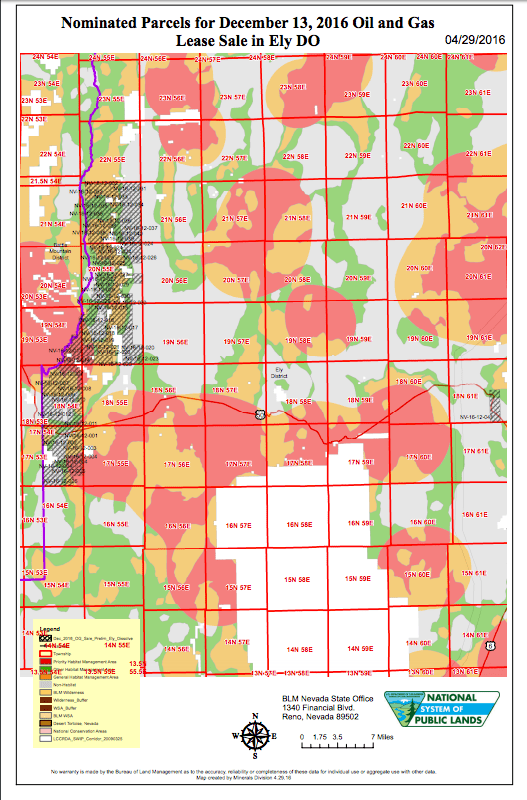
It’s time to connect the dots about what’s really going on in eastern Nevada
Your comments are needed!
Pancake and Triple B wild horse HMAs are affected for this round of oil and gas leasing. What other HMAs are next?
From a BLM press release:
Ely – The Bureau of Land Management (BLM) Ely District is asking the public to provide input on potential issues associated with oil and gas leasing on 41 parcels of public land, totaling 82,121 acres, in White Pine County, Nevada. Leased parcels may later include exploration and development. The BLM is analyzing the parcels to identify potential impacts in an environmental assessment (EA), in accordance with the Oil & Gas Leasing Reform mandated in 2010. The deadline to provide input is Friday, June 3, 2016.
The input received will assist in the preparation of a preliminary EA that the BLM will make available for public review and comment in late June 2016. A Competitive Oil and Gas Lease Sale is scheduled on Dec. 13, 2016.
Scoping information and other documents can be found at http://1.usa.gov/1ssQyIn. Interested individuals should address all written comments to the BLM Ely District Office, 702 N. Industrial Way, Ely, Nevada 89301 Attn: 2016 Oil & Gas Lease Sale or fax them to (775) 289-1910, Attn: 2016 Oil & Gas Lease Sale. Email comments will not be accepted.
Before including your address, phone number, e-mail address, or other personal identifying information in your comment, you should be aware that your entire comment – including your personal identifying information – may be made publicly available at any time. While you can ask us in your comment to withhold your personal identifying information from public review, we cannot guarantee that we will be able to do so.
For more information, contact Leslie Riley at the BLM Ely District Office at (775) 289-1860
[End of BLM press release]
Protect Mustangs is an organization who protects and preserves native and wild horses.
“BLM does have a billion-dollar problem — its livestock-grazing program. According to Taxpayers for Common Sense, the direct and indirect costs of the Federal Grazing Program may result in the loss of as much as a billion dollars to the American people — every year! Note that Kornze’s one billion-dollar wild-horse “problem” covers the lifespan of horses. So, that amount would be spread out over a period of 20 years. For the same time-frame, the Federal Grazing Program would cost the taxpayers $20 billion. The fictitious wild-horse “problem” reflects BLM’s lack of scientific integrity and its deceitful data. There is no overpopulation of mustangs except on BLM’s fraudulent spreadsheets. Reviews of BLM’s year-to-year population-estimates disclose reproductively-impossible birth-rates let alone population growth-rates. For instance, in Nevada, BLM announced that the Lava Beds burro herd grew from 40 to 350 in one year, a 775% herd-growth rate. In Oregon, BLM claimed that the famous Kiger herd grew from 21 horses to 156 horses in four years, an increase of 643%. In Wyoming, BLM declared that the Salt Wells Creek herd grew from 29 horses to 616 horses in 6 months (yes, months), a 2,024% increase. BLM’s “data” is chock-full of such preposterous growth-estimates. What is a normal herd-growth rate? About 7% or 8% a year, although some estimates peg it at 4% to 6%. As for the alleged number of wild horses held in captivity, an independent forensic audit would likely reveal many “ghost” horses — ones that exist only in BLM’s bookkeeping records. BLM is a corrupt agency. It has invented a counterfeit crisis to create a sense of urgency, gambling that Congress will be tricked into increasing its budget to “solve” a non-existent problem. Finally, wild-horse adoptions have not actually declined. The appearance of a decline is due to the reformed definition of what constitutes an “adoption.” Up until 2005, BLM counted sales-for-slaughter as “adoptions.” After 2005, only “forever-family” placements qualified. Consequently, adoption-figures seemed to decline but true adoptions continued at their historical level. However, mustangs are not homeless horses. They are wild horses that belong at home — on the range.” ~ Marybeth Devlin
“This is the cost of EXTRACTION of a wildlife species for commercial purposes paid by taxpayers. It is a fraud perpetrated on the American Public and the destruction of a National “protected” treasure.” ~ Kathleen Hayden
Protect Mustangs is a nonprofit organization who protects and preserves native and wild horses.
The head of the U.S. Bureau of Land Management says it’s time to admit his agency has a $1 billion problem.
BLM Director Neil Kornze says the administration can’t afford to wage an increasingly uphill battle to protect the ecological health of federal rangeland across the West while at the same time properly managing tens of thousands of wild horses and caring for tens of thousands more rounded up in government corals.
Kornze told The Associated Press the agency may not have done as good of a job as it could have in recent years to underscore the environmental and budgetary crisis looming in its wild horse and burro program.
His experts estimate $1 billion will be needed to care for the 46,000 wild horses and burros currently in U.S. holding facilities over their lifetime. That doesn’t include the cost of future efforts to shrink the population of the record-67,000 now roaming public lands in 10 western states.
“We’re trying to make an effort to be real clear about the challenges because they are significant,” Korzne said late Tuesday.
“We need partners coming to the table, whether it’s states or counties or others,” he said”
The 67,000 horses and burros on the range is a 15 percent increase from last year, and more than double the population that was estimated when President Nixon signed the Wild and Free Roaming Horses and Burros Act into law in 1971. The landmark legislation allows for removals but also grants the animals unique federal protection and requires they be treated humanely during and after their capture.
Korzne said his agency’s horse budget has doubled since 2009 — from $40 million to more than $80 million currently — but “the trajectory of the population has just gone up and up.” Left unchecked, the population naturally doubles every four years.
“It’s a double bind,” Korzne said. “There’s a very real impact on the range when the herds are overpopulated, but it costs us $50,000 per horse if the horse lives out its whole life in holding.”
Kornze said one of the growing problems is a dramatic drop in the private adoptions of gathered mustangs over the past decade from about 8,000 a year to 2,500 or fewer.
Critics fear BLM is exaggerating the numbers to build support for past proposals by livestock interests to slaughter the oldest mustangs that have been placed in long-term holding with little chance of being adopted.
“The BLM’s numbers are inflated estimates to fear-monger elected officials into supporting a breakdown of the 1971 law,” said Anne Novak, executive director of the California-based Protect Mustangs.
Korzne insisted the agency has no intention of allowing the slaughter of federal horses. But he said it’s considering spaying, neutering or otherwise sterilizing some animals that are on the range — something just as distasteful to most horse protection groups who argue the real answer lies in dramatic cutbacks in government-subsidized livestock grazing.
“Wild horses are present on just 12 percent of federal rangelands, which they share with livestock, and their habitat has shrunk by over 40 percent the last four decades,” said Suzanne Roy, executive director of the American Wild Horse Preservation Campaign. “The feds consider 67,000 wild horses and burros to be overpopulated, yet there are only 70,000 big horn sheep remaining in the West and they are highly endangered.”
Shared for educational purposes from: http://abcnews.go.com/Politics/wireStory/blm-boss-wild-horse-program-facing-future-1b-39070413
Seen in the Washington Post https://www.washingtonpost.com/business/blm-boss-wild-horse-program-facing-future-1b-budget-crisis/2016/05/12/128ae566-18b2-11e6-971a-dadf9ab18869_story.html and going viral
Protect Mustangs is a nonprofit organization who protects and preserves native and wild horses.